
Bucketful of BS
Four years in, the President’s answer to drought is a pail? Hilarious. Pathetic.

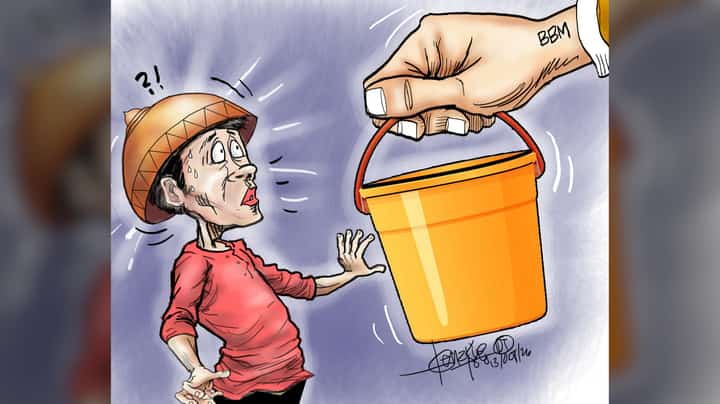
“Buy your buckets now.”
With those words, President Ferdinand Marcos Jr. told Filipinos to collect rainwater, filter it, and store it against a potentially severe El Niño stretching into 2027. The government, he promised, would teach them how.
It is practical advice. It is also the most damning thing this administration has said about itself.
A bucket is a household adaptation, while water security is a state responsibility. When a president responds to a looming drought by handing the burden back to the families, he concedes that the government has failed to build what it was supposed to build.
The money was there. Climate-tagged allocations rose from P289.7 billion in 2022 to P457.4 billion in 2024, then to P1.156 trillion in 2025. The 2026 National Expenditure Program proposed another P983.82 billion.
Okay, those figures are not perfectly comparable, since the tagging methodology changed in 2024, and a tag proves neither theft nor failure. But the Congressional Policy and Budget Research Department itself notes that spending is heavily concentrated on big infrastructure projects, including flood control and urban transit.
Except flood control is where the trail had turned rotten. The Philippine Center for Investigative Journalism documented 9,855 flood control projects worth more than P545 billion funded between July 2022 and May 2025, amid allegations of ghost projects, substandard construction, and corruption.
So where are the reservoirs? The rehabilitated irrigation systems? The protected watersheds? The dependable distribution networks? The drought-resistant investments farmers can use? Four years in, the President’s answer to drought is a pail?
Hilarious. Pathetic.
None of this was unforeseeable. In 1997, Fidel Ramos convened an El Niño task force after PAGASA’s warnings, and the episode exposed how foreknowledge fails without infrastructure.
Gloria Macapagal-Arroyo created a climate task force in 2007 and signed the Climate Change Act in 2009, yet legislation does not pour concrete for dams. Benigno Aquino III responded to the 2015-2016 El Niño with irrigation, small impoundments, and cloud seeding.
Rodrigo Duterte faced the 2019 Angat Dam shortage and could only order conservation, which showed that a megacity cannot conserve its way out of dependence on a single source.
Each government learned the lesson. Each left it alone.
Not to exculpate him, but Marcos inherited decades of warnings, a National Adaptation Plan for 2023-2050, plus a Philippine Development Plan of his own. Someone should tell him, though, that plans and allocations are input, not outcome.
Even the response is contradictory. Executive Secretary Ralph Recto now urges agencies to spend faster. Faster? Before demanding speed, the government must prove it can spend honestly.
Cloud seeding, rice imports, hospital readiness, and school contingencies for extreme heat are emergency measures — the scramble of a state reacting to the weather rather than governing ahead of it.
El Niño is natural, and not every episode is caused by global warming. But a warming climate aggravates heat extremes, which makes long term adaptation more urgent, not less.
A bucket cannot irrigate thousands of hectares. It cannot refill a reservoir, repair a leaking network, or build a treatment plant. Rainwater harvesting belongs within a real water management program, not in place of one.
The President should order a public project-by-project accounting of every climate-tagged allocation from 2022 to 2026: how much was appropriated, obligated and disbursed; which contractors were paid; what was actually built; what the Commission on Audit found; and who was held accountable for the irregularities.
The accounting must distinguish flood control from drought preparedness and paper accomplishments from infrastructure that works. Every peso must be traceable, every project verifiable, every anomaly investigated.
Mr. President, do not ask Filipinos to catch rain in buckets while leaving them to wonder where their tax billions went. Publish the records. Name the projects.
Identify the contractors and the officials responsible. Recover public funds where wrongdoing is established, prosecute those responsible, and disclose what has been delivered — not what was merely promised.
Before the President asks the people to prepare for drought, he should prove that their money was not allowed to evaporate.