
No papers, no pork
‘Every delayed project has an economic cost, while every anomalous, poorly vetted project costs us even more through wasted taxpayer money.’
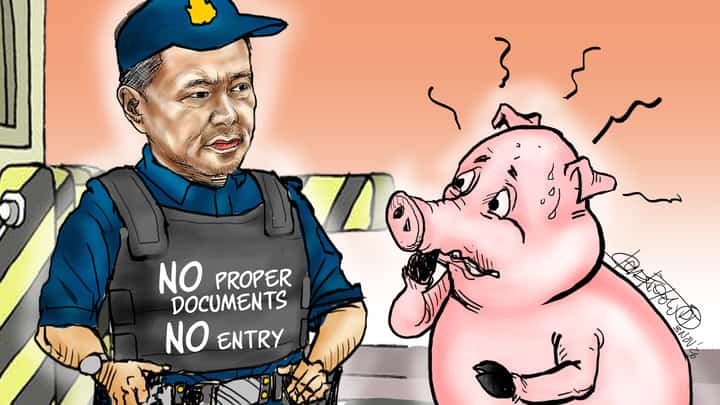
The road to a clean 2027 national budget is fraught with challenges that Senate finance panel chief Senator JV Ejercito hopes to surmount by engaging civil society organizations (CSOs) that, surprisingly, have better monitoring resources and technology.
Either those pilfering public funds must abhor advanced systems because they will be discovered, or computerization is the lowest priority of members of Congress, thus resulting in an opaque budget review process.
The CSOs’ participation through their vetting and recommendations helps ensure a tighter budget and more efficient use of funds, but Ejercito explained that Congress, particularly the Senate, ultimately sets the priorities.
That was how the Senate panel immediately pinpointed 6,271 pet projects in the House-transmitted General Appropriations Bill (HGAB), mostly as items under the Department of Public Works and Highways (DPWH) budget.
Ejercito ordered the DPWH to sift through the projects and determine which did not go through the required process and thus would be dropped in the Senate version of the budget bill.
His panel’s review indicated the DPWH projects swelled from 11,420 under the President’s National Expenditure Program to 16,244 in the HGAB. Of the entries in the HGAB, 6,271 projects were new and not part of the executive branch’s original submission.
While the country badly needs to boost infrastructure spending, this should not be done at the expense of the reforms being instituted.
“Every delayed project has an economic cost while every anomalous, poorly vetted project costs us even more through wasted taxpayer money, endangered communities and eroded public trust,” Ejercito said.
During the DPWH budget briefings in September, Ejercito flagged 155 flood control projects worth P8.2 billion that lacked the required documents, including certificates of implementability, programs of works and geotagged photographs.
These requirements are part of stricter project evaluation measures following the P1-trillion flood control scandal.
The problem is that the Senate proposal would again go through the Bicameral Conference Committee (Bicam), where legislators whose projects were removed can lobby to have them reinstated.
Nonetheless, Ejercito said he has secured the DPWH’s commitment to strike off projects with incomplete requirements.
With so many projects on the chopping block, the DPWH may have to contend with a smaller budget next year and the year after.
Ejercito said it plainly: an agency that asks for public funds and spends only half of them has no business asking for the same outlay again.
The groups that sat with the senators for six hours compared the NEP with the HGAB and found what a tired committee staff member might have missed as machines did the sorting.
Then there’s the harder truth. The government is short of cash. Growth is weak. Cash helps people, and no one wants to abandon them.
But every peso of assistance needs a peso of revenue behind it. Aid feeds a family today. Jobs feed it for life, but there’s also the need for roads, bridges and bypasses.
Thus, the requirement is simple. Spend efficiently, show the receipts and stop pretending that a project is its own justification.
The Senate has opened its books and invited CSOs to scrutinize the proposed budget.
That is a start. But the real test comes when the final spending bill is published and the public can examine every line and demand an explanation.
If project proponents cannot justify their proposals and provide supporting documents, the Senate should strike them from the budget.