
200 Japanese business leaders eye investment opportunities at Luzon Economic Corridor
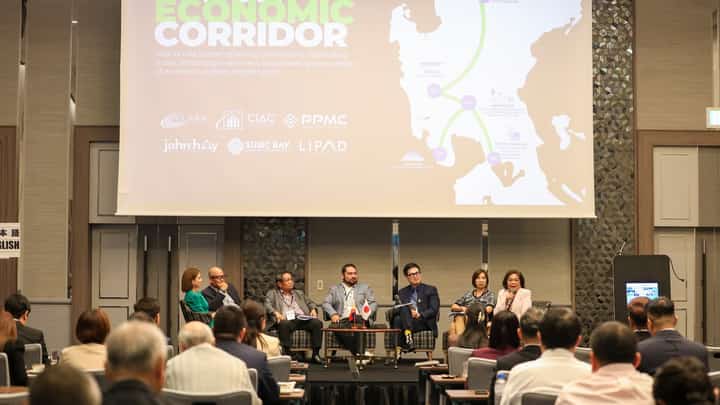
More than 200 Japanese business leaders and senior executives have shown great interest in investing at the Luzon Economic Corridor (LEC) as the Philippines continue to market the country into becoming a strategic platform for advanced manufacturing, logistics, energy, digital infrastructure, and other high-value industries.
This was felt during the Philippine Investment Forum-Japan in Osaka held on 1 October and in Tokyo on 5 October 2026. The Bases Conversion and Development Authority (BCDA) led the said event, in partnership with the Department of Trade and Industry–Philippine Trade and Investment Center (DTI-PTIC) and the Philippine Embassy in Japan.
These two-city investment roadshow brought the Philippines’ investment proposition directly to Japanese companies and business organizations, highlighting opportunities across the LEC, a priority economic corridor connecting Subic Bay, Clark, Metro Manila, and Batangas.
The corridor is being developed to strengthen connectivity, improve supply chains, expand energy and digital infrastructure, and support the growth of high-value industries.
In Osaka, DTI-PTIC Osaka Commercial Counsellor and Director Michael Alfred Ignacio presented the Philippine investment climate, highlighting the country’s economic fundamentals and the opportunities emerging from the Luzon Economic Corridor.
In Tokyo, DTI-PTIC Tokyo Commercial Counsellor Froilan Emil Pamintuan similarly presented the Philippine investment climate, providing Japanese business leaders with an overview of the country’s investment environment and opportunities.
The investment push is aligned with the economic agenda of President Ferdinand R. Marcos Jr., which seeks to attract productive, long-term investments that strengthen Filipino enterprises, develop local talent, integrate domestic suppliers into global value chains, and create higher-value opportunities for Filipinos.
In his recent remarks on the LEC, President Marcos Jr. emphasized that the corridor is not simply a collection of infrastructure projects, but a “strategy for organizing growth” and translating investments into projects, jobs, enterprises, and opportunities for Filipinos.
“Japan has long been a cornerstone partner in the Philippines’ industrial development. The Luzon Economic Corridor gives us an opportunity to take that partnership into the next generation of industries,” BCDA President and CEO Engr. Joshua M. Bingcang said.
“As global supply chains evolve, we want the Philippines to be a reliable, high-value partner for Japanese companies—one where they can build long-term operations, develop local talent, work with Filipino suppliers, and participate in industries that will shape the future of the region,” he added.
The BCDA Group presented the distinct investment opportunities across its strategic economic zones and development areas, with participating entities including the John Hay Management Corporation (JHMC), represented by President and CEO Manjit Singh Reandi; Poro Point Management Corporation (PPMC), represented by President and CEO Servillano Flores Jr.; Clark Development Corporation (CDC), represented by President and CEO Atty. Agnes VST Devanadera; Clark International Airport Corporation (CIAC), represented by President and CEO Joseph Alcazar; Subic Bay Metropolitan Authority (SBMA), represented by Senior Deputy Administrator Renato Lee III; and LIPAD Corporation, represented by Vice President for Commercial Development Eva Gabor-Tejada.
Private-sector partners from Science Park of the Philippines and Filinvest Land likewise participated in the roadshow, sharing their insights into the opportunities and requirements of investors looking to establish and expand operations in the Philippines. InfiniVAN, Marubeni Corporation and Kansai Electric Power Company (KEPCO) authoritatively demonstrated proof of concept and the Philippine advantage through their excellent proof-of-concept testimonials.
From strategic gateways to a global coalition
At Clark, investors were introduced to opportunities in aviation, logistics, advanced manufacturing, digital infrastructure, and urban development, supported by the Clark International Airport, Clark Aviation Capital, Clark Freeport Zone, and the broader New Clark City ecosystem.
Subic was positioned as a strategic maritime and industrial gateway, with opportunities linked to logistics, manufacturing, port development, energy, and international trade. Poro Point highlighted its potential as a gateway for maritime trade, logistics, tourism, and other commercial activities in Northern Luzon.
Camp John Hay presented opportunities anchored on its established tourism, hospitality, and mixed-use environment, while Metro Manila remains a critical center for finance, professional services, technology, and access to the country’s largest concentration of businesses and talent.
“For our Japanese partners, this Corridor represents a massive unprecedented opportunity. Japan has long been a cornerstone of Philippine economic progress, and Japan has already been a bedrock of our foreign direct investments. Now, through the Corridor, we’re offering a streamlined highly supported ecosystem designed specifically to secure and diversify your global supply chain,” said Hon. Donna Rodriguez, Philippine Consul General to Osaka.
For Hon. Christian L. De Jesus, Deputy Chief of Mission, Philippine Embassy to Japan, “ Through its development projects and partnerships with the private sector, BCDA helps create modern, investment-ready environments that support businesses, generate jobs, and contribute to sustainable growth.”
The roadshow also highlighted the growing pipeline of infrastructure and investment opportunities across the corridor, including aviation and logistics development, information and communications technology infrastructure, energy and transmission systems, water and wastewater facilities, and the proposed advanced manufacturing park in New Clark City.
“These platforms are increasingly connected. We have spent years building the physical connections across Luzon. We are now looking at how those connections can support deeper industrial linkages, stronger supply chains, and more investment across the region,” BCDA Executive Vice President and Chief Operating Officer Atty. Gisela Z. Kalalo said.
The Japan roadshow, which was held in partnership with Science Park of the Philippines and Filinvest Land, forms part of BCDA’s continuing effort to connect international investors with concrete opportunities across its strategic properties, while supporting the government’s broader objective of turning infrastructure and investment into productive enterprises, stronger Filipino capabilities, quality jobs, and long-term economic value.
The LEC was launched in 2024 by the Philippines, the United States, and Japan as the first Partnership for Global Infrastructure and Investment (PGI) economic corridor in the Indo-Pacific. The initiative has since expanded its coalition to include other partner countries committed to strengthening resilient supply chains, infrastructure connectivity, energy security, and sustainable economic growth.