
Starship reaches orbit
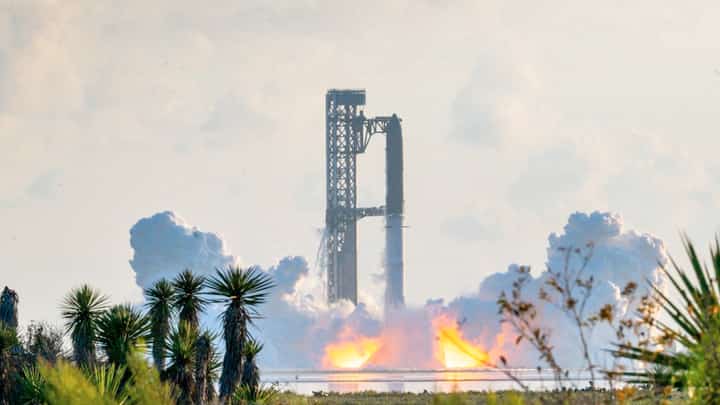
AN engine problem forced SpaceX to shorten the planned 10-hour mission, but Starship completed orbital insertion, satellite deployment, reentry and a controlled Pacific splashdown.
Photo courtesy of Brandon Bell/Agence France-Presse
SpaceX sent Starship into orbit for the first time Monday evening, Philippine time, deploying 26 next-generation Starlink satellites despite an engine failure that forced the company to cut the mission short.
The 14th Starship flight lifted off from SpaceX’s Starbase facility in South Texas at about 8:48 p.m. Philippine time on 28 September, carrying Ship 41 atop the Super Heavy booster. All 13 previous Starship test flights since 2023 had remained on suborbital trajectories.
Super Heavy pushed the upper stage toward space before separating through Starship’s hot-staging sequence. The booster then reversed course and performed a controlled splashdown in the Gulf of Mexico. SpaceX said some booster engines stopped operating during the descent.
The upper stage encountered a more significant problem when one of its three center Raptor engines shut down prematurely during ascent. SpaceX initially said it would not proceed to orbit, but engineers later determined the remaining systems could support an insertion maneuver.
Starship subsequently fired a single center Raptor for about 19 seconds, adding enough velocity to enter a stable orbit roughly 275 kilometers above Earth. The burn marked the first time a Starship vehicle completed orbital insertion.
Once in orbit, Starship deployed all 26 Starlink V3 satellites, its first operational payload. SpaceX said the satellites were functioning normally after deployment. The V3 spacecraft are larger than the Starlink V2 Mini satellites normally carried by Falcon 9 and are designed to provide roughly 10 times more data capacity per satellite.
Flight 14 had originally been designed to remain in orbit for nearly 10 hours and complete about six revolutions around Earth. SpaceX instead ended the mission after roughly three hours because of the ascent engine issue.
Starship performed a deorbit burn and reentered over the Pacific, using its heat shield and aerodynamic flaps to control its descent. The spacecraft executed its final flip maneuver before splashing down north of Hawaii. SpaceX did not plan to recover the vehicle.
The orbital flight moves Starship beyond its previous suborbital test phase and demonstrates its ability to deliver payloads. However, the Raptor shutdown adds another propulsion issue for SpaceX to investigate as it works toward routine Starship operations.
Starship is also central to SpaceX’s plans to deploy larger Starlink satellites and to NASA’s Artemis program, which is developing a modified Starship as a lunar lander for future crewed missions.