
‘Monster of Malan’: China tests giant mystery drone

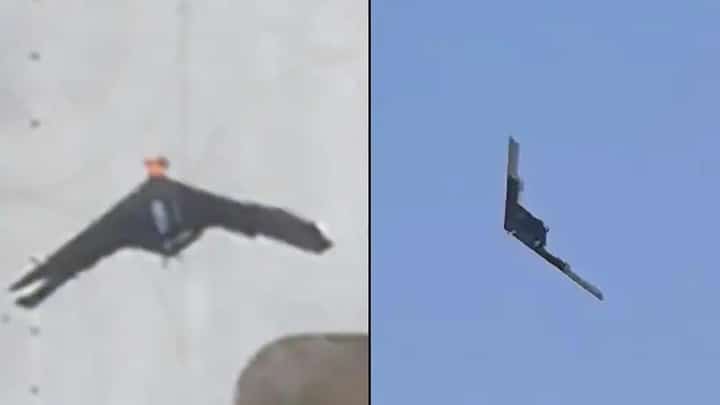
THE aircraft, unofficially called the WZ-X, is being tested at the secretive Malan facility in Xinjiang. Its true mission, range and capabilities remain unknown, but analysts believe its enormous wings could point to a high-altitude, long-endurance surveillance role.
Photograph courtesy of Andreas Rupprecht/LinkedIn
China is reportedly stepping up tests of a massive experimental flying-wing drone nicknamed the “Monster of Malan,” with new images offering the clearest look yet at the secretive aircraft.
The unmanned aircraft, unofficially called the WZ-X by observers, has been associated with the Malan test facility in China’s Xinjiang region, a site used for the development and testing of advanced unmanned aircraft.
New photographs circulating online in September appear to show the aircraft in flight, revealing a distinctive stepped wing configuration and serrated trailing edge that analysts say could be intended to reduce its radar signature.
However, the images have not been independently verified, while China has not publicly confirmed the aircraft’s official designation, manufacturer, mission or performance.
The drone is estimated to have a wingspan of about 52 meters, or 170 feet, putting it roughly in the same size class as the US Air Force’s B-2 Spirit stealth bomber.
The comparison, however, is based on size rather than capability. There is no public evidence showing that the Chinese aircraft matches the B-2 in range, payload, stealth or weapons capability.
A monster takes shape
The aircraft first attracted widespread attention after commercial satellite imagery from 14 May 2025 showed an enormous flying-wing design at Malan.
The War Zone, which analyzed Planet Labs imagery of the facility, estimated the aircraft’s wingspan at about 170 feet. Its unusual dimensions led the publication to nickname it the “Monster of Malan.”
Further satellite imagery dated 26 March 2026 showed the aircraft alongside another large flying-wing drone at the facility. The Monster of Malan was estimated in that imagery to span about 173 feet, while the second aircraft, featuring a cranked-kite configuration, measured about 137 feet across.
The War Zone said it was the first time both aircraft had been captured outside their hangars at the same time, pointing to increased advanced drone testing at Malan.
Built to go far?
The WZ-X’s long, narrow wings have fueled speculation that it could be a high-altitude, long-endurance aircraft designed primarily for intelligence, surveillance and reconnaissance missions.
Such a configuration could allow an unmanned aircraft to remain airborne for extended periods and cover vast distances.
WION reported estimates suggesting the aircraft could have sufficient range to reach targets across the continental United States from China. Such claims remain speculative, however, because Beijing has disclosed no official range figures and the aircraft’s actual capabilities remain unknown.
Recent analysis similarly cautions that the available images cannot establish the aircraft’s radar signature, operational range, payload or whether it has a strike capability.
Its flying-wing configuration and serrated edges nevertheless offer clues about China’s pursuit of low-observable unmanned aircraft.
The drone also appears to be part of a much broader Chinese push into advanced unmanned aviation.
Satellite imagery of Malan has revealed several experimental aircraft, including the two giant flying wings and a smaller tailless, fighter-like drone. The War Zone said the activity indicates China is simultaneously testing multiple advanced unmanned aircraft designs at the secretive facility.