
ASEAN creative economy eyes bigger global value

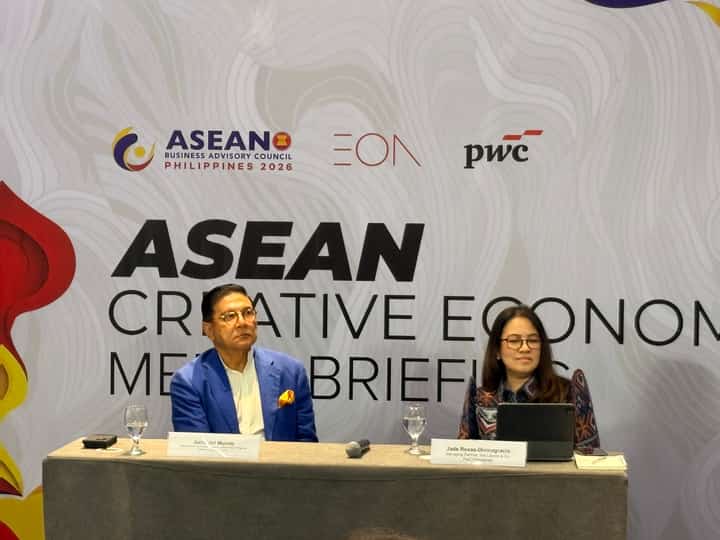
Junie del Mundo, Senior Adviser for Creative Economy of ASEAN-BAC Philippines and Chair of the Creative Economy Working Group, and Jade Roxas-Divinagracia, Deals and Corporate Finance Managing Partner at Isla Lipana & Co./PwC Philippines, during the ASEAN Creative Economy briefing in Taguig City on 17 September 2026.
Photo taken by Mico Virata for DAILY TRIBUNE.
The Philippines is pushing ASEAN to turn its creative strength into bigger economic returns by helping creators and businesses own, commercialize and scale the intellectual property they produce.
The agenda is at the center of the Philippines’ 2026 ASEAN Chairship, with the ASEAN Business Advisory Council (ASEAN-BAC) Philippines working with the private sector to develop recommendations for strengthening the region’s creative economy.
A regional study led by Isla Lipana & Co./PwC Philippines examined five sectors — film, animation, game development, fashion and performing arts — and identified opportunities to improve financing, intellectual property, incentives and business capabilities.
PwC estimates that creative industries across selected ASEAN economies generated about $300 billion in aggregate value in 2025, with around $150 billion in creative goods and services exports in 2024. The figures are directional estimates because creative economy definitions and statistical systems vary across countries.
In the Philippines, the creative economy generated P2.12 trillion in 2025, equivalent to 7.6 percent of gross domestic product, and supported 8.71 million jobs, according to the Philippine Statistics Authority.
“Creative industries have always been important culturally, but increasingly, they also matter for employment, for entrepreneurship, for exports, for intellectual property, investment, as well as digital growth,” Mary Jade Roxas-Divinagracia, Deals and Corporate Finance managing partner at Isla Lipana & Co./PwC Philippines, said.
Roxas-Divinagracia said ASEAN’s challenge is not a lack of creative output but the ability to capture more value further along the business chain.
“ASEAN is generally strong in creation and production, and that would be the initial stages of the value chain. But our participation becomes less consistent as we move further into ownership, into commercialization, into distribution, and ultimately into scale,” she said.
The study found that creative enterprises, many of which are micro businesses, small firms and freelancers, often face difficulties accessing financing, distribution networks and international markets.
Digital transformation was identified by 67 percent of surveyed stakeholders as the strongest driver of future growth, while 55 percent cited regional financing as an important area for cooperation.
The ASEAN-BAC Philippines Creative Economy Working Group will use the research and stakeholder consultations to develop an ASEAN Creative Economy Policy Paper for regional consideration.
For the Philippines, Roxas-Divinagracia said there remains significant room to expand the sector’s contribution.
“Our creative economy is contributing significantly to the GDP and to employment. But we can still do a lot more. We’re still scratching the surface,” she said.