
RCEP review puts business barriers in focus

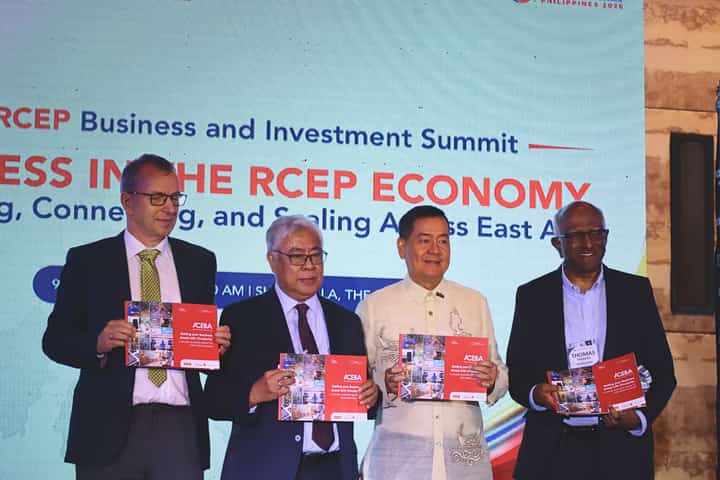
The Philippines is pushing for a more practical use of the Regional Comprehensive Economic Partnership (RCEP) as businesses prepare for the trade pact’s first General Review.
The East Asia Business Council (EABC) held the inaugural RCEP Business and Investment Summit at Shangri-La The Fort on 9 September, bringing together business leaders, policymakers and regional stakeholders to discuss how the Philippines can deepen its participation in regional trade and investment.
EABC Chairperson Jay Yuvallos said companies now need to build resilience into their supply chains as geopolitical tensions, protectionism and tariff disruptions create greater uncertainty.
“The business model that served us for decades was built around ‘Just-in-time.’ Now, ‘Just-in-time’ must increasingly be matched with ‘Just-in-case,’” Yuvallos said. “In other words, resilience has to become part of how we design our value chains.”
The upcoming review is expected to give businesses an opportunity to raise practical problems that can limit the use of RCEP, including customs procedures, sourcing requirements, documentation, standards, logistics and financing.
Trade Secretary Ma. Cristina A. Roque urged companies to provide government with specific feedback ahead of the review.
“We need your feedback. Tell us what needs to work better—customs procedures, sourcing requirements, and other barriers that affect your operations,” Roque said.
Roque said the Philippines’ exports rose 15.4 percent in 2025 to a record high, showing the potential of local products to compete internationally. However, she stressed that trade agreements only create opportunities when businesses are able to use them.
“These FTAs remain as agreements unless we maximize or use their full potential,” Roque said.
RCEP covers a market of more than 2.3 billion people, offering Philippine firms opportunities to diversify suppliers, join regional value chains and expand into new markets.
Yuvallos said MSMEs should also be given greater support to participate in these networks.
“We need businesses—especially our MSMEs—to participate in regional value chains, and we need to make it easier for companies to understand and actually use the opportunities that RCEP provides,” Yuvallos said.