
ATI, DP World add six hybrid cranes at Manila South Harbor

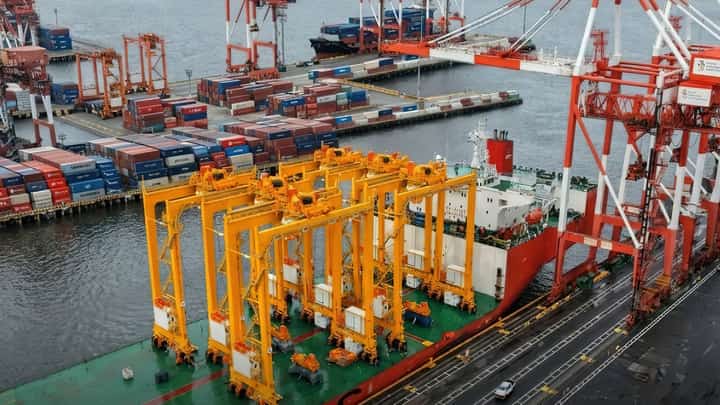
STRATEGIC partners Asian Terminals Inc. and DP World have commissioned six state-of-the-art hybrid Rubber-Tyred Gantry cranes at Manila South Harbour, strengthening the terminal’s capacity and supporting safer, more efficient, and lower-emission operations. Manufactured by Shanghai Zhenhua Heavy Industries Co., the new-generation RTGs use hybrid technology to reduce fuel consumption and emissions.
Photograph courtesy of DP World
Asian Terminals Inc. (ATI) and Dubai, UAE-based international logistics company, DP World have commissioned six hybrid rubber-tired gantry (RTG) cranes at Manila South Harbor, expanding the terminal’s cargo-handling capability while moving its operations toward lower-emission equipment.
Manufactured by Shanghai Zhenhua Heavy Industries Co. (ZPMC), the cranes are capable of stacking six containers high and bring the terminal’s RTG fleet to 29 units.
Hybrid technology is used by the equipment to reduce fuel consumption and emissions while incorporating safety features such as automatic gantry steering, anti-sway technology, truck detection, chassis positioning and emergency-stop systems.
Designed for eventual conversion to electric operations
These cranes are also designed for eventual conversion to fully electric operations, allowing the terminal to further reduce emissions as technology and infrastructure develop.
The latest equipment investment forms part of the continuing modernization of Manila South Harbor, which has included upgrades to both seaside and landside facilities, digital systems and cargo-handling equipment.
ATI and DP World said these investments have helped increase the terminal’s annual container-handling capacity by nearly 40 percent, from 1.45 million twenty-foot equivalent units in 2021 to 2 million TEUs in 2025.
Cleaner equipment and smarter technologies
William Khoury, DP World vice president for Ports & Terminals in Southeast Asia and ATI director, said the partners are investing in cleaner equipment and smarter technologies to strengthen the country’s trade infrastructure.
“For 40 years, ATI has continuously invested in the infrastructure, technology and people that keep Philippine trade moving. Together with DP World, we are building on this strong foundation by investing in cleaner equipment, smarter technologies and more resilient infrastructure that will make our gateways safer, more efficient and sustainable into the future,” Khoury said.
The port’s shift to cleaner equipment also includes 15 fully electric internal transfer vehicles deployed in 2025.
By end-2026, Manila South Harbor is expected to add more electric cargo-handling equipment, including empty container handlers, reach stackers and 15 additional electric Internal Transfer Vehicles - zero-emission battery-power trucks used to transport shipping containers inside the port.