
Senate can’t usurp SC power
Escudero will commit a grave error if he subjects the question to a vote since the impeachment court cannot decide on whether it would follow the Constitution.

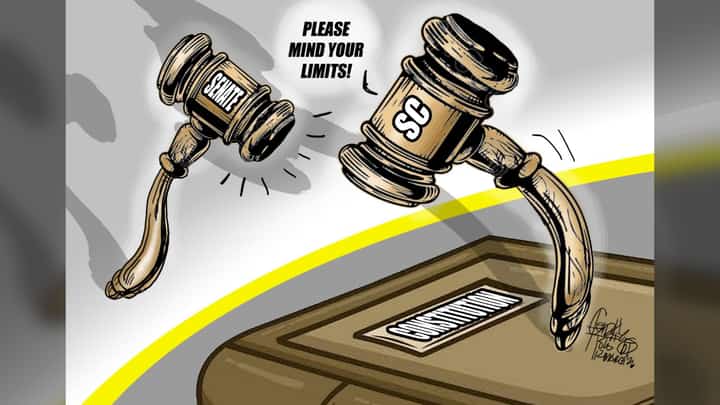
Despite its asserted authority, the Senate impeachment court may be on course to overstepping its constitutional boundaries, according to a legal scholar.
The scholar said the Senate impeachment court has no authority to review the constitutional two-thirds vote requirement to convict Vice President Sara Duterte, arguing that such a constitutional question falls under the Supreme Court’s jurisdiction.
On 8 September, Sen. Erwin Tulfo asked the Senate impeachment court to reconsider the 16-vote requirement for Duterte’s conviction, citing the absence of four senators.
Tulfo pointed to Senators Jinggoy Estrada and Rodante Marcoleta, who are in detention; Sen. Ronald “Bato” dela Rosa, who is in hiding from an International Criminal Court arrest warrant; and Sen. Loren Legarda, who is abroad for supposed medical treatment.
Counting all 24 members in the vote risks an “acquittal by default,” Tulfo warned.
Presiding Officer Sen. Francis Escudero then scheduled a consultation with retired Supreme Court justices and constitutional experts, to be followed by oral arguments and a Senate vote on 23 September to decide on the number of votes for conviction.
Escudero will be committing a grave error if he subjects the question to a vote since the impeachment court cannot decide whether or not it would follow the Constitution.
Article XI, Section 3(6) of the Charter requires the concurrence of “two-thirds of all the members of the Senate” for conviction. Article VI, Section 2 fixes the Senate membership at 24. Two-thirds of 24 is 16. There is no discretion provided for in that threshold.
The Constitution has fixed the threshold at 16 votes. The Senate may revisit its own procedural and evidentiary rulings, but it cannot rewrite a constitutional requirement. Detention, absence, illness or inability to attend does not strip senators of their constitutional office.
The rule exists precisely to limit the Senate’s power to convict. Allowing senator-judges to lower that threshold would effectively give them the power to rewrite the Charter’s safeguard — a limitation imposed to restrain their authority.
With the chamber’s ranks diminished, 14 senators could then declare 14 votes sufficient and convict a sitting Vice President on a threshold of their own making.
A bare majority cannot be allowed to defeat a constitutional supermajority requirement designed to prevent a tyranny of the majority.
Those seeking to reduce the guilty base have leaned on the 1949 jurisprudence. Then Senate President Jose Avelino addressed the quorum needed for the Senate to transact ordinary legislative business.
It said nothing about impeachment and did not construe the phrase “two-thirds of all the members of the Senate.” The ruling addressed the quorum requirement and not how many affirmative votes were needed to convict in an impeachment trial.
If the basis would be jurisprudence, the applicable precedent is Bayan v. Zamora in 2000, where the High Tribunal construed the identical phrase in ratifying a treaty.
The Court addressed the Senate’s 24-member composition and confirmed that 16 affirmative votes were needed to approve a pact.
The dispute cannot be treated as a housekeeping matter but as a justiciable question.
A previous High Court ruling also affirmed that impeachment proceedings remain subject to judicial review when Congress is accused of violating the Constitution or committing grave abuse of discretion.
The Senate’s sole power to try impeachment cases does not give it final authority to interpret the Constitution that grants that power.
Escudero appears to be bending to pressure, despite having acknowledged in earlier remarks that the 16-vote question could only be properly argued before the courts.
He should hold the line and allow the constitutional challenge to be resolved there, rather than through a vote of the Senate impeachment court.
The impeachment court may determine guilt or innocence. It cannot, by majority vote, rewrite the very constitutional threshold that limits its power to convict.