The Spanish Riding School — In Vienna?
How could something called Spanish be tucked away in another country?

Text size
How could something called Spanish be tucked away in another country?

Stallion herded by its trainer. Behind is a rider in uniform.
Photograph courtesy of Wikimedia
Lipizzaner horses return to their stables after training.
Photograph courtesy of Richardelainechambers, CC BY-SA 3.0
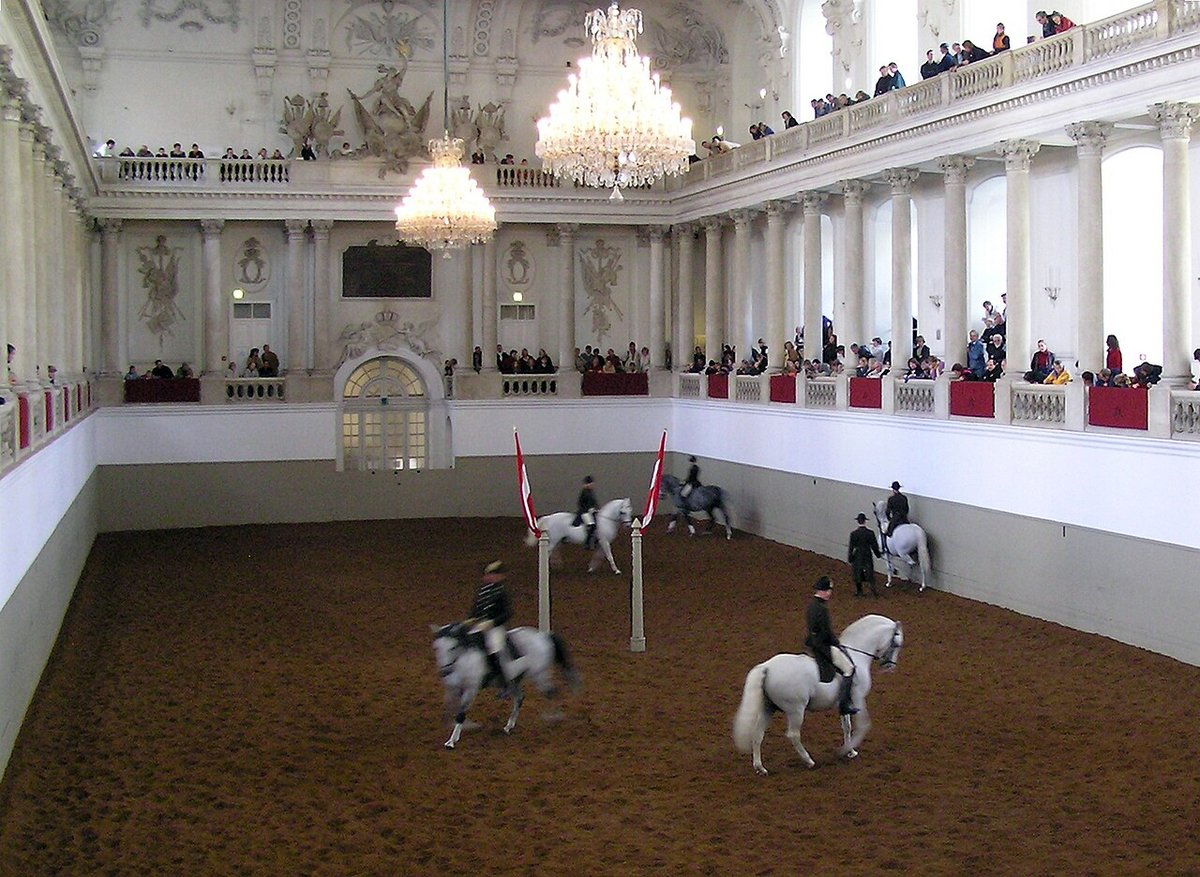
Baroque Winter Riding School Building.
Photographs by Edu Jarque for daily tribune
A collection of trophies and memorabilia.
Merchandise to commemorate the institution’s 460 years of existence.
The empty arena is set ready for the big exhibition show.
A painting of Kaiser Charles VI by Johann Gottfried Auerbach is prominently displayed.
A signage leads to the school.
When I was a youngster, my dad would tell tales of the Spanish Riding School in Vienna. It was strangely planted and stayed somewhere in my curious tiny mind — although I could never quite figure it out. Why was the famed Spanish Riding School in Vienna and not in Spain? How could something called Spanish be tucked away in another country? It was one of those silly childhood questions which bothered me.
Little did I know then the Spanish Riding School, or Spanische Hofreitschule, is one of those dubbed as the Big Four — the most prestigious classical riding academies in the world! The others were the Cadre Noir in the commune of Saumur in France, the Portuguese School of Equestrian Art in Lisbon and the Royal Andalusian School in Cadiz, Spain. So how come these other three had names which corresponded to their whereabouts? The name of the Austrian institution, I eventually learned, had more to do with the innate Spanish ancestry of its famous horses than its prime location.
So, on our recent trip to Vienna, Austria, we just had to visit once again. This time, we had the lucky opportunity to briefly chat with some of the officers and ushers to learn more about the valiant horses and those who studiously train them.
The school is home to the celebrated white Lipizzaners, whose majestic presence has become closely associated with Vienna and its honored equestrian tradition. The grueling training itself is a fascinating exercise! The well-researched methods adopted by the Riding School were based on the work of François Robichon de la Guérinière, the influential French writer and master rider whose novel ideas shaped classical dressage. One of the staff dispelled an unfounded rumor: the elaborate movements were not developed for battle. They were actually intended to strengthen the war horse’s body and mind, turning him into a supreme athlete!
The saga of the Lipizzaners has its origin far from Vienna — at the Lipizzaner Stud Piber in the mountainous Austrian state of Styria. Aptly recognized by UNESCO as a center of international intangible cultural heritage, the stud farm preserves centuries of knowledge to breed and raise these prizes horses. It is the source of the next generation of stallions for the Spanish Riding School!
We then made a discovery which would have surprised my naïve younger self: at present, there are lady riders at the school, with professionals not limited to solely Austrians, but hailing from different countries. It is a full-blown career requiring years of dedication!
But now on to the first part of the morning show! We briefly marveled at the hush-hush exercises, followed by the much-anticipated performance proper. Oh yes, we were firmly warned: absolutely no photos — not even a single stolen shot!
Without a choice, we had to preserve and cherish the memorable moments in our minds. Perhaps that was not such a heartbreaking restriction — not even in the slightest. For after all, the performances were originally reserved only for guests of the Imperial Court. These were finally opened to the general public approximately at the turn of the century, initially for special occasions.
Today, the Ballet of the White Stallions is presented in the magnificent Baroque Winter Riding School Building at the Hofburg Palace, built under Emperor Charles VI, who reigned from 1711 to 1740.
The riders emerged dressed in their traditional uniform of brown tailcoats, bicorne-style hats, white buckskin breeches, white suede gloves and black top riding boots. The program took us through the different stages of training, beginning with the Young Stallions from Piber and progressing to the fully trained School Stallions.
There was the High School section, which featured movements such as the “flying change, passage, pirouette and piaffe”, followed by the Pas de Deux, where two horses performed opposite each other, mimicking each others’ measured steps. Work in Hand demonstrated how the elegant stallions are prepared for movements such as the “levade, capriole and courbette”. The On the Long Rein showcased a fully trained Lipizzaner with robust movements expected while it is under the saddle.
Then came Airs Above the Ground, as the four-legged creatures seemingly danced with riders without stirrups. The action-packed presentation ended with the School Quadrille — eight pilots together in formation, as their mighty steeds walked, trotted and cantered, with “flying changes, pirouettes, half passes and passages.”
All wrapped up in, say, 20 minutes, the School Quadrille is said to be the longest and most difficult globally!
As we witnessed the mounts gallop with such control while classical Viennese melodies filled the arena, I understood, once again as in previous shows, what my dad narrated to us for over half a century and two decades ago.
And yes Virginia, there is a Spanish Riding School in Vienna!