
Tinio blasts ‘fabricated’ Marcos poverty metrics

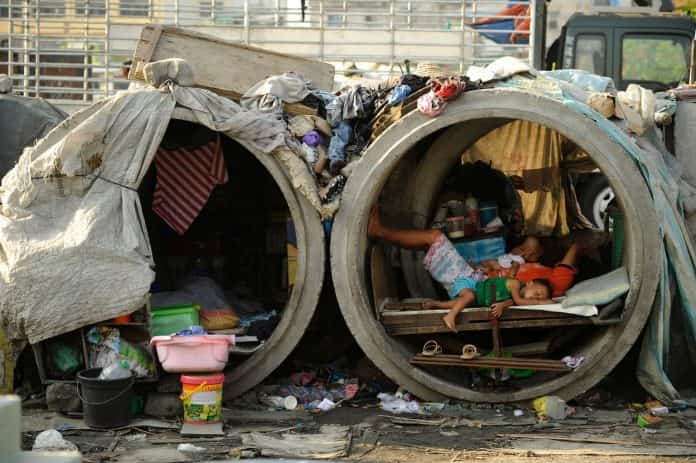
A mother and her two children make do with a makeshift home inside concrete pipes, a stark portrait of poverty amid government claims that the number of poor Filipinos has gone down.
PHOTO courtesy of AGENCE FRANCE-PRESSE
The administration of President Ferdinand Marcos Jr. must face the reality of poverty in the country amid rising market prices, stagnant wages and a lack of jobs instead of covering up the issue with “fabricated” metrics, a lawmaker said on Sunday.
ACT Teachers Partylist Rep. Antonio Tinio questioned the recent statistic released by the Philippine Statistics Authority (PSA), claiming that poverty incidence in the country had dropped to 9.7 percent in 2025.
The lawmaker lamented that the data undermined the facts, citing a separate recent survey in which 10.3 million Filipinos rated themselves poor.
“What is the Marcos administration really saying in their PSA report? Optics or lies? Hopefully the truth can be revealed. You cannot claim victory over poverty while 5.6 million Filipino families are going hungry under your watch,” Tinio stressed.
Under the same survey, an additional 4 percent of Filipinos identified themselves as poor, bringing the figure to 39 percent, while those who said they were hungry rose to 21 percent since the study was previously conducted in March.
“The truth is there are more families that remain hungry, there are more Filipinos that are in poverty. This administration has nothing to be proud of,” the lawmaker said.
Veiled figures
Tinio said the increase could be attributed to the rising cost of living, with each Filipino needing to earn at least P1,312 per day to have a “dignified life.”
The PSA, however, placed the annual per capita poverty threshold at P35,121, a metric that the lawmaker said was “grossly insufficient” and “conservatively computed” to hide actual poverty numbers.
“The threshold is pegged so low that anyone who manages to eat a handful of rice and a piece of dried fish is considered non-poor,” he said.
“Filipino families need P1,312 per day to live with dignity but this administration just shows press releases that poverty has decreased.”
Tinio further said that even the statistics agency itself had identified an issue with how it computed the poverty rate, noting that the agency’s chief statistician had said the food budget allocated did not meet basic nutritional needs.
He said the figure was increasingly unrealistic because it did not account for the numerous price shocks experienced in 2026, which drove more Filipinos into poverty.
Tepid growth
The PSA’s announcement came amid weakening economic momentum, with gross domestic product growing by just 2.3 percent in the second quarter of 2026, the slowest expansion since the pandemic.
Questions have also been raised over whether the government’s poverty threshold adequately captures the actual cost of living for Filipino families.
The latest PSA data showed that about 11.08 million Filipinos remained below the official poverty threshold in 2025, even as the official poverty rate fell to 9.7 percent from a higher level in 2023.
Critics have also pointed to the methodology used to determine the threshold.
In its assessment of the 2023 poverty figures, the IBON Foundation cited a national average daily per capita poverty threshold of P91, of which P63 was allocated for food, or about P21 per meal, while P28 was allotted for non-food needs.
IBON said the amount did not adequately reflect the cost of maintaining a minimally decent standard of living, including housing, transportation, utilities, health care and education.
‘Victory laps’
Tinio said the official figures did not reflect the country’s economic realities.
“The report does not reflect today’s realities of rising prices, stagnant wages, and widespread joblessness. The crisis is very much alive in our families, but the government is hiding behind fabricated figures,” he said.
Amid his opposition to the metric released by the PSA, Tinio called on the Marcos administration to focus reforms on addressing economic deficiencies rather than doing “victory laps” on numbers that did not display the harsh reality faced by the public.
Former Finance Secretary Gary Teves earlier told DAILY TRIBUNE that self-rated poverty remains high, indicating that many Filipinos continue to consider themselves marginalized.
“The assistance intended for beneficiaries may end up going to other people. So aid also needs to be reduced. The money saved should be redirected to other parts of the economy,” Teves said.
He also warned that unconditional aid could create dependency, with some people becoming less motivated to look for work because they know they will receive assistance.