
Pax Silica’s real test: Diligence
If the Philippines wants Pax Silica to be remembered as nation-building rather than another New Clark City promise that outran its due diligence, the burden of proof rests with the BCDA, not with the senators asking it to show its work.

Philippine Ambassador to the United States Jose Manuel Romualdez, in a media briefing after the Stratbase forum last Monday, asked Filipinos to think like investors weighing a closing window.
Regarding the US-led Pax Silica initiative, Romualdez said to take the deal or watch Hanoi, Kuala Lumpur or Jakarta take it instead. The three ASEAN countries are reportedly actively interested in the multibillion-dollar tech and manufacturing pact and are fully prepared to take on the project or offer Washington favorable terms if their neighbor’s bid stalls.
It is a persuasive frame. It is also an incomplete one, and the gap between the two is where this debate actually lives.
Start with what is real. Pax Silica is not vaporware. Twenty-three countries have signed on. The Philippines has already joined. BCDA has designated 1,620 hectares in New Clark City, and CEO Joshua Bingcang’s numbers, if they hold, are not small: $40 billion to $70 billion in investment, up to 190,000 direct jobs and $200 billion in exports over 30 years.
For a country still exporting raw nickel and copper concentrate while Indonesia and Vietnam climb the value chain, an offer to process critical minerals domestically instead of shipping them out raw is not something to wave away.
Romualdez is not wrong in saying the region is hungry for this kind of anchor investment, and he is not wrong in advising that hesitation has a price. Capital goes where it is welcome.
But “we’re not the only game in town” is an argument for urgency, not an argument for silence on the specifics. And the specifics are where the criticism bites.
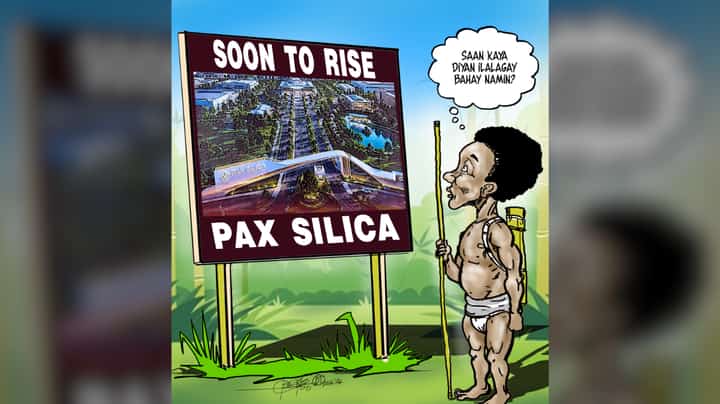
Senator Risa Hontiveros’s Senate Resolution 563 does not oppose Pax Silica — it asks whether BCDA’s own numbers survive contact with the ground, whether Aeta and farming communities in and around a 4,000-acre footprint will in fact be displaced even as officials insist in press briefings that they won’t.
For her part, Senator Imee Marcos’s parallel resolution goes at the harder engineering question: a facility that BCDA itself says will need 3 gigawatts at full build-out, in a country where Luzon’s grid already strains during dry-season peaks, proposes to meet that load through “embedded clean energy” that does not yet exist at scale.
Add a semiconductor and AI manufacturing complex’s water requirements, addressed so far by a promised rainwater-harvesting scheme rather than a completed one, and you have a project whose headline numbers are firmer than its operational plan.
That is not misinformation. Romualdez’s own government colleagues have had to walk back parts of the pitch in real time — no data centers, then some data centers; no ancestral domain, then a Senate resolution asking BCDA to prove it.
When farmers’ groups say Malacañang’s assurances “failed to answer questions,” that is not paranoia. That is what happens when a government asks for public trust while treating basic environmental and displacement due diligence as something to complete after the deal, not before it.
So do the pros outweigh the cons? On the economics alone, probably yes — the diversification away from raw mineral export dependency is the single most important industrial policy shift the Philippines could make in a generation, and no other current proposal offers a comparable scale of ambition.
But framing this as pros versus cons, economy versus environment, misstates the actual choice on the table. Nobody serious is arguing the Philippines should reject high-value manufacturing investment.
The argument is that a project this large, this water-and-power-intensive, and this close to indigenous land demands an environmental and social impact study that precedes the groundbreaking, not one that trails behind the ribbon-cutting as a public relations exercise.
A balance is achievable, but only if the government stops treating scrutiny as an obstacle to be managed and starts treating it as the mechanism that would make the $200-billion projection credible in the first place.
Neighboring countries desirous of this hub are not waiting because they lack ambition. They are simply not being asked to answer for Aeta relocation, grid capacity and the impact of the water supply on communities affected by the project while the ink is still wet.
If the Philippines wants Pax Silica to be remembered as nation-building rather than another New Clark City promise that outran its due diligence, the burden of proof rests with the BCDA, not with the senators asking it to show its work.