
Serbia shares territorial stance


For many Filipinos, Serbia is best known as the home of tennis legend Novak Djokovic. But beyond the Grand Slam champion lies a European nation seeking to deepen its partnership with the Philippines, one it says is built on shared values, growing opportunities and a common belief in dialogue.
Serbia and the Philippines established diplomatic relations in 1972. Five decades later, Belgrade sees Manila not only as a longtime friend but also as a strategic partner in Southeast Asia.
In an exclusive interview with the DAILY TRIBUNE, Serbian Foreign Affairs Minister Marko Đurić outlined his country’s vision for expanding ties with the Philippines, from trade and education to diplomacy and regional cooperation.
A landlocked nation in Southeastern Europe with a population of more than six million, Serbia sees itself as a bridge between Europe and Asia — and believes the Philippines can play a similar role in the Indo-Pacific.
Shared principles, history
For Đurić, the relationship between the two countries has long been anchored on mutual respect for sovereignty and international law.
“Serbia and the Philippines share a long, friendly, positive history of diplomatic relations. We’ve always been by each other’s side at difficult historic intersections and moments. We immensely appreciate the steadfast support of the Philippines for the basic principles of international public law, for the respect for sovereignty and territorial integrity of independent nations.”
The 43-year-old foreign minister said Serbia highly values the Philippines’ consistent support for its territorial integrity, describing it as a reflection of the two countries’ shared commitment to the rules-based international order.
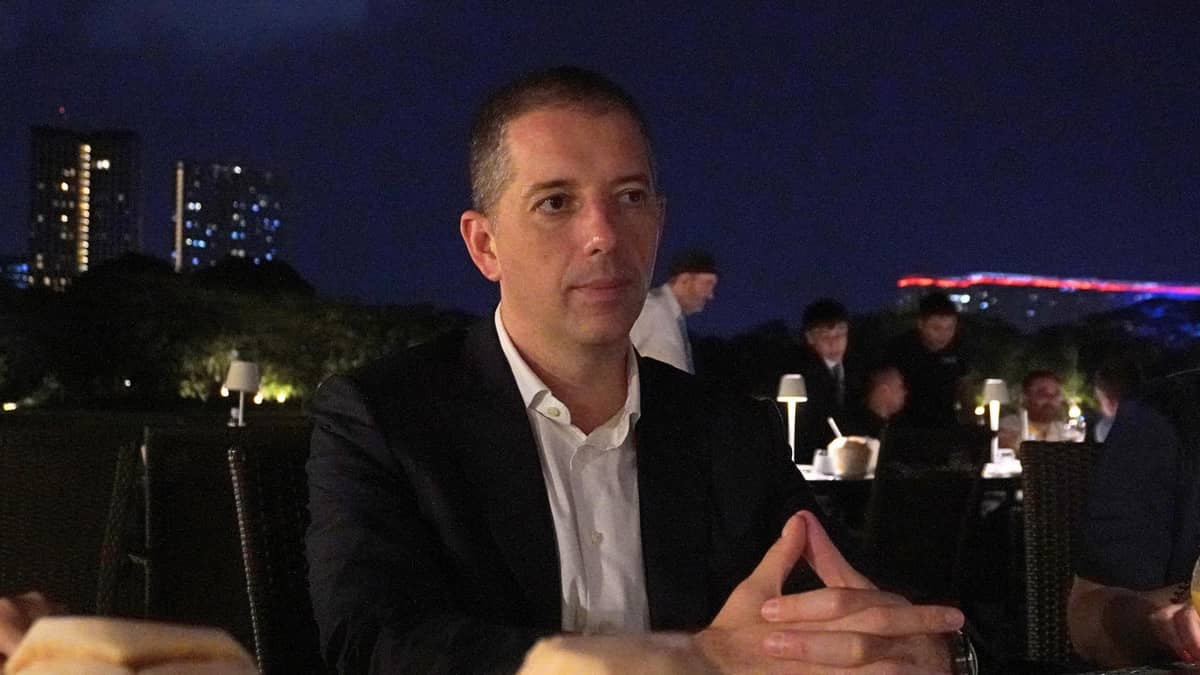
Serbian Foreign Affairs Minister Marko Đurić talks about the current state of Serbia-Philippines diplomatic relations, areas of cooperation, and what both countries can expect in the years ahead.
Photo: YUKO SHIMOMURA
A diplomatic hub
Đurić also praised the Philippines’ role as this year’s ASEAN chair, saying Manila has emerged as an important venue for international dialogue.
“On the other hand, I believe that congratulations are to the government and the people of the Philippines for hosting a successful peacemaking summit here in Manila at a crucial point for the international order.”
He pointed to the presence of senior officials from major world powers during the ASEAN Foreign Ministers’ Meeting, including US Secretary of State Marco Rubio, Russian Foreign Minister Sergey Lavrov, Chinese Foreign Minister Wang Yi, and Indian External Affairs Minister Subrahmanyam Jaishankar.
“The very fact that here in Manila you had a meeting is something that brings hope, frankly speaking, in an era in which dialogue is, for some, almost a forbidden word.”
Đurić, who has an extensive diplomatic background, having served as Serbia’s ambassador to the United States, Antigua and Barbuda, and Colombia, among other posts, said bringing competing powers together around one table demonstrates the Philippines’ growing diplomatic influence.
He commended Manila for fostering discussions based on “principles of cooperation, based on principles of non-violence, based on principles of peaceful and constructive discussion,” adding that he was “very encouraged by all this.”
‘The stars are aligned’
Despite Serbia’s relatively small size, Đurić said his country has much to offer.
“We have a lot of ambition, and we have something to offer,” he said.
Asked about future areas of cooperation, the Serbian foreign minister said "the stars are aligned" for closer relations. He cited the two countries' shared positions on major international issues, support for multilateralism, respect for the United Nations Charter and international law, as well as their strategic locations in their respective regions.
Economically, Serbia hopes to become the Philippines' gateway to Europe while viewing the Philippines as Serbia's entry point to Southeast Asia.
"Serbia has eight neighbors immediately on its borders, which makes us centrally positioned in Southeastern Europe. If we connect well, we can really serve as a bridge between two important global regions. This goes into many areas, from economy, defense and security to education as well."
He also said he was impressed by the Philippines' economic and infrastructure development, which he believes strengthens its position as a regional hub.
Beyond diplomacy
For Đurić, diplomacy should extend beyond government-to-government relations.
He said Serbia is pushing for stronger people-to-people exchanges, particularly through education.
One initiative is the World in Serbia government scholarship program, which offers students from partner countries opportunities to study at one of Serbia's eight state universities. According to the minister, similar exchange programs have already strengthened Serbia's relations with other countries, and he believes geographic distance is no longer a barrier to meaningful cooperation.
He also noted the growing Filipino community in Serbia.
According to information relayed by Serbian officials, around 2,000 mixed marriages between Serbians and Filipinos have been recorded in recent years.
Why ASEAN matters
Leading the Serbian delegation to the ASEAN Foreign Ministers' Meeting and Related Meetings, Đurić said Serbia's participation reflects its strategic priority of strengthening political and economic cooperation with Southeast Asia, citing the region's growing influence on global economic and political affairs.
"We believe that ASEAN plays a central role in maintaining and promoting regional stability, cooperation and adherence to the same principles for which we stand, which are the principles of respect for the UN Charter... peaceful cooperation, non-interference in the sovereign affairs of other countries, respect for territorial integrity."
He said those principles are particularly important in a region with enormous economic potential.
"For Serbia, this means not only supporting principles, but also seeking partnerships beyond our immediate neighborhood."
Asked what Serbia's participation signifies, Đurić said he hopes Serbia and the Philippines will eventually establish permanent diplomatic and economic missions, expand educational exchanges, and continue supporting each other's key national interests.
"I also hope that we will continue to mutually support each other when it comes to key national interests. And, of course, we are very grateful to the Philippines for your country's support for our territorial integrity and sovereignty."
As global uncertainty continues to reshape international relations, he said countries should continue building partnerships rooted in trust.
"In a world full of uncertainty, it's always good to have more friends every year."
Serbia is set to host Expo 2027 in Belgrade, where about 140 countries are expected to participate in the specialized world exposition under the theme "Play for Humanity: Sports and Music for All." For Belgrade, the event is expected to showcase not only Serbia's culture and innovation but also the partnerships it hopes to strengthen—including one with the Philippines.
In 2023, Serbia acceded to the Treaty of Amity and Cooperation in Southeast Asia (TAC) as a High Contracting Party, joining the legally binding ASEAN peace pact that promotes peaceful coexistence, non-interference, respect for sovereignty, and friendly cooperation among states.