
Baguio eyes higher minimum legal drinking age

Baguio City is considering raising its minimum legal drinking age beyond 18 as a public health measure backed by the WHO and medical experts. The proposed ordinance aims to curb early alcohol use, protect adolescent brain development, and reduce alcohol-related deaths and hospitalizations through stricter enforcement, treatment access, and education.
BAGUIO CITY — Members of the Baguio City Council have yet to finalize the proposed ordinance seeking to raise the city's minimum legal drinking age from 18 to a higher, more feasible age.
What originally started as a discussion on regulating the distance between liquor-selling establishments and protected institutions has broadened into a comprehensive public health measure supported by the World Health Organization and medical experts. To ensure the measure withstands future legal challenges, lawmakers and health officials are anchoring the policy on established statutory precedents, public consultation data, and scientific research on adolescent brain development.
Baguio City Councilor Paulo Salvosa noted that while the age of majority was lowered to 18 under the 1987 Constitution primarily for voting rights, emancipation under Philippine law is not absolute. He highlighted existing statutory provisions that already restrict certain activities for young adults, such as requiring parental consent or advice for marriage under the Family Code, setting the legal gambling age at 21 under Presidential Decree No. 1869, and raising the legal age for smoking and vaping to 21 under Republic Act No. 11467.
City lawmakers emphasized that intoxicating and addictive substances such as alcohol require similar legislative safeguards to protect the youth.
Dr. Rafael Legaspi of the Philippine General Hospital's Division of Addiction Recovery Medicine differentiated civic rights from substance use, explaining that voting is a sober act that encourages learning and civic responsibility. In contrast, he said, alcohol chemically affects a brain that continues to develop well beyond the age of 18.
He explained that the brain's prefrontal cortex, which governs decision-making and impulse control, does not fully mature until around age 25.
Legaspi stressed that raising the legal drinking age to 23 would provide young people with the biological time necessary for full neurological development, helping prevent early-onset addiction. He said the proposal is intended not to punish the youth but to protect them.
Presenting international and local data, Dr. Donna Tubera-Panes of the City Health Services Office (CHSO) refuted claims that a higher drinking age is unprecedented. She cited global data showing that dozens of countries enforce minimum drinking ages of 21 or higher, with some setting the limit at 25 or banning alcohol altogether.
In her presentation, she stated that local health surveys showed a worrying trend, with three out of four students aged 13 to 15 who had consumed alcohol saying they started drinking before the age of 14.
Health officials noted that raising the legal drinking age aims to curb early alcohol initiation and would directly affect an estimated 197,000 residents aged 23 and below by 2050.
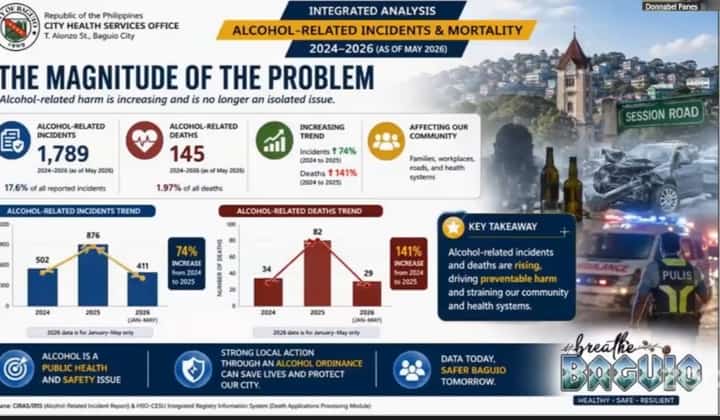
Local law enforcement and health records from 2024 to 2026 indicate that males accounted for nearly 96 percent of alcohol-related deaths in the city. The data revealed a distinct life-course pattern, with alcohol-related incidents peaking among individuals aged 30 to 35, while alcohol-related fatalities peaked two to three decades later, between ages 65 and 66.
Health authorities stressed that alcohol-related trauma and chronic conditions seen in young adults today directly contribute to mortality in later decades if preventive measures are not introduced.
Data from the Baguio General Hospital and Medical Center recorded 3,162 alcohol-related cases between 2024 and 2026, translating to an average of 88 admissions per month. A significant portion of these admissions resulted from vehicular accidents and physical trauma, occupying critical emergency room capacity and healthcare resources.
Health officials warned that linear projections suggest alcohol-related deaths in Baguio could quadruple over the next five years if current trends remain unaddressed.
The proposed ordinance is anchored on a public health framework that includes stricter enforcement, expanded treatment access, public education, and continuous data monitoring. Supported by Mayor Benjamin Magalong and local health boards, medical professionals urged the city council to approve the measure, arguing that an evidence-based preventive policy is essential to reducing preventable deaths and safeguarding long-term public health.