
Lady Luck’s quiet broker
Under Leyeza’s vision, the company has expanded its nationwide footprint, delivering last-mile digital access to communities long underserved by traditional infrastructure.


Businessman Martin Leyeza expects a hole-in-one in his firm, ComWorks, being tapped by the Philippine Charity Sweepstakes Office as a nationwide Lotto Authorized Agent.
Photograph courtesy of Martin Leyeza/ FB
Martin Leyeza does not sell luck. He sells access to it, one point-of-sale terminal at a time.
The ComWorks Inc. president recently signed his name beside that of Philippine Charity Sweepstakes Office (PCSO) general manager Melquiades Robles at the agency’s main office in Mandaluyong City.
The document was a memorandum of agreement, four pages of legal language that, in effect, hands his company a piece of the country’s most durable business: the dream of a winning number.
Under the deal, ComWorks, through its retail technology arm Suki Lotto, becomes a Level 2 Corporate-Owned Chain Business PCSO Lotto Authorized Agent.
It means Leyeza’s retail network can now sell and distribute official PCSO lotto tickets through point-of-sale terminals in retail stores across the archipelago. It is a modest phrase for a large ambition: to put a lotto counter within reach of more Filipinos than PCSO’s own network currently allows.
Leyeza runs a company built for exactly this kind of quiet expansion. ComWorks began in 1996 in a single rented room, the sort of origin story that sounds smaller with each passing year of the company’s growth. It now occupies its own seven-story headquarters, the CWI Corporate Center in Quezon City, a fixture in the wholesale trade of telecommunications equipment and, increasingly, in the retail technology that connects government services to ordinary consumers.
That trajectory, from telecom hardware distributor to lottery access point, is not as strange as it first appears.
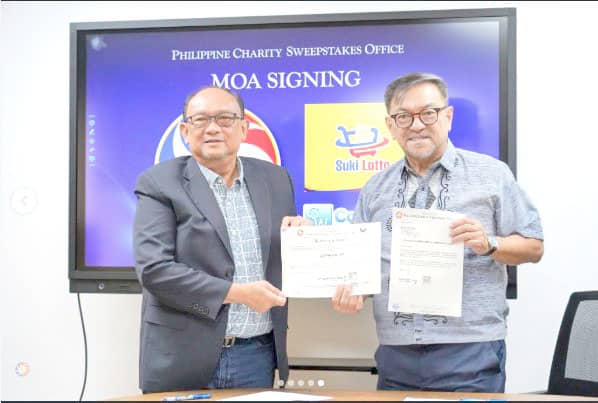
Under a recently signed memorandum of agreement, ComWorks, through Suki Lotto, will serve as a Level 2 corporate-owned chain business PCSO Lotto authorized agent, allowing it to sell and distribute PCSO lottery tickets through point-of-sale terminals in retail outlets nationwide. PCSO general manager Melquiades Robles (right) and ComWorks president Martin Leyeza display copies of the MoA.
PHOTOGRAPH COURTESY OF PCSO/FB
The infrastructure is the same in both cases: point-of-sale terminals, retail networks, and the unglamorous plumbing of transactions that most customers never think about. Leyeza’s company has spent three decades wiring the back end of Philippine retail.
For PCSO, the arrangement fits a pattern the agency has leaned into over the past several years — outsourcing distribution and technology to private partners while keeping the games themselves under state control. The charity office has said the Suki Lotto tie-up is meant to widen access to its lottery products through technology, and, not incidentally, to generate more revenue for its health and welfare programs. Robles, who led the signing, has called it part of PCSO’s broader push toward digital modernization.
ComWorks is widening the counter where citizens buy in. Leyeza was not alone at the recent signing. PCSO chairman Felix Reyes Jr. and directors Jennifer Guevara and Imelda Papin looked on, along with a delegation of ComWorks officials.
A Level 2 COCB designation gives his company the standing to operate lotto terminals at scale across a retail footprint that PCSO itself would take years to build organically.
Leyeza leads a firm that has quietly become one of the country’s more durable players in mobile and retail technology distribution, one that has now maneuvered itself into the peculiar business of helping the state sell hope by the ticket.
From bustling metros to far-flung barangays, ComWorks is reshaping how Filipinos connect — one transaction at a time.
Under Leyeza’s vision, the company has expanded its nationwide footprint, delivering last-mile digital access to communities long underserved by traditional infrastructure.
By linking industries and championing micro, small and medium enterprises (MSMEs), ComWorks is turning digital inclusion into economic opportunity. Its technology-driven initiatives simplify everyday transactions, from payments to connectivity, into essential services, bringing them within reach of ordinary Filipinos, regardless of location.
Beyond last-mile digital access, ComWorks anchors its business in a robust portfolio of communication facilities.
The company has positioned itself as a full-service technology partner rather than a single-product vendor, primarily serving businesses that assist small and micro firms.
Sari Mall, a ComWorks digital platform, is reimagining the humble sari-sari store as a modern service and distribution hub.
Built to transform corner stores into modern service access points and community-based business hubs, Sari Mall enables small retailers to offer new products and services and to pursue digital earning opportunities, supporting inclusive growth at the grassroots level.
Through the platform, store owners can offer big-ticket items, like mobile phones, appliances, and even motorcycles, without carrying inventory, opening new income streams that were once out of reach for small entrepreneurs.
By strengthening community-based trade networks and expanding digital access, Sari Mall positions everyday sari-sari stores as frontline partners in nationwide financial and digital inclusion, turning local trust into lasting economic opportunity.
“Our mission is simple,” ComWorks affirms, “bring services closer to every Filipino.” As digital transformation accelerates, ComWorks positions itself not just as a connectivity provider but as a catalyst for inclusive nationwide growth.
Diversified force
Beyond consumer-facing platforms, ComWorks has built deep roots across the Philippine telecommunications ecosystem. The company serves as a regional distributor for the telco products and services of an established Philippine telco, extending its network reach and connectivity solutions nationwide.
Its footprint also spans infrastructure: ComWorks operates as a contractor for fiber installation for established Philippine telcos, helping lay the physical backbone that powers the country’s broadband expansion. As a systems integrator for information and communication technology (ICT) facilities, it further supports enterprises and institutions in building reliable digital infrastructure.
The company also holds a minority stake in a Philippine tower company engaged in passive telecommunications infrastructure, giving it a stake in the shared infrastructure that drives nationwide mobile connectivity.
ComWorks formerly served as the national distributor for a now-defunct direct-to-home satellite TV provider. This earlier chapter reflects its long-standing role in bringing communication and media services to Filipino households.
Something is fitting in that. PCSO’s lottery products have always depended on distribution — the corner store, the mall kiosk, the terminal that turns a few pesos into a chance. Leyeza’s career has been about building exactly those channels, first for phones and gadgets, now for a jackpot.
Whether the partnership delivers on PCSO’s stated goal — more funds for the agency’s social welfare programs — will show up in ticket sales and remittances over the coming months, not in Monday’s signing photograph.
Leyeza is now identified with a business proposition as old as the lottery itself: sell more tickets, reach more people, and let the numbers do the rest.