
Leonen: Corporate governance must serve communities
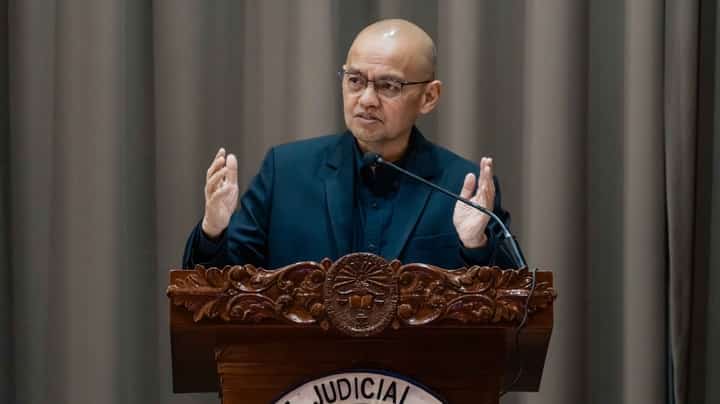
Supreme Court Senior Associate Justice Marvic M.V.F. Leonen said corporate leadership must extend beyond maximizing shareholder profits and instead serve the wider communities that enable businesses to exist and thrive.
Leonen made the remarks during the Institute of Corporate Directors' Forum on 7 July 2026, at Discovery Primea in Makati City, where he addressed directors, executives and governance leaders gathered to discuss ethical leadership and corporate governance.
Leonen challenged corporate leaders to rethink integrity—not merely as compliance with rules, but as a commitment to recognize and act on realities often overlooked in boardroom decision-making.
Anchoring his message on the metaphor of photography, Leonen described every frame as a deliberate choice about what is included and what—or who—is left out.
Participants were invited to reflect on how integrity has become far too narrowly defined by society, reduced to not stealing, not lying or merely complying with the rules.
He urged them to see integrity as more than a private virtue, but as a broader responsibility.
“It becomes the courage to widen the frame. It is the courage to insist on looking at the poverty, the inequality, the disempowerment that the comfortable picture so conveniently crops away.”
Leonen observed that most failures of integrity do not arise from outright dishonesty but from what he called the "small respectable refusals" to initiate change after recognizing an uncomfortable reality.
Applying this perspective to the corporate setting, he reminded corporate leaders that companies should not focus solely on shareholder profits or equate the best interests of a corporation with the enrichment of whoever happens to hold its shares at a given time.
“To read it that way is to forget who the true beneficiary is… It is the community whose law bequeathed to the corporation its being. It’s the community whose life the corporation was always, and in the end, always meant to serve.”
Leonen also examined the difference between "use value," or the value derived from what a thing does, and "exchange value," or what it commands in the marketplace.
While both are important, he warned of the consequences of allowing financial worth to become the sole measure of success.
Leonen said boards that focus exclusively on market value risk overlooking broader social and environmental contributions.
“The forest is prized by its timber and never by the rain it makes. The fishing ground is prized by the oil beneath it and never by the families it has fed for hundreds of years… We have grown exquisitely skilled at counting what can be sold and very nearly blind to what can only be lived.”
Turning to the role of independent directors, Leonen highlighted that they occupy seats at the board table with the freedom to voice uncomfortable truths and perspectives that do not depend on agreement.