
RTC orders Benguet residents to lift mining barricades

The hands of the residents of Barangays Guinaoang and Bulalacao, who are defending their agricultural lands from what they perceive as destruction, are now tied after the court ordered them not to stop the entry of equipment belonging to a mining firm.
Contributed photo
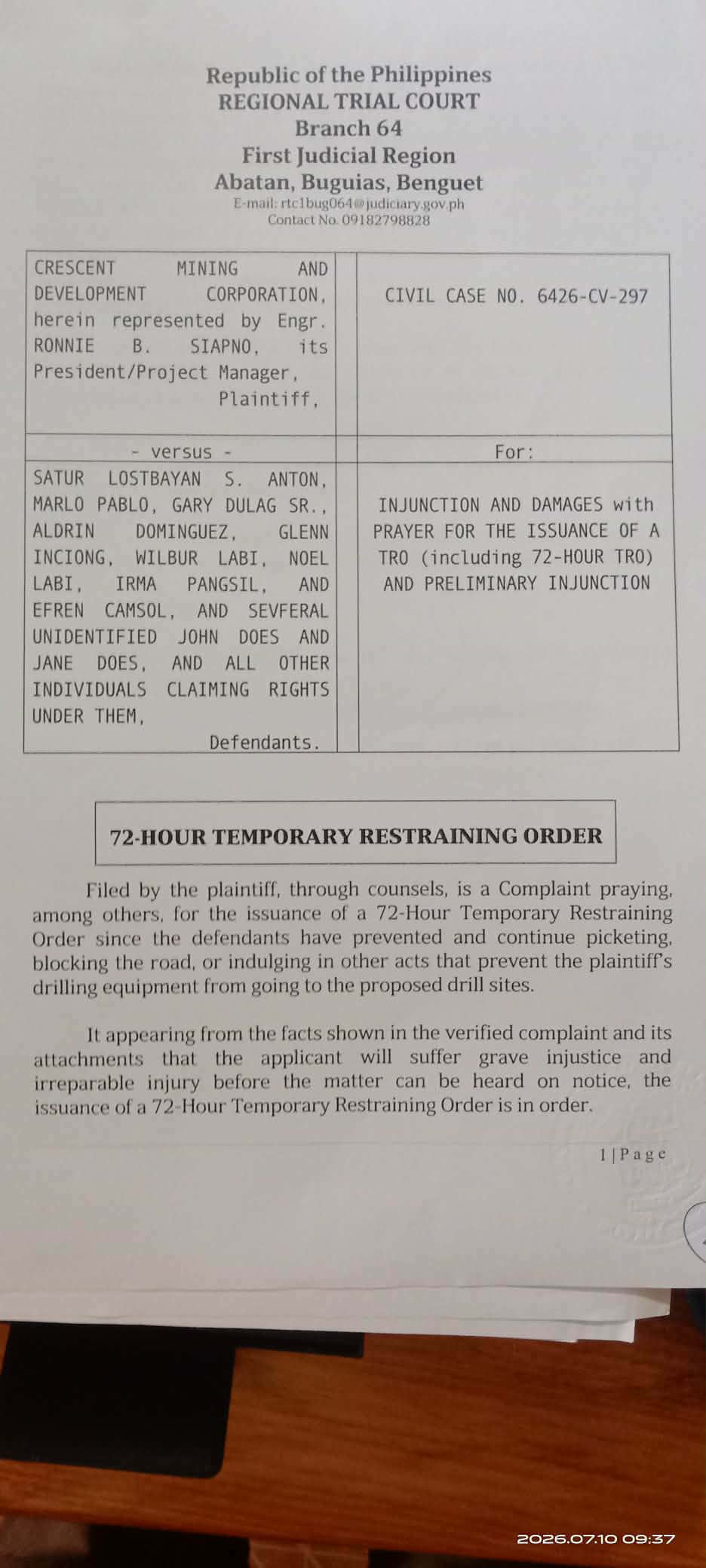
MANKAYAN, Benguet — Residents were ordered by the Regional Trial Court (RTC) Branch 64 in Abatan, Buguias, Benguet to immediately stop picketing and blocking roads leading to the proposed drilling sites of Crescent Mining and Development Corporation (CMDC).
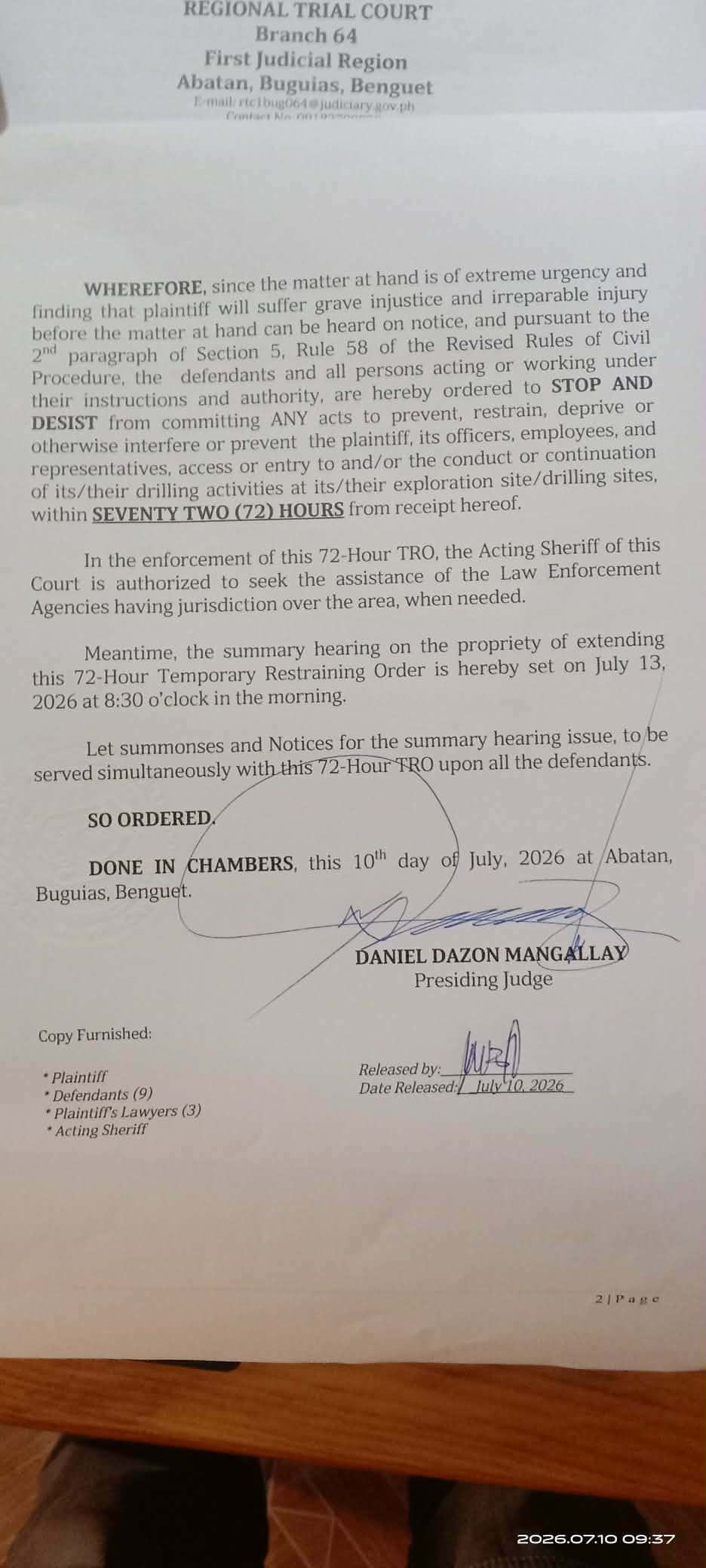
On 10 July 2026, Presiding Judge Daniel Dazon Mangallay issued a 72-hour temporary restraining order (TRO) after the mining company claimed it would suffer grave injustice and irreparable injury due to the ongoing protests. The court order is directed against Satur Lostbayan S. Anton, Marlo Pablo, Gary Dulag Sr., Aldrin Dominguez, Glenn Inciong, Wilbur Labi, Noel Labi, Irma Pangsil, Efren Camsol, and several unidentified individuals.
The order directs the defendants, and anyone acting under their authority, to stop any acts that prevent, restrain, or deprive the company, its officers, and employees from accessing and continuing drilling activities at its exploration sites. The court scheduled a summary hearing on 13 July 2026 to determine whether the TRO should be extended.
CMDC, represented by its president and project manager, Engr. Ronnie B. Siapno, filed the complaint for injunction and damages with a prayer for the issuance of a TRO. The company said the ongoing community pickets and roadblocks have prevented its drilling equipment from reaching the intended exploration zones. The court also authorized the acting sheriff to seek assistance from law enforcement agencies, if necessary, to enforce the 72-hour directive.
Residents and students in the affected villages of Bulalacao and Guinaoang have consistently maintained community barricades to protest the exploration activities, citing threats to ancestral lands, water sources, and agricultural livelihoods.
The conflict over the mining project traces back to community resistance that intensified around June 2022, when residents first established a major barricade to halt operations. The protests began after the government renewed the company's 25-year Mineral Production Sharing Agreement (MPSA) in March 2022.
Affected communities heavily criticized the renewal, arguing that the 533.4-hectare exploration project proceeded without securing the legally mandated Free, Prior, and Informed Consent (FPIC) from the indigenous population.
Despite subsequent efforts by government agencies to conduct community consultations and formalize agreements, local leaders and residents have repeatedly rejected the renewal of the mining license.
Opponents of the project maintain that the administrative certifications used to validate the extension were flawed and circumvented the genuine consent process.