
Building the foundation for nuclear readiness through Meralco’s FISSION Scholarship Program.


A milestone achievement for the philippine nuclear energy The first two scholars of FISSION Program, Amiela Nicodemus (second to the right) and Gener Atienza (rightmost front), complete their Master’s-level Nuclear Engineering studies at the University of Illinois Urbana-Champaign (UIUC), one of the world’s leading nuclear engineering institutions.
As the Philippines seeks to diversify its energy mix and strengthen long-term energy security, nuclear energy is gaining momentum as a potential source of reliable, low-carbon baseload power.
The Philippine government has affirmed the country’s nuclear ambitions, targeting the integration of 1,200 megawatts (MW) of nuclear capacity by 2032 as part of a diversified energy mix. Emerging technologies such as small modular reactors (SMRs), coupled with supportive policies including Republic Act No. 12305 or the Philippine National Nuclear Energy Safety Act signed in September 2025, have further reinforced the country’s push toward nuclear energy.
For Manuel V. Pangilinan-led Manila Electric Co. (Meralco), preparing for a nuclear future is not a matter of building reactors overnight, but laying down the foundations today.

NEW generation of nuclear engineers Filipino Scholars and Interns on Nuclear Engineering (FISSION) scholars Amiela Nicodemus and Gener Atienza are set to embark on a one-year industry immersion program in the United States to gain hands-on industry experience before returning to the Philippines in 2027.
Launched in 2025, Meralco’s Nuclear Energy Strategic Transition (NEST) program serves as the company’s flagship initiative aimed at preparing for the responsible integration of nuclear power into the country’s energy mix.
More than technology
At its core, NEST is anchored on a three-pronged approach that involves assessing the feasibility of rehabilitating the Bataan Nuclear Power Plant (BNPP), exploring the development of a greenfield utility-scale nuclear facility, and studying the potential adoption of SMRs.
Going beyond technology assessments, the program encompasses forging international partnerships, strengthening regulatory and institutional readiness, and investing in the development of a highly skilled workforce that will support the country’s long-term nuclear ambitions.
“Capability-building has always been a core pillar of our NEST program. We recognize that a successful nuclear program goes beyond technology. It requires people with the right knowledge and expertise to safely and responsibly operate and regulate these facilities,” Meralco Executive Vice President and Chief Operating Officer Ronnie L. Aperocho said.
Investing in talent
Even prior to the launch of the NEST program, Meralco had already started developing a talent pool through Meralco Power Academy’s Filipino Scholars and Interns on Nuclear Engineering (FISSION) program in 2023.
Designed to support both Meralco’s NEST program and the country’s broader nuclear aspirations, FISSION supports Filipinos to become nuclear professionals through overseas education and training.
To date, 12 scholars have been deployed to undertake specialized studies and train in universities and institutions in the United States, Canada, China, France and South Korea.
A major milestone was recently achieved with the graduation of the program’s first two scholars, Amiela Nicodemus and Gener Atienza, who completed their Master’s-level Nuclear Engineering studies at the University of Illinois Urbana-Champaign, one of the world’s leading nuclear engineering institutions.
As pioneers of the first FISSION batch deployed in 2024, their achievement marks a significant milestone not just in Meralco’s NEST program, but also in building the Philippines’ nuclear-ready workforce –in support of the nation’s goal of integrating 1,200 MW of nuclear energy by 2032.
The two scholars are now set to embark on a one-year industry immersion program in the United States to gain hands-on industry experience before returning to the Philippines in 2027.
“The graduation of the first FISSION scholars is significant milestone in Meralco’s long-term nuclear readiness journey,” Aperocho said. “Upon their return, they will help strengthen Meralco’s NEST and on a broader scale, contribute to the country’s nuclear energy push. As the country’s nuclear energy program continues to evolve, we see sustained value in investing in talent development.”
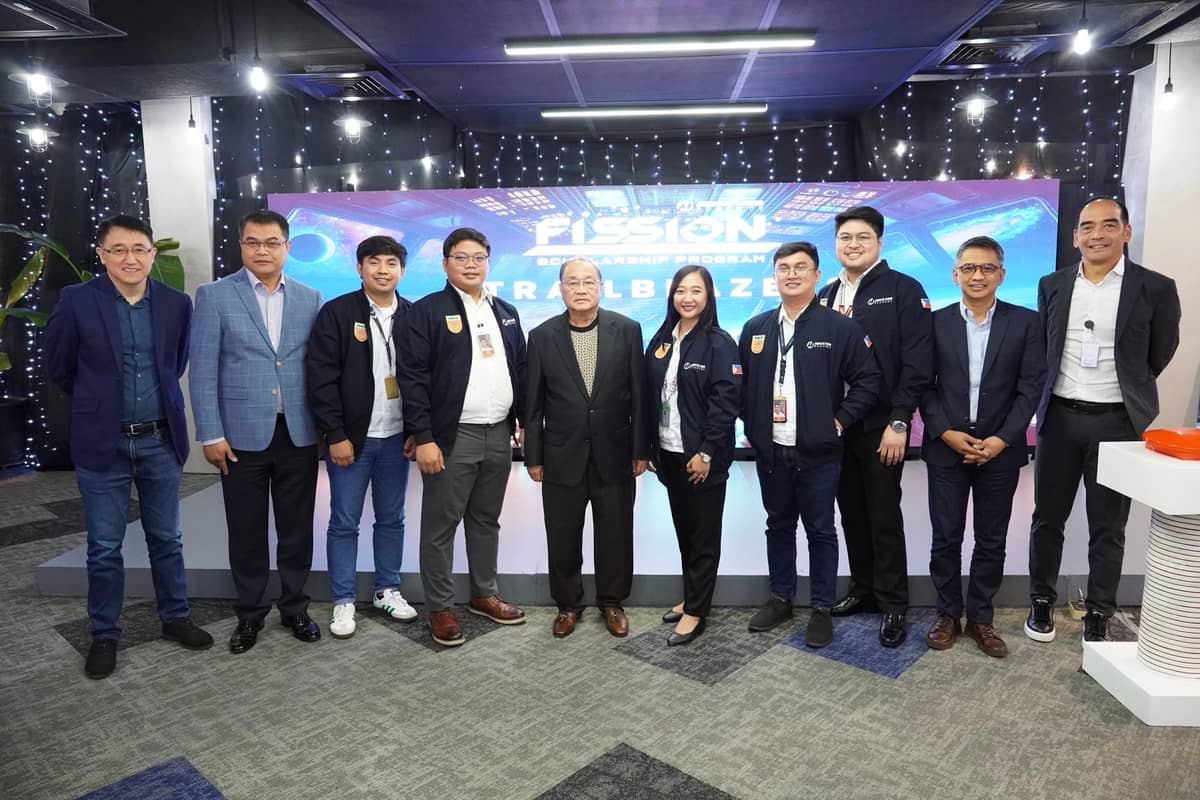
Pioneering talent development in nuclear energy Manila Electric Company (Meralco) officially introduced the pilot batch of scholars under Meralco Power Academy’s Filipino Scholars and Interns on Nuclear Engineering (FISSION) program in 2024. Seen in the photo are: (L-R) Meralco Senior Vice President and Chief Human Resources Officer and Head Edgardo V. Carasig; Meralco Executive Vice President and Chief Operating Officer Ronnie L. Aperocho; FISSION scholars Gener Atienza and Kenneth Tulagan, Chairman and Chief Executive Officer Manuel V. Pangilinan, FISSION scholars Amiela Nicodemus, Justin Salas, and Marc Ceria, Meralco First Vice President and Head of Networks Froilan J. Savet, and Meralco PowerGen Corporation President and Chief Executive Officer Emmanuel V. Rubio.
A new generation of Filipino nuclear engineers
A graduate of Electrical Engineering from Bulacan State University in 2017, Nicodemus joined Meralco’s five-month Networks Cadet Engineering Program before eventually becoming a distribution engineer.
Her growing interest in reliable and sustainable energy systems eventually led her to pursue nuclear engineering. From a technical perspective, she is particularly interested in reactor safety, risk assessment, and reactor operations, which are critical in ensuring the safe, reliable, and efficient deployment of nuclear power plants in a new player like the Philippines.
“I would like to focus on helping build the Philippines’ nuclear energy capabilities to improve energy access in underserved areas and diversify the country’s energy mix. I believe nuclear energy can play an important role in providing stable and reliable power while supporting the transition to cleaner energy sources,” Nicodemus said.
She believes that investments in people are just as important as investments in technology.
“Building a nuclear industry requires expertise across many disciplines—from engineering and operations to regulation and safety. Developing that talent base takes time, which is why programs like FISSION are so important,” Nicodemus said.
Once done with her training, Nicodemus is eager to contribute to Meralco’s NEST program and the government’s efforts to include nuclear energy in the Philippine Energy Plan.
“For me, being part of an initiative that seeks to deliver reliable and sustainable energy to Filipinos reflects the very purpose of the scholarship and training that Meralco has invested in us. It is an opportunity to apply what I have learned and contribute meaningfully to the country’s energy future,” she said.
A shared responsibility
Industry experts agree that no single organization can build the country’s nuclear workforce alone.
Developing a safe and sustainable nuclear industry will require close collaboration among government agencies, regulators, academe, energy players, and international partners.
“The current pool of scholars is an important and encouraging start, but no single program can meet the country’s future nuclear workforce requirements on its own. Achieving the government’s 2032 target will require a whole-of-industry effort involving government, academe, industry, regulators, and international partners,” Aperocho said.
While nuclear energy remains a long-term undertaking, Meralco believes preparation must begin today.
Through the NEST program and initiatives such as FISSION, the company continues to invest in the people, partnerships and capabilities needed to support the country’s pursuit of a safe, reliable and sustainable energy future.
“We hope that Meralco’s FISSION will be able to demonstrate that meaningful groundwork is already being laid to build the human capital needed for a future nuclear industry. Every trained expert strengthens the country’s readiness for the safe and responsible adoption of nuclear energy,” Aperocho said.