
The heart of the matter
While walking in to UP PGH we had to pass the back side and go through the hall ways adjacent to the emergency section. It was frightening to see the number of people and the crowded conditions. The hospital made it look like it was prewar time but the crowd of people made it look like wartime.

I am reading a book called Last Conversations. It is written by a hospice pastor on his conversations with dying patients and how it affected him.
But what if you have a heart attack and died instantly? There would be no conversations, no goodbyes.
Let me share with you my journey.
My name is Peter. I will be 68 years old this year. I had an angioplasty procedure on 31 January 2025. It has been almost a year and a half since.
I have been advised that cardiovascular disease is the disease of the arteries. The arteries send blood to the various places of your body. A stroke happens when the cardiovascular disease affects the arteries in your brain. When the artery in your brain gets clogged and blocked, you suffer a stroke. Survivors are usually left partially paralyzed. When the artery that gets clogged is very near the heart, it is called a heart attack. Many do not survive strokes or heart attacks. Most do not want to survive a stroke because they could be paralyzed or bedridden for life.
I thought I could avoid such diseases because these are actually called “lifestyle diseases” — that is, they are usually caused by unhealthy lifestyle choices. These include diabetes, hypertension, obesity and cardiovascular diseases. Smoking, drinking, inactive lifestyles and bad food choices make for an unhealthy lifestyle, or so I believed. I thought I would have the discipline to keep a healthy diet and exercise.
In 2024, I was overweight. I blamed the Covid-19 lockdown for this because I had to exercise at home. I would walk up and down my driveway for more than an hour, and I would do weight exercises after walking.
In July of that year, I developed angina. I initially dismissed it as being tired. I later found out it was stable angina. I would have chest pain five minutes into an exercise, and then it would stop. I was also feeling tired most of the time, which I attributed to lack of sleep.
Their decision, too
I traveled to the US without issue, but when I got back after a construction site meeting (I am an architect), I walked to my car and had trouble stabilizing myself to enter the car. My son saw me and had me sit and rest while he got me some help. I had very high blood pressure reading. It must have been about 177/120. I had to stay in a friend’s house nearby for about two hours sipping hot water till it went down to 130/90.
When my wife, Fe, fetched me, we agreed to embark on dealing with my health. Of course, we both knew I could have a heart attack anytime. We started by seeing a cardiologist and an alternative medicine doctor at the same time.
The alternative medicine doctor was good, but alternative remedies are for long-term use before any gains are seen. My situation was a bit advanced for natural alternative measures. Though I did do juicing and klelation drips, my wife and I eventually decided to follow up with a cardiologist. There may not have been “last conversations,” but the conversations with my wife and my children eventually taught me that my decision was not my own — it was theirs, too.
I reluctantly followed the cardiologist and had a series of tests done to check the situation of my arteries. We left the gold standard test for artery blocks for the last. I started with calcium test, and ECG with blood tests. They all pointed to blocked arteries — but, of course, we could not tell which arteries and how great the blocks were.
Silent attack
In December 2024, I had a stress test. This was a treadmill test. I was asked if I felt any chest pains into the fifth minute. There was none. As usual, the pain left five minutes into walking. But the test was showing that my heart was being stressed, and I was advised to stop even if I felt that I could continue. I had unexplained extreme fatigue for about a week. I was later told by my interventional cardiologist that I had a silent heart attack, and that it was seen in the scar tissues in my heart.
So the final and gold standard test was scheduled for 31 January 2025. With our cardiologist, we chose the hospital, UP PGH. My wife has a degree in BS Zoology and I in BS Architecture, both from UP Diliman. The cost was the other consideration.
Our interventional cardiologist, Dr. Wilfred Dee, assured us that UP PGH had the proper facilities to have the angiogram and, if needed, the angioplasty (stents). Dr. Dee said that I would be under sedation enough to be partially awake or conscious so that he would be able to talk to me about the angiogram findings and to ask my permission if we would proceed with an angioplasty or not. My decision then would not be my own, but it would be my wife’s and my children’s. Conversations of someone facing certain death.
While walking in to UP PGH we had to pass the back side and go through the hallways adjacent to the emergency section. It was frightening to see the number of people and the crowded conditions. The hospital made it look like it was prewar time but the crowd of people made it look like wartime. Walking down the main lobby to the elevator to my room on the seventh floor, I was met by graceful and repetitive arches. It looked like a museum. I was beginning to doubt my decision to have the procedure done there.
In late 2024, the UP PGH underwent a massive clinical reengineering and facility modernization. This included upgrading their cardiovascular catherization laboratory with ultra-advanced, first-of-its-kind imaging tech in Southeast Asia. These next-generation machines use Artificial Intelligence and 3D image fusion. I was just in time to use this brand new, high-tech machine for the first time.
Death’s reach
The chance of death due to angiogram is less than 0.1 percent, but we had a friend who died while having one. So it was a bit tense. My daughters were also there with my grandson, and my son constantly communicating. I remember as I was sedated thinking that it would not be bad at all if I died during the angiogram. I would not feel a thing. It felt like going to sleep. But I also had a frightening thought of my family — hopeful in prayer, waiting outside.
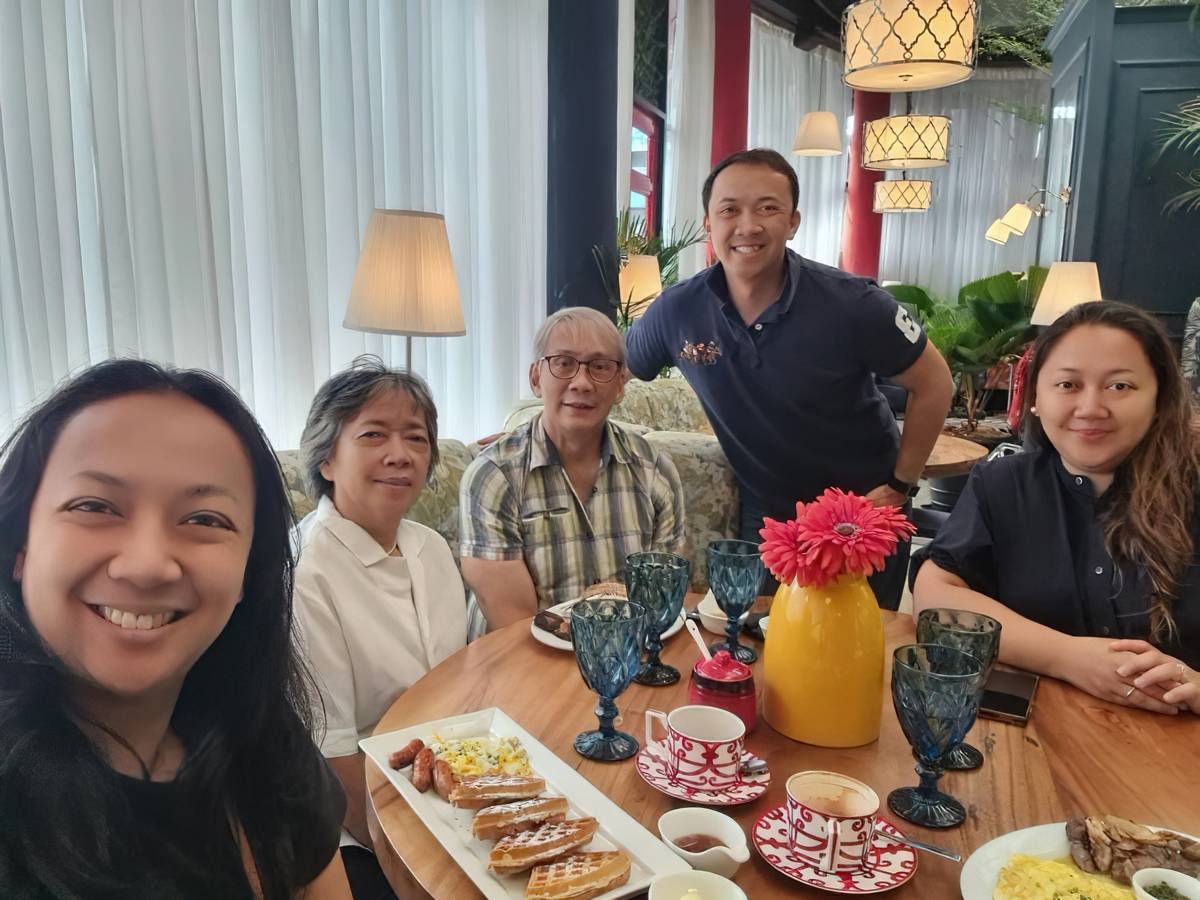
ALL in the family: Youngest daughter Gabrielle, wife Fe, Peter, son Enrique and eldest daughter Natalia.
PHOTOGRAPH COURTESY OF PETER MORAN
Dr. Dee woke me up and spoke to me. He said something like this, “You have three 100-percent blocked main arteries to your heart. The standard recommendation for this situation is for you to have an open-heart bypass surgery. But after knowing your condition and history, I can do an angioplasty if you want.”
I really did not understand what he meant or what he was offering me at that time, but I have come to know that my three 100-percent blocked major arteries near the heart (including the widow maker) would have been hands-down open-heart bypass surgery. No one would dare try to do an angioplasty. Each of the blocks was also one inch long.
I said I will go with you on the angioplasty as long as my wife and children agree.
Victory arrives
Was that applause I could hear? Like in a football match, loud and enthusiastic, but from a small group doctors and nurses and aides in the Cath lab. It was genuine relief and awe from the group in the Cath lab to see firsthand that Dr. Wilfred Dee had done it!
He drilled though three blocked arteries, an inch long each. It was a feat for the medical history and my case became a celebrated occasion. The whole procedure with angiogram took four hours.
Today, a year and a half later, I am healthy. I see Dr. Dee almost every four months and he says that I am in excellent condition. He tells me I should keep it up so he can boast of my case in his international and national conventions.
How can I stay healthy? I should eat healthy, exercise regularly, take my medication religiously, sleep well and keep active socially. Oh, yes, listen to my family, always, and allow them to make decisions for me — well, with regard to my health.
I thank God for all the provisions and love I have.