
Feast of Santa Marta de Pateros 2026: Vibrant with pandanggo and pasubo
Faith and folklore come alive each February as Pateros honors Saint Martha with dancing, processions and the age-old pasubo ritual.

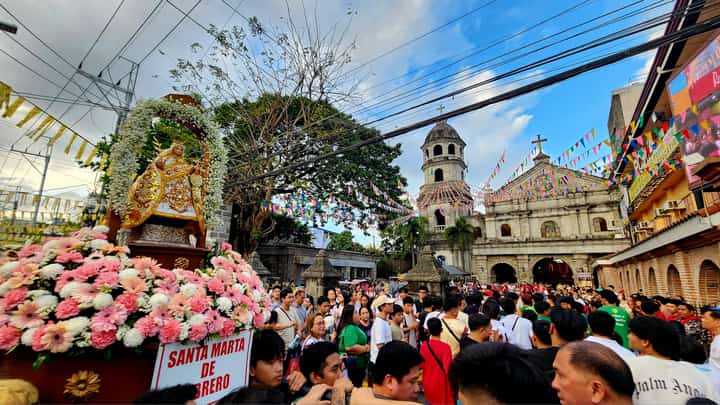
IMAGE of Santa Marta de Pebrero arriving at the church during the traslacion procession on 30 January, the first day of the nobenaryo.
Pateros, in the southeastern part of the National Capital Region, remains the only municipality within the sprawling metropolitan area composed mostly of cities. Although it has become highly-urbanized in recent years, it still retains its small-town character shaped by enduring traditions and local lore — most vividly expressed during its patronal fiesta in honor of Santa Marta de Pateros.
While the titular patron saint of Pateros is Saint Roch, devotion to Saint Martha of Bethany remains strong. In the Roman Catholic liturgical calendar, her feast is celebrated on 29 July together with her siblings Lazarus and Mary. In Pateros, however, her patronal and thanksgiving feast is observed every second Sunday of February. The reason is uncertain, though it is surmised that this season coincides with the abundance of duck eggs — the main ingredient of the town’s most famous products: balut (fertilized duck egg) and the magenta-painted salted egg known as itlog maalat. Pateros has long been associated with duck raising, reflected even in its name, which means “duck farmers” in Spanish.
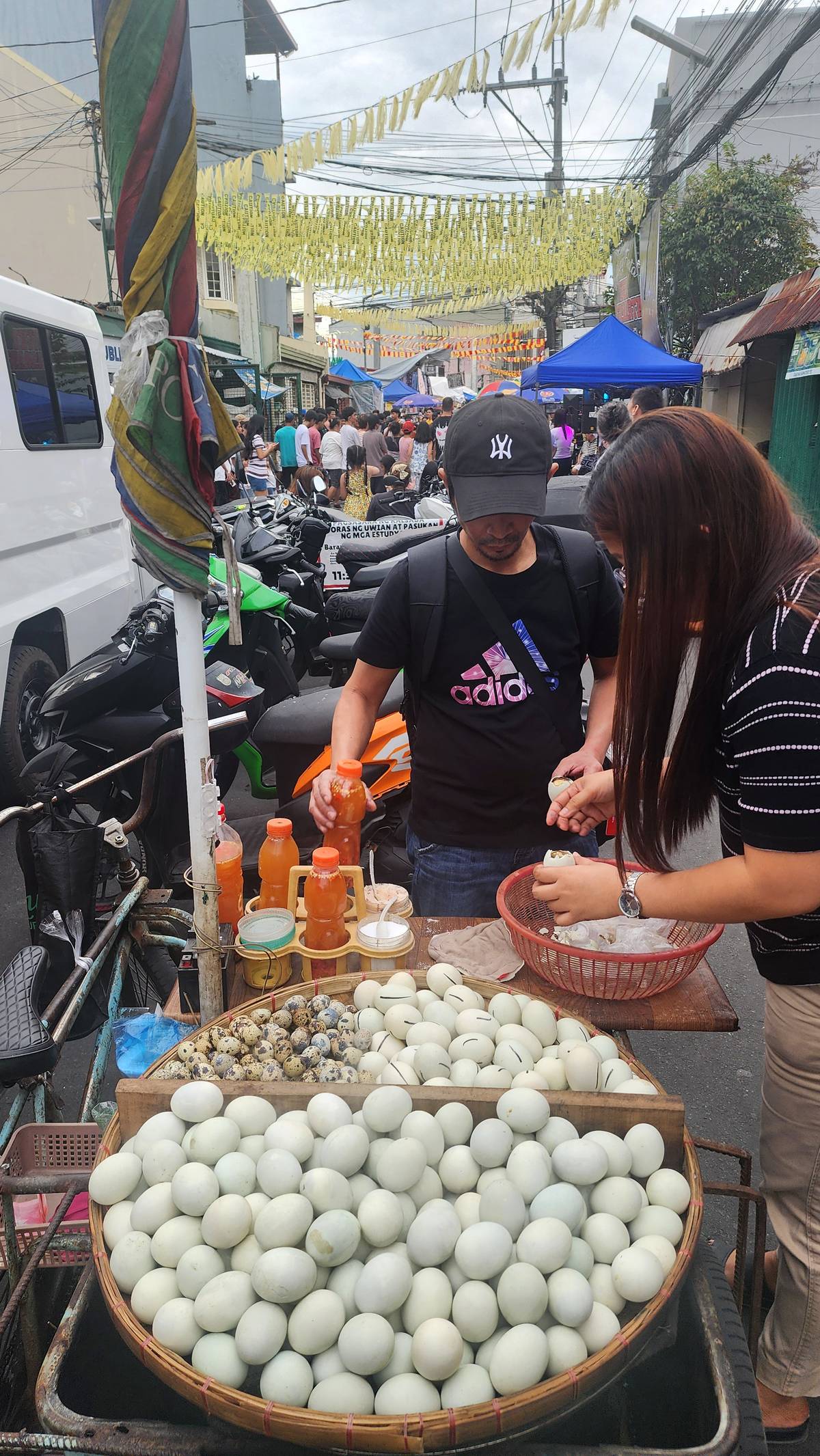
PATEROS is known for its balut-making industry.
Balut is said to have originated in southern China before spreading across Southeast Asia, particularly Vietnam. Some accounts tell of a Chinese migrant from Fujian who married a woman from Pateros and introduced balut to the community and country.
With abundant produce came the means to celebrate a fiesta.
The beginnings of devotion to Saint Martha in Pateros are likewise uncertain. Local lore recounts that an image of the saint was found in the river during the eighteenth century and soon venerated by residents. Some researchers suggest that the devotion may echo precolonial beliefs in a female deity.
The most famous lore about Saint Martha tells about her appearance in the nineteenth century. According to the story, a large crocodile had been preying on ducks and threatening the town’s livelihood for more than two hundred years ago. Seeking help, the townspeople consulted a friar devoted to Saint Martha, who advised prayers to the saint, recalling her miraculous taming of the dragon-like monster Tarasque in Tarascon, France. After fervent prayers, a warrior was said to have slain the crocodile with a bolo under a full moon, while another version claims that Saint Martha herself subdued or banished the rapacious reptile. In gratitude, the townspeople commissioned an image of the saint standing upon a crocodile, holding a cross and palm frond — an iconography that continues today. She came to be revered as patroness of duck raisers and balut makers.
That devotion remains palpable during the annual feast, which fell on 8 February this year. Preparations begin with the nobenaryo or pagsisiyam, a nine-day period of novena prayers, daily Masses, processions, and related rituals and activities organized by both church and community with support from the local government.
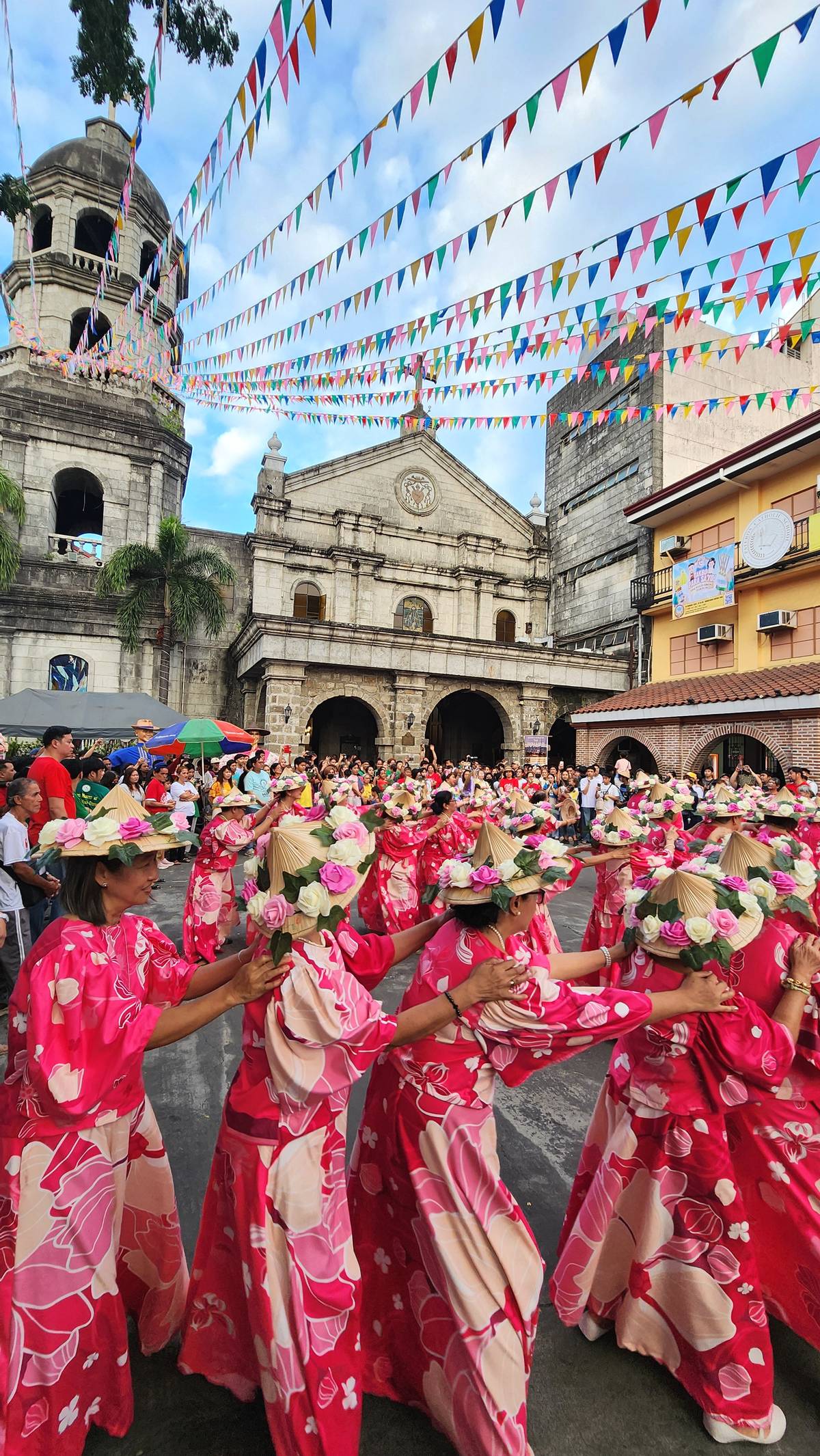
AN offering of the pandanggo dance at the church patio.
On the first day of the nobenaryo on 30 January, the Matandang Imahen (old image) of Santa Marta — an eighteenth-century wooden image — underwent pagbibihis, the solemn changing of vestments. The parish venerates three principal images: the Matandang Imahen; the Batang Imahen (young image), a smaller figure with blond hair also called Santa Marta de Pebrero; and the Callejerang Imahen (shrine image), made of ivory. The Batang Imahen was vested the following day.
The main event for the first day of the nobenaryo was the traslacion (transfer reenactment) procession of Santa Marta de Pebrero from the residence of the Tuazon family — one of the town’s prominent balut-making clans — to the Diocesan Shrine of Santa Marta de Pateros of the Parish of Saint Roch, or Pateros Church, in the town proper. The image was perched on the andas festooned with flowers and carried on the shoulders of young men, who danced along the way. Part of the procession was a group of ladies in their bright pink dresses, who also danced along the way. Before entering the church, the image was paraded around the patio, and the ladies performed a devotional dance of the pandanggo, a popular Philippine folk dance adapted from the Spanish fandango.
In the late afternoon, after the Misa Nobenaryo, another procession was held, led by a young group of participants who energetically danced from the aisle of the church to the streets.
Every late afternoon of the nobenaryo, processions were held with different groups of dancers. On 2 February, 11 images of Saint Martha joined the procession.
On the afternoon of 6 February, the Pagoda sa Daan was held. Joined by floats and decorated vehicles that were equipped with attractive lights, the procession is an adaptation of the traditional fluvial procession or pagoda once held along the Taguig River, which has since deteriorated and become heavily polluted. A form of the pasubo tradition continued to be observed, with food — traditionally suman, balut, itlog maalat and candies — and other items such as alpombra slippers, a known product of the town, thrown to onlookers along the route. The nightly procession continued to be held separately. The town became crowded and lively as the two parades converged at some points.
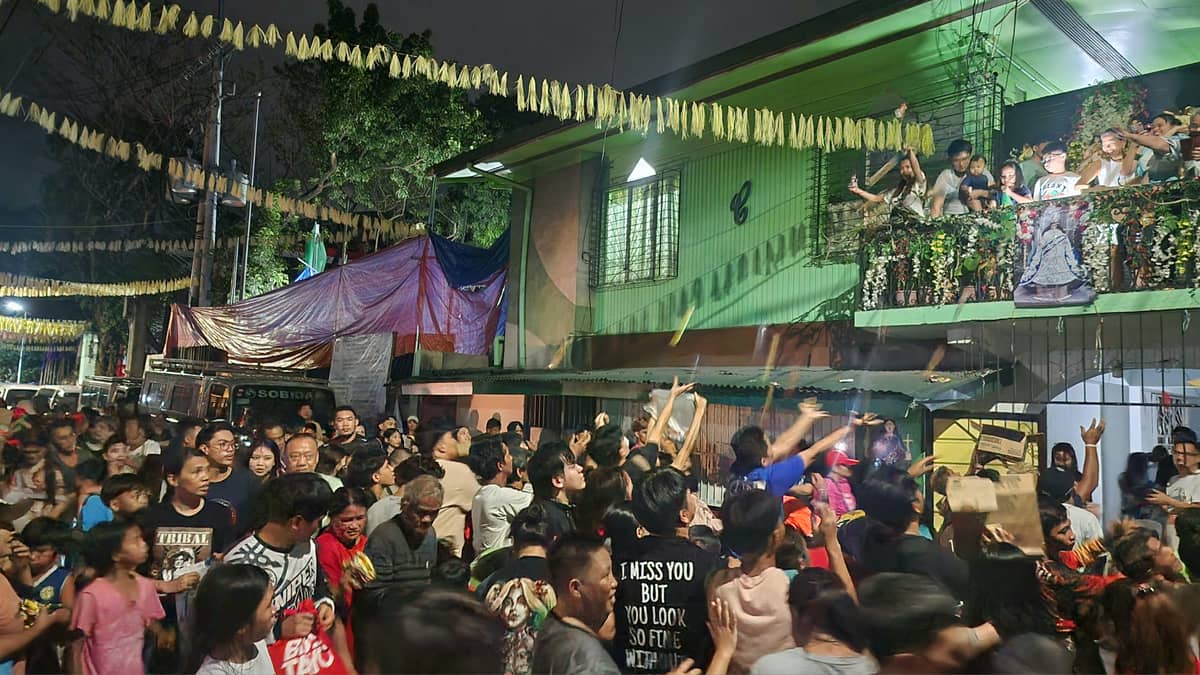
THE pasubo is practiced during the procession after the Fiesta Mass.
The following night, 7 February, the bisperas or eve of the feast day, the 35th Pandangguhan Festival, a contest on dancing the pandanggo, was held at the church grounds. Ten groups, most of which are barangay-organized, joined the contest with the barangay of San Pedro emerging as champion, followed by Poblacion at second place and Martirez del ‘96 at third place.
The event was marred by a controversy that resulted in the contingent of Barangay Santo Rosario Silangan withdrawing from the competition. A new guideline prohibiting “cross-dressing” was imposed. This rule appeared to be directed at transgender women participants wishing to dress in a manner aligned with their gender identity. Queer people have been an integral part of the community and the church, contributing in their own ways, especially in celebrations like fiestas, making their exclusion a point of concern and source of disappointment.
Also during the bisperas, a sprawling tiangge started to emerge on the main street of B. Morcilla and on the streets surrounding the church. Stalls offered clothes, gadget accessories, household items, toys alongside traditional delicacies such as suman kalamay, sapin-sapin and espasol. Food stalls and itinerant vendors also sold balut, lugaw, mami, inihaw na pusit, shawarma, grilled corn, takoyaki, bibingka, isaw, hotdog, among others. The tiangge continued until midnight of the feast day.
The feast day itself started at midnight of 8 February with a Pilgrim’s Mass. The images of Saint Martha and Saint Roch were then brought out to the patio for the pahalikan, the traditional act of kissing or venerating the images. Parishioners danced the pandanggo as the images were carried to a stage arranged with a crocodile figure recalling the saint’s legendary miracle.
Masses were celebrated throughout the day. After the morning Misa Mayor, a procession with the Santa Marta de Pebrero image took place, followed by another in the afternoon featuring the Callejera image after the Fiesta Mass. Both were marked by pandanggo dancing and the pasubo — this time with onlookers along the route throwing food to the passing participants and image. This tradition serves as an expression of thanksgiving to the patron saint by sharing blessings.
Pasubo came from the Filipino word subo, which means “to swallow” or “to put into the mouth.” “Pasubo” can literally mean an offering that is eaten or swallowed. The practice traces its roots to precolonial rites of offering food to the land and river to appease, express gratitude to, ask permission from or give respect to the spirits or deities residing in these places. In the local Saint Martha story, pasubo is said to have been practiced — throwing food to the river to allay or distract the great crocodile.
In these days when modern and local-government-organized festivals, with street-dancing and parades inspired by the Mardi Gras and the Rio de Janeiro Carnivale, cannibalize and overshadow local fiestas, take traditional practices out of their cultural and religious contexts and tend to be more touristic and commercial, the Feast of Santa Marta de Pateros remains vibrant with traditions and stories and endures as a religious heritage upheld by both the church and community. Yet as it continues, it also calls for greater awareness of exclusion and oppressive ways and a more inclusive embrace of devotees, especially ones who have been long marginalized, as they are also long been part of this living tradition.