
18 Chinese vessels monitored in West Philippine Sea, Navy says
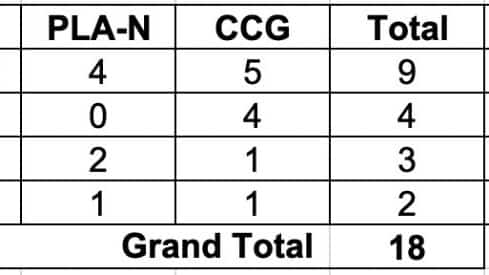
Eighteen Chinese vessels have maintained their presence in the West Philippine Sea (WPS) over the past week, the Philippine Navy reported Tuesday.
Philippine Navy spokesperson for the WPS, Rear Admiral Roy Vincent Trinidad, said the Chinese ships were monitored from 15 to 22 February.
Trinidad said four People’s Liberation Army Navy (PLA-N) vessels and five China Coast Guard (CCG) ships were spotted in Bajo de Masinloc, while four CCG vessels were monitored in Ayungin Shoal. Three vessels — two PLA-N ships and one CCG vessel — were seen in Escoda Shoal, and two more — one PLA-N and one CCG — were detected near Pag-asa Island.
On Monday, the Philippine Coast Guard (PCG) reported that China appeared to have engaged in signal jamming, hampering communications of Philippine vessels conducting maritime patrols near Bajo de Masinloc.
Parts of the South China Sea that fall within Philippine territory have been officially renamed the West Philippine Sea to reinforce the country’s maritime claims.
Trinidad said the West Philippine Sea refers to the maritime areas on the western side of the Philippine archipelago, including the Luzon Sea and waters around, within and adjacent to the Kalayaan Island Group and Bajo de Masinloc.
The Permanent Court of Arbitration in The Hague previously ruled in favor of the Philippines over China’s sweeping claims in the South China Sea, stating that Beijing’s assertions had “no legal basis.”
Tensions persist as China claims almost the entire South China Sea, a strategic waterway through which more than $3 trillion worth of global trade passes annually. The area is also claimed in part by the Philippines, Vietnam, Indonesia, Malaysia and Brunei.