
DOE drafts bill to reduce geothermal investor barriers

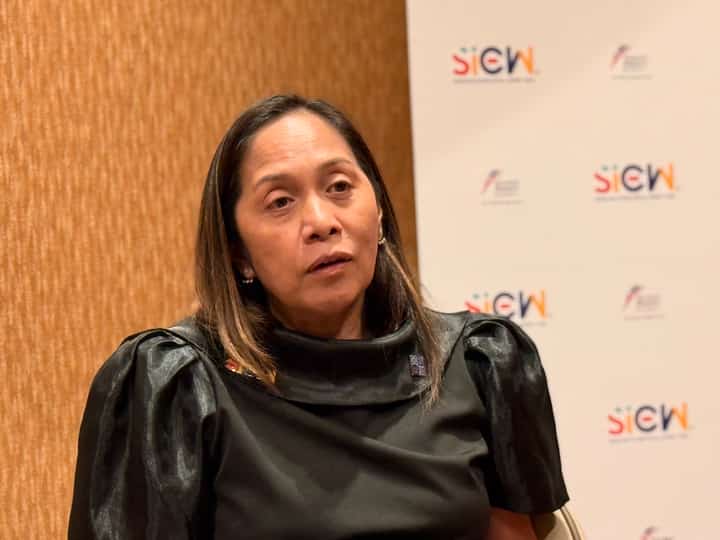
Energy Secretary Sharon Garin discusses the Department of Energy’s plan to conduct nationwide geothermal surveys and draft a bill to reduce investment risks at the sidelines of the Singapore International Energy Week.
Photograph by Maria Romero for the Daily Tribune.
SINGAPORE — The Department of Energy (DOE) is drafting a new bill to make geothermal energy a safer bet for investors by addressing the high costs and risks that have long kept private capital at bay.
Speaking to reporters at the sidelines of the Singapore International Energy Week on Wednesday, Energy Secretary Sharon S. Garin said the proposed legislation seeks to give geothermal projects special treatment, incentives, and cost structures designed to encourage investment.
“Geothermal is one of our best assets. We want to encourage the industry, then maybe give them more incentives,” Garin said.
Garin added that the proposed legislation would slash these barriers and de-risk investment, potentially unlocking one of the Philippines’ most untapped and strategic renewable energy assets.
Unlike solar or wind, geothermal development is notoriously capital-intensive and high-risk, with costs averaging around $6 million, or about P352 million per megawatt (MW)—and that’s before factoring in the possibility of dry wells or failed drilling.
Aside from a new measure, the DOE is also pressing for funding to conduct detailed geothermal surveys, including gradiometric studies.
Energy Undersecretary Felix William Fuentebella said these surveys will cover the country to identify potential geothermal resource areas and provide data to attract investors. Gradiometric surveys detect density contrasts in the land’s subsurface, which can point to geological features linked to geothermal energy.
“The gradiometric survey covers the central Philippines, so that's the Visayas area and portions of Mindanao. And then, once the gradiometric survey is done, which is akin to an X-ray, then we will go to CT scan mode. If we see an anomaly in the area, then we can go and do a 3D CT scan,” Fuentebella said.
As of the end of July, the Philippines has a total grid-connected capacity of 31,701 MW, with geothermal energy contributing 2,004 MW—or about 6 percent of the total.
The country ranks third in the world for geothermal production, trailing only the United States and Indonesia.