
Arab, EU diplomats in Saudi for talks on Syria aid
EU wants Syria’s new rulers to form an inclusive government that protects minorities

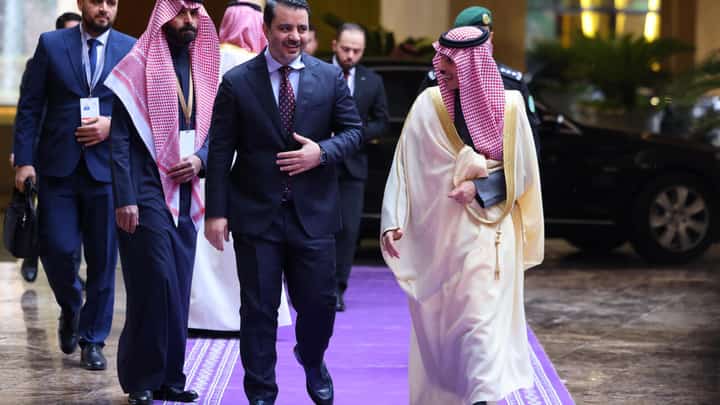
Saudi Foreign Minister Prince Faisal bin Farhan (R) welcomes his Syrian counterpart Asaad al-Shaibani (C) before attending the talks
Fayez Nureldine / AFP
RIYADH, Saudi Arabia (AFP) — Top diplomats from the Middle East and Europe are due in the Saudi capital on Sunday to discuss Syria as world powers push for stability after the fall of Bashar al-Assad.
The talks on Sunday will unfold in two sessions: the first will bring together Arab officials while the second will feature wider participation including from Turkey, France, the European Union (EU) and the United Nations, a Saudi official told Agence France-Presse on Saturday.
The gathering takes place as Syria’s new leader Ahmed al-Sharaa, whose forces seized Damascus and toppled longtime ruler Assad last month, is pushing for sanctions relief.
Western powers, including the United States (US) and the EU, slapped sanctions on Assad’s government over his brutal crackdown on anti-government protests in 2011 that triggered civil war.
More than 13 years of conflict in Syria have killed more than half a million people, ravaged the economy, and pushed millions to flee their homes, including to Europe.
The EU’s top diplomat, Kaja Kallas, said on Friday that the 27-nation bloc could begin lifting sanctions if Syria’s new rulers took steps to form an inclusive government that protects minorities.
Saudi Arabia cut ties with Assad’s government in 2012 and had long openly championed his ouster. But in 2023 it hosted an Arab League meeting at which Assad was welcomed back into the regional fold.
This month the Gulf kingdom, the biggest economy in the Middle East, has sent food, shelter and medical supplies to Syria overland and by plane.
Riyadh is now negotiating how to support the war-struck country’s transition beyond that.
“This summit sends the message that Saudi Arabia wants to take the lead on coordinating the regional effort to support Syria’s recovery,” said Anna Jacobs, non-resident fellow at the Arab Gulf States Institute in Washington.
“But the big question is how much time and how many resources will Saudi Arabia devote to this effort? And what is possible with many of the sanctions remaining in place?”