
CALABARZON drafts El Niño Action Plan
Regional disaster council moves to strengthen water, food and energy security while protecting farmers, fisherfolk and vulnerable communities.
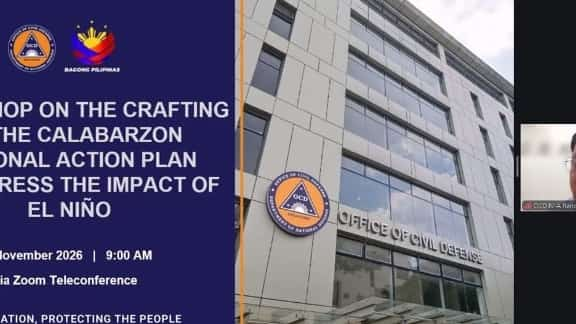
Officials and representatives of regional government agencies participate in an online workshop on the Regional Action Plan to Address the Impact of El Niño (R.A.I.N.) on Friday, 13 November 2026. The meeting focused on coordinated preparedness measures to protect communities and livelihoods across CALABARZON. (Photo courtesy of OCD CALABARZON)
CALABARZON Drafts El Niño Action Plan
Regional disaster council moves to strengthen water, food and energy security while protecting farmers, fisherfolk and vulnerable communities.
By JOSEPHINE D. ESCOVIDAL
CALAMBA CITY, Laguna — The Regional Disaster Risk Reduction and Management Council (RDRRMC) CALABARZON convened 34 regional government agencies and local government representatives on Friday, 13 November, to finalize a regional action plan aimed at reducing the potential impact of El Niño on communities and livelihoods.
The online workshop, jointly spearheaded by the Office of Civil Defense (OCD) CALABARZON and the Department of Economy, Planning and Development (DEPDev), focused on the Regional Action Plan to Address the Impact of El Niño, or R.A.I.N.
Representatives from Cavite, Laguna, Rizal, Quezon and the highly urbanized City of Lucena participated in the discussions.
The proposed action plan will guide regional government agencies in coordinating assistance and preparedness measures, particularly for farmers, fisherfolk and communities vulnerable to prolonged dry conditions and water shortages.
RDRRMC CALABARZON Chairperson and OCD Regional Director Carlos Eduardo E. Alvarez III emphasized that disaster preparedness must prioritize the welfare of communities rather than focus solely on infrastructure and logistical requirements.
Alvarez identified five critical areas requiring coordinated government intervention: water security, food security, energy security, health and public safety.
He stressed that preparedness measures must protect lives and livelihoods while ensuring that essential services remain accessible to communities potentially affected by El Niño.
DEPDev CALABARZON Regional Director Carmel P. Matabang, meanwhile, called for stronger interagency coordination to develop a unified approach to managing the potential effects of the climate phenomenon.
“Together, we must craft a comprehensive, unified roadmap that ensures CALABARZON is fully prepared to anticipate, mitigate, and respond to the impacts of El Niño,” Matabang said.
Alvarez also announced that the RDRRMC would formally recommend the reactivation of the Regional El Niño Team.
Once reactivated, the team would lead coordination, implementation and monitoring of programs, projects and activities identified under the regional action plan.
The proposed mechanism is intended to improve coordination among government agencies and local authorities in addressing potential disruptions to agricultural production, water availability, energy supply and public health services.
Participating agencies included the Department of Agriculture, Department of Health, Department of Social Welfare and Development, Department of Energy, Department of Environment and Natural Resources, Department of Science and Technology, Philippine Atmospheric, Geophysical and Astronomical Services Administration, Philippine Coast Guard and Philippine National Police.
Other participating offices included the Department of Education, Department of Public Works and Highways, Department of Labor and Employment, Department of Budget and Management and Philippine Red Cross chapters in Batangas and Cavite.
The RDRRMC said the action plan would serve as a framework for coordinated government interventions to minimize the potential effects of El Niño and strengthen community resilience across CALABARZON.