
BCDA, companies to assess proposed 40MW power plant, underground ICT network in New Clark City
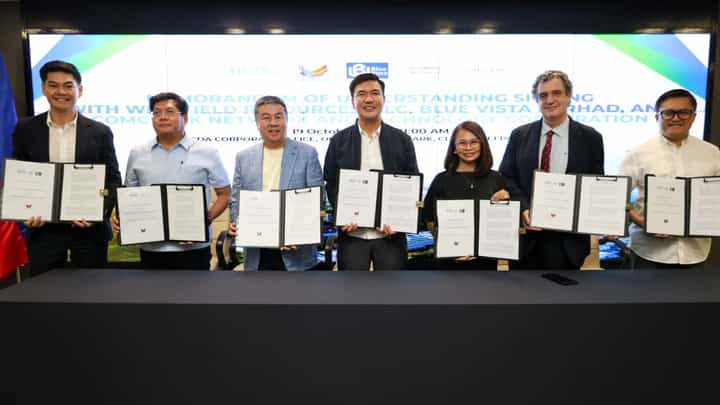
(L-R) BCDA Vice President for Strategic Projects Management Randy S. Viacrusis, ComClark Network and Technology Corporation Office of the CEO Chief of Staff Atty. Frank Martin S. Abalos, ComClark Network and Technology Corporation Chief Executive Officer Dennis Anthony H. Uy, BCDA President and CEO Joshua M. Bingcang, Westfield Resources LLC Country Project Development Representative-Philippines April Agatha G. Flores, Baker Hughes Sales Staff Director Francesco Cervini (signed as witness on behalf of Blue Vista Berhad), and Westfield Resources LLC Project Coordinator Bernard R. Peralta.
BCDA
The Bases Conversion and Development Authority (BCDA) has tapped companies that will help the agency assess a proposed 40-megawatt liquefied natural gas (LNG)-fired power plant and an underground ICT network in New Clark City.
According to BCDA President and Chief Executive Officer Joshua M. Bingcang, the agency signed agreements with Blue Vista Berhad, Westfield Resources LLC, and ComClark Network and Technology Corp. (the parent company of fiber broadband player Converge ICT Solutions Inc.) to assess these big ticket projects.
He said, “Reliable power and digital connectivity are essential to New Clark City’s development. We need to assess these requirements early and work with partners who can help us determine the most viable solutions.”
He furthered that under the first Memorandum of Understanding (MOU), Blue Vista and Westfield will help the BCDA evaluate the proposed LNG-fired facility’s technical and commercial feasibility, potential grid connections, LNG supply and logistics, financing, and environmental and regulatory requirements.
“This pioneering project will not only secure reliable power independently of the main grid, but will also serve as a showcase solution for the wider Philippine power landscape,” Westfield Resources LLC President and CEO Neil Gonzales said. “The mission is to lower the power cost, to produce cleaner energy, and to replace dirty emissive diesel engines with much cleaner LNG natural gas fuel.”
The assessment will determine whether the facility could meet part of New Clark City’s future power needs as development progresses and businesses establish operations in the area.
In a separate MOU, BCDA and ComClark will explore a common underground ICT passive infrastructure network for New Clark City locators and future developments. The parties will assess the project’s technical and financial feasibility. BCDA will provide relevant planning information and facilitate access for technical studies, subject to applicable requirements, while ComClark will conduct the necessary surveys and assessments.
“Our vision was to lay down the digital infrastructure of tomorrow, and we are proud to say it is fully ready today. High-speed fiber is the essential bedrock for AI deployments, making economic hubs incredibly attractive to global innovators. We are excited to partner with BCDA to connect hundreds of locators in New Clark City, ensuring government offices, data centers, and manufacturing facilities have the powerful connectivity they need right now,” ComClark Network and Technology Corporation President and Chief Executive Officer Dennis Anthony Uy said.
The agreements support BCDA’s efforts to plan New Clark City’s infrastructure and engage potential development partners as the site grows. They also contribute to the government’s broader priorities of attracting investments, creating jobs, strengthening regional development, and building resilient and future-ready communities.
Located in Tarlac, New Clark City is envisioned as a smart, sustainable, and disaster-resilient urban center within the Luzon Economic Corridor. Reliable power and digital infrastructure will support business operations, investment, and economic activity in the area, while helping advance the government’s goal of developing competitive growth centers outside Metro Manila.
The initiatives are aligned with President Ferdinand R. Marcos Jr.’s agenda to promote sustainable infrastructure, strengthen energy security, advance digital connectivity, and drive inclusive economic growth. They also support the administration’s efforts to develop competitive growth centers, attract investments, create jobs, and build resilient and future-ready communities.
Both MOUs establish exploratory frameworks. Any implementation will depend on the assessment results, applicable laws and regulations, and further agreements between the parties.