
It ain’t over till it’s over
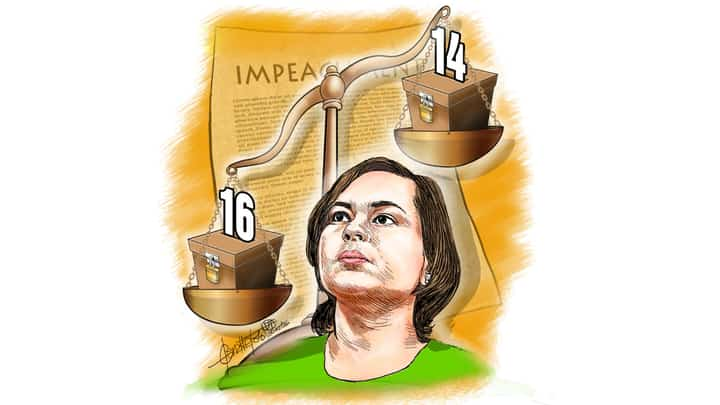
The Senate has 24 members, and two-thirds of 24 is 16. The impeachment court first set the threshold at 16 on 6 July, as soon as the trial began.
The Supreme Court (SC) has signaled it may rule on the new voting threshold in Vice President Sara Duterte’s impeachment trial, treating the issue as potentially justiciable.
The Court could have dismissed the petition outright without seeking comments, as it did on 30 September when it rejected three earlier challenges to the voting threshold.
In a resolution dated 14 October, the High Court gave the Senate, sitting as the impeachment court, and the House of Representatives a non-extendible five days to submit their respective comments.
However, it stopped short of issuing the temporary restraining order sought by the petitioners.
The move was the latest twist in the Senate court soap opera. Article XI, Section 3(6) of the 1987 Constitution says that no person shall be convicted without the concurrence of two-thirds of all the members of the Senate.
The Senate has 24 members, and two-thirds of 24 is 16. The impeachment court first set the threshold at 16 on 6 July, as soon as the trial began.
On 6 July, the first day of the trial, Presiding Officer Sen. Francis “Chiz” Escudero ruled that 16 votes, or two-thirds of the 24-member Senate, were needed to convict. No senator-judge appealed.
On 8 September, a senator-judge aligned with the Senate majority sought to overturn that ruling, arguing that four senators could not take part in the trial.
Loren Legarda is on an extended medical leave, while Rodante Marcoleta and Jinggoy Estrada are detained on plunder charges. Ronald “Bato” dela Rosa is dodging an International Criminal Court arrest warrant.
On 23 September, the court voted 13-1, with six abstentions, to count only the senators “legally and factually capable of participating,” which lowered the bar from 16 votes to 14.
In this view, “all the members” means only those who can take part when the vote is cast. The petitioners say this method removed four senators from the count. That leaves 20, and two-thirds of 20 rounds up to 14, so the bar falls from 16 votes to 14.
Senators Robin Padilla and Christopher “Bong” Go filed the petition.
Their 106-page petition for certiorari and prohibition argues that the Senate cannot change a constitutional requirement by an ordinary majority vote or an interlocutory ruling in the middle of a trial.
They also asked the Court to void any conviction that gets fewer than 16 votes while all 24 senators remain in office.
When the SC, on 30 September, dismissed the three petitions challenging the impeachment court’s reading of the two-thirds rule, it did so on the grounds of lack of legal standing and prematurity.
Padilla and Go wrote their petition to meet both. They argue that, as sitting senator-judges, they have a direct stake because the new rule changes the weight of their own votes. That is a stronger claim than a private citizen’s.
The SC has shown it will review the impeachment steps. In a 2003 ruling, it held that impeachment is not beyond judicial review because the Constitution gives courts the duty to check any grave abuse of discretion by the branches of government.
The Senate, for its part, holds the “sole power to try and decide” impeachment cases. Where one power ends and the other begins is at the heart of the dispute.
The resolution suggests that the Court sees grounds to examine the senators’ petition and has not dismissed the matter as a political question beyond judicial review.
In effect, the SC is considering whether the dispute presents a justiciable issue it can resolve by interpreting the Constitution rather than deferring to another branch of government.
The timing adds urgency. The impeachment trial is proceeding, and the Senate could vote before the Court rules, complicating matters because Vice President Sara Duterte’s fate may hinge on whether conviction requires 14 or 16 votes.