
JSCC honors Gesmundo ahead of retirement
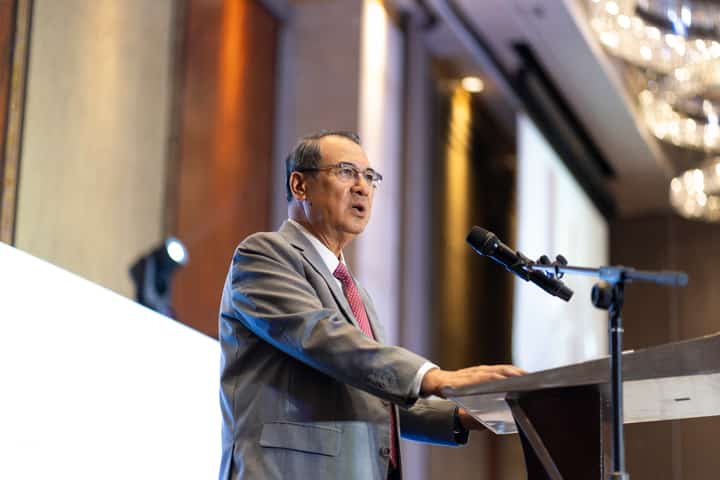
The Justice Sector Coordinating Council honored Chief Justice Alexander Gesmundo with a sculpture and video tribute during the 2026 JSCC Summit at The Manila Hotel, recognizing his leadership in advancing justice sector reforms.
The tribute was presented to Gesmundo, a JSCC co-principal, during the summit held from 21 to 22 September, his last as sitting chief justice before his retirement on 6 November.
The council presented Gesmundo with “Crystal Island,” a sculpture by veteran artist Cris Velasco depicting small houses on stilts built on a rock.
Supreme Court Chief Communications Officer Michael Jobert Navallo, who served as summit emcee, said the artwork symbolized the bayanihan spirit embodied by the JSCC, describing it as “a community built not from one individual's strength, but from the combined contributions of many.”
The Supreme Court Communications Office also prepared a video tribute highlighting Gesmundo’s efforts to bring together the Supreme Court, Department of Justice and Department of the Interior and Local Government under the shared vision of “Bayanihan Para sa Katarungan.”
The summit served as a venue for dialogue and collaboration among justice sector institutions while reviewing gains made over the past five years, including efforts to reduce court backlogs and jail congestion.
Under Gesmundo’s leadership, the JSCC’s flagship Justice Zones initiative expanded from seven areas in 2021 to 20 nationwide, strengthening coordination among justice institutions and improving access to justice in local communities.
Interior Secretary Juanito Victor Remulla, also a JSCC co-principal, described Gesmundo’s leadership as one marked by “a clear commitment to making our justice system responsive, accessible, and relevant to the needs of our people.”
“Together, we strengthened our cooperation of our justice institutions and expanded the country’s justice zones, bringing coordination and access to justice closer to our communities,” Remulla said.
“But beyond these accomplishments is a legacy of principled leadership and a lifetime devoted to the rule of law and the Filipino people.”
Justice Secretary Fredderick Vida likewise thanked Gesmundo for his contributions to the judiciary and the broader justice sector.
Vida said Gesmundo’s reform initiatives helped break institutional barriers and strengthen collaboration between the Supreme Court and DOJ.
“Your stint may now be coming to a close, but the legacy you will leave behind will definitely carve an indelible mark in the institution and the profession which you serve with outmost integrity,” Vida said.
In his keynote message, Gesmundo thanked his fellow JSCC co-principals and justice sector officials who contributed to the council’s initiatives.
“As the work of the Council continues, I hope we retain what these years have taught us: that our institutions are strongest when they are secure in their own mandates, faithful to their constitutional boundaries, yet open to understanding how their work connects with the work of others.”
Gesmundo said the administration of justice should not be viewed as the responsibility of one institution or as the sum of institutions working separately.
“It is a common endeavor, carried forward by distinct institutions, each faithful to its own constitutional role, yet conscious that the justice we seek to administer is one and indivisible,” he said.