
Phl-EU FTA: 2027 Signing Looms

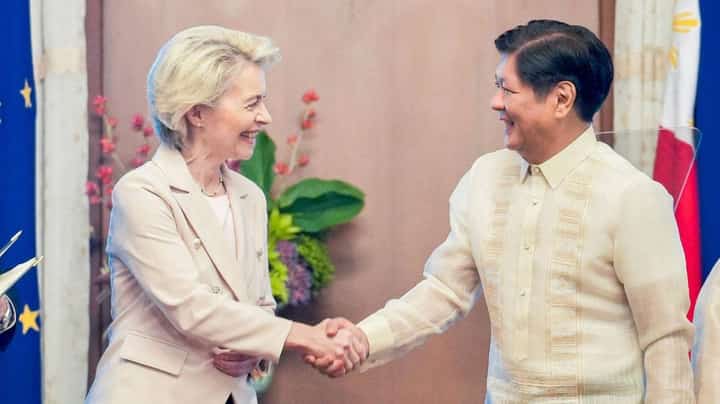
EUROPEAN Commission President Ursula von der Leyen shakes hands with President Ferdinand R. Marcos Jr. during the former’s state visit to Manila in July 2023. She was the first EU Commission president to set foot on Philippine soil. During her visit, the two leaders agreed to revive EU-Philippines Free Trade Agreement negotiations which started in late 2015 and stalled in 2017. Negotiations were resumed in 2024.
Photograph courtesy of PCO
The European Union (EU) and the Philippines have reached substantial agreement on a Free Trade Agreement (FTA), which, once sealed could benefit the country by unlocking up to $12 billion in export potential and securing long-term preferential access to a market of 450 million European consumers.
A readout of the overseas telephone conversation between European Commission President Ursula von der Leyen and President Ferdinand Marcos Jr. on Tuesday morning, indicated that an EU-Phl FTA is about to be concluded, three years after the EU head visited Manila in July 2023, when the two leaders agreed to revive the then stalled negotiations.
Positive outcome welcomed
“President von der Leyen welcomed the positive outcome and thanked the negotiating teams for their hard work and commitment, led on the EU side by Commissioner for Trade and Economic Security Maroš Šefčovič,” said the announcement posted by the EU Commission.
Malacañang, meanwhile, has yet to release a comment on the agreed FTA, a mutually beneficial agreement that could bring tangible benefits, including new opportunities for businesses, more investment and more jobs.
Landmark deal
Further, the EU Commission said the landmark deal would support shared priorities on sustainable development and clean and digital transitions.
“Given the challenging geopolitical and geo-economic context, the two leaders also underlined the importance of working with like-minded partners across the world to ensure open, fair and predictable trade,” the EU Commission statement said.
During their conversation, President von der Leyen congratulated President Marcos on the Philippines’ chairmanship of ASEAN, reaffirming the EU’s commitment to concluding similar free trade agreements across the ASEAN region.
She also noted that the deal is an important signal ahead of next year’s 50th anniversary of EU-ASEAN relations.
“The (European Commission) President looks forward to returning to the Philippines in 2027 to sign the FTA. On regional security, the President expressed the EU’s solidarity with the Philippines in the face of aggressive maritime claims and reaffirmed the EU’s continued support,” the EU said.
Responding to news regarding EU-Philippine FTA talks on the verge of conclusion, the Philippine Chamber of Commerce and Industry (PCCI) and the Federation of Philippine Industries (FPI) said the deal could expand market access, boost exports and attract investments into Philippine manufacturing.
Philippine Chamber of Commerce and Industry President Perry Ferrer said that the talks on the FTA are now on track for formal conclusion is significant milestone for the country’s trade and investment agenda after years of negotiations covering intellectual property, sustainability, labor and human rights, and environmental and carbon-emission requirements.
“We are elated with this development. Certainly, this is a meaningful feat for the Philippines as we are the third country to conclude an FTA with the EU,” Ferrer said, adding that the deal could create new opportunities for exporters, attract investments and improve the competitiveness of local industries, particularly small and medium enterprises.
“The timely ratification of the agreement will be crucial in unlocking its full benefits and ensuring that Philippine businesses can compete more effectively in the European market,” he said.
For FPI, the agreement could provide a pathway for manufacturing expansion and deeper participation in global value chains.
FPI chairperson Elizabeth H. Lee said stronger access to European markets could generate wider economic activity as increased production creates demand for transport, logistics, warehousing, packaging, utilities and local suppliers.
“Manufacturing creates powerful multiplier effects across the economy, and stronger export growth can translate into more jobs, more investments, and a more competitive industrial sector,” Lee said.
She said attracting foreign investment would be critical to turning market access into longer-term industrial gains.
“The real prize is not just market access. It is attracting the investments that create factories, transfer technology, and generate quality jobs for Filipinos,” Lee said.
Also, the German-Philippine Chamber of Commerce and Industry (GPCCI) welcomed the substantial agreement reached on the EU-Phl FTA, treated as a landmark moment for German-Philippine economic relations and the outcome German business in the Philippines has long advocated for.
“Today’s agreement is the milestone; delivering it is the goal, and German business stands ready to turn it into investments and jobs in the Philippines,” said Dr. Christian Scheld, GPCCI president. “GPCCI looks forward to its official documentation and ratification well ahead of the expiry of GSP+ in 2027, so that Philippine exporters face no gap in market access.”
Third in ASEAN with a FTA with the EU
The European Chamber of Commerce of the Philippines (ECCP) also lauded the agreement, which the organization sees as a landmark achievement that makes the Philippines only the third country in ASEAN — following Singapore and Vietnam — to conclude a bilateral free trade agreement with the European Union, cementing the nation’s status as a premier hub for European trade and investment in the Indo-Pacific.
“The successful conclusion of these negotiations is a historic first for Philippine-European economic relations,” said Dr. Diana Edralin, president of ECCP.
“After years of rigorous dialogue, we now have a world-class framework that establishes a predictable foundation for trade and investment. For the Philippines, securing this agreement as a pioneer in ASEAN demonstrates our economic resilience and readiness to compete globally.”
Beginning of a transformative chapter
“This is the beginning of a transformative chapter,” said Florian Gottein, executive director of ECCP. “European companies gain a robust, stable platform to expand their footprint in the Philippines, while Philippine exporters secure preferential access to a high-income market of nearly 450 million consumers. We now call on policymakers on both sides to maintain this strong momentum through the signing and ratification phases to unlock these opportunities as soon as possible.”
First launched in December 2015, paused in 2017, and formally resumed in March 2024, the negotiations spanned almost a decade of dedicated diplomatic and technical engagement.
The resulting modern, comprehensive deal covers critical areas including trade in goods and services, investment, government procurement, digital trade, intellectual property, trade facilitation, sustainable food systems, and trade and sustainable development.