
‘Higher calling’ behind PCO chief’s dismissal

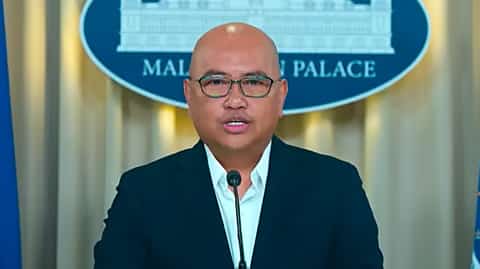
How do you ease out a Cabinet man who has outlived his usefulness and usher in a new, fair-haired political boy who can be weaponized for the 2028 elections?
The answer shocked many, especially Presidential Communications Office Secretary Dave Gomez.
First came a leak on the social media page of a former Marcos Cabinet member suggesting that newly appointed PTV-4 general manager Lino Cayetano would replace Gomez.
Media members are familiar with leaks, which are designed to fuel speculation, exactly what the Cayetano leak did — an operation of “higher calling,” according to a government source.
Hours later, President Ferdinand Marcos Jr. appeared before the Malacañang Press Corps for a “Kapihan” in Singapore, where he was asked about a Cabinet revamp.
The President confirmed the resignation of Information and Communications Technology Secretary Henry Aguda, then announced that Cayetano will replace Gomez upon their return to Manila.
“It’s just a matter of formalizing everything,” he said.
The unceremonious departure mirrored similar departures of Marcos Cabinet members, notably that of Executive Secretary Lucas Bersamin. Bersamin himself didn’t know whether he had resigned or was fired. He just learned from the media that he was no longer ES.
Cayetano, a former Taguig City mayor, will be the sixth official to head the PCO in the Marcos administration. Gomez took over in July 2025 from Jay Ruiz, who had replaced Cesar Chavez in February that year.
The latest changes followed the November 2025 departure of then ES Bersamin, which the Palace first announced as a resignation.
Palace Press Officer Claire Castro said on 17 November 2025 that Bersamin and Budget Secretary Amenah Pangandaman had resigned out of delicadeza after their offices were linked to the flood control scandal. Ralph Recto, then the finance secretary, was named to replace Bersamin.
Bersamin disputed the account two days later. “I did not resign,” he said, adding that a close friend had called him that Monday and told him he had to leave his post. He said news reports described him as resigning out of delicadeza. He also denied any involvement in the flood control controversy.
Castro later acknowledged that Malacañang had issued the resignation announcement. The Palace said it recognized Bersamin’s clarification of how his transition happened and described it as part of an administration reorganization.
Marcos made up story
In Gomez’s case, however, the reason for his departure was not even true.
First, the bicameral Commission on Appointments (CA) did not bypass him, contrary to the President’s claim.
Congress had not adjourned when the President reached that conclusion; the rules provide that an ad interim appointee is bypassed only if the CA fails to act before Congress adjourns.
And according to a reliable source, Gomez was set for a smooth sailing in the CA, if only it had convened.
Gomez did not seem to have any problems with Congress. In fact, the PCO budget passed the House plenary in five seconds.
In the last hearing of the Senate Appropriations Committee, even opposition senators praised the PCO’s performance and approved its budget with nary a question.
Even if the CA had bypassed Gomez, the President could have issued another ad interim appointment. Most past presidents followed that practice.
Gomez, a former senior reporter who covered both Congress and Malacañang and later held senior corporate communications roles in the private sector, assumed the post in July 2025.
He tried to set a standard in the PCO with his “3Ps Minus One” approach — programs and policies minus the politics.
Chucking out the influence of politics in his dealings may have been his downfall.
One of his most concrete contributions was the structured fight against disinformation. Through Oplan Kontra Fake News, the PCO partnered with the country’s nine major broadsheets, including the Daily Tribune, and coordinated with the Department of Justice and the Department of Information and Communications Technology, resulting in the establishment of an Anti-Fake News Desk.