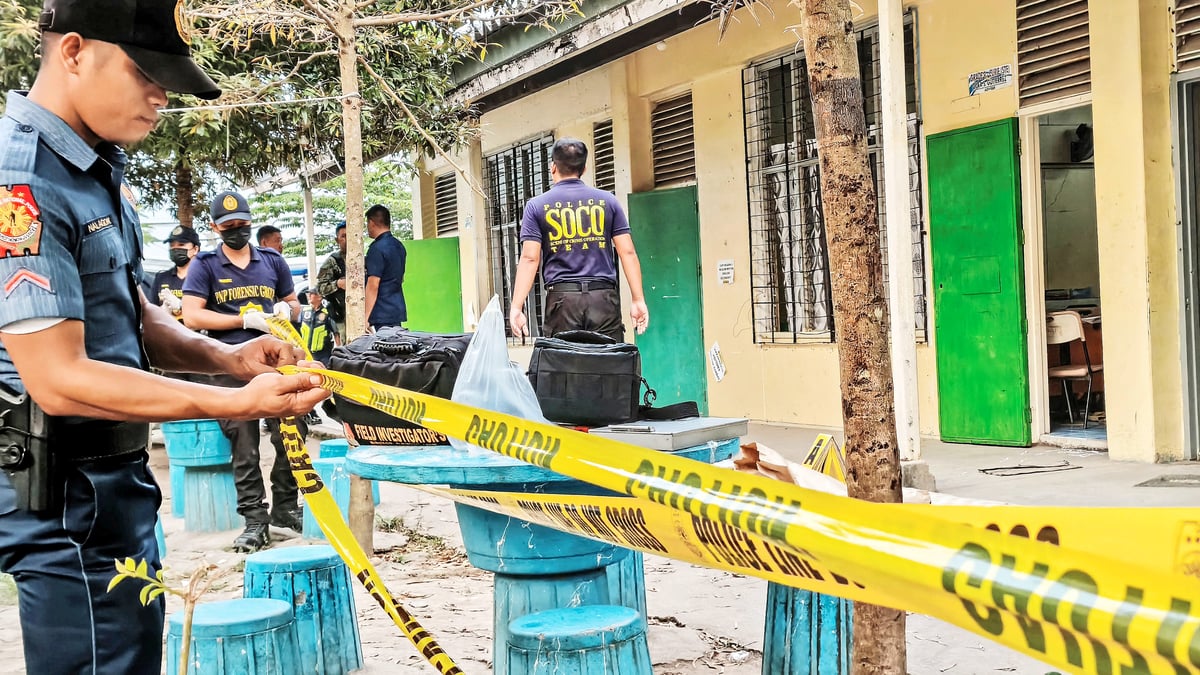
The education crisis couldn’t have gotten any worse — schools short of classrooms and basic resources, students trapped in a deepening learning crisis, and teachers overworked and underpaid — when a disturbing wave of violence broke into the very spaces meant to keep children safe, according to the Ibon Foundation study.
“The Marcos Jr. government is quick to wash its hands of state responsibility by shifting the entire blame on parents and teachers across both public and private schools,” it said.
After the shooting incident at Ateneo de Zamboanga in August, presidential spokesperson Claire Castro had remarked that the teachers themselves taught bad manners.
Teacher organizations, including the Alliance of Concerned Teachers (ACT), criticized her over her remarks. Castro clarified that she was not blaming teachers for the school violence, only reminding them of their vital role in shaping youth values.
Ibon said Castro’s remark was not only an attempt to absolve the government of responsibility but was a demeaning attack on a profession carrying the weight of a broken education system.
It said that instead of addressing the education crisis, the Marcos Jr. government is fixated on mass-producing a labor force tailored to meet global market needs.
In the process, it sidelined the broader aims of education: cultivating critical thinking, values formation, and social responsibility, Ibon said.
“The government itself is part of the crisis,” the think tank noted.
After the Banga incident, Education Secretary Sonny Angara visited the site of the tragedy and underscored the urgency of immediate care, community partnership, and proactive mental health interventions.
“No words can undo the grief and trauma felt by our families here in Banga. Our primary duty right now is care, providing real, sustained support to our learners, teachers, and personnel,” Angara said.
Angara conferred with school personnel, parents, local officials, and police to coordinate the emergency response, deploy critical psychosocial services, and address safety vulnerabilities.
He also inspected the school, attended security and teacher debriefings, visited the wakes of the victims, and checked on the wounded in hospitals.
Addressing the safety challenges, Angara noted that the Department of Education’s focus on learning leaves schools unprepared for violence, making support from local governments and communities crucial.
Counselor shortage to blame
The Alliance of Concerned Teachers quickly countered Angara and pointed to the shortage of guidance counselors as a shortcoming of the Marcos administration in the education sector.
Affected learners urgently need professional debriefing, counseling, and direct social support, not militarized drills, ACT indicated.
The group warned against the state’s knee-jerk responses, reiterating that campus militarization, deploying armed School Resource Officers, expanding intelligence surveillance, and conducting active shooter drills were poorly planned, one-sided reactions without solid scientific grounding.
“Decades of international research confirm that turning schools into checkpoints does not reduce violence; it merely turns schools into barracks, treats students as security threats, and conditions youth to accept armed authority as a normal learning environment,” ACT said in a statement.
“Let us not blame the teachers or video games for this tragedy just to cover up the government’s negligence. We desperately need guidance counselors and mental health and psychosocial programs, but where are they? Instead, drills and the deployment of police officers — who are themselves known for perpetrating violence — are being prioritized,” ACT Philippines chairperson Ruby Bernardo said.
The group stressed that the prevalence of school violence cannot be separated from the chronic neglect the education sector faces. The state offloads the burden of school safety onto the students, teachers, and parents as a matter of individual discipline rather than fulfilling its public obligation, it said.
Under its 2026 budget, the DepEd created 10,000 School Counselor Associate I positions, translating to roughly one counselor associate for every 2,600 learners nationwide.
ACT also called for an investigation into how minors involved in school shootings were able to access firearms through family members serving in government, as reported in South Cotabato, where the firearm used belonged to a local government employee.
“Violence in schools is not an isolated issue; it is a manifestation of the deepening crisis in our society, in the economic, political, and cultural spheres. This crisis will persist as long as state repression and violence, widespread poverty, and an education system that serves foreign interests rather than the people remain in place,” Bernardo said.