
Marcoleta rejects threshold vote plan

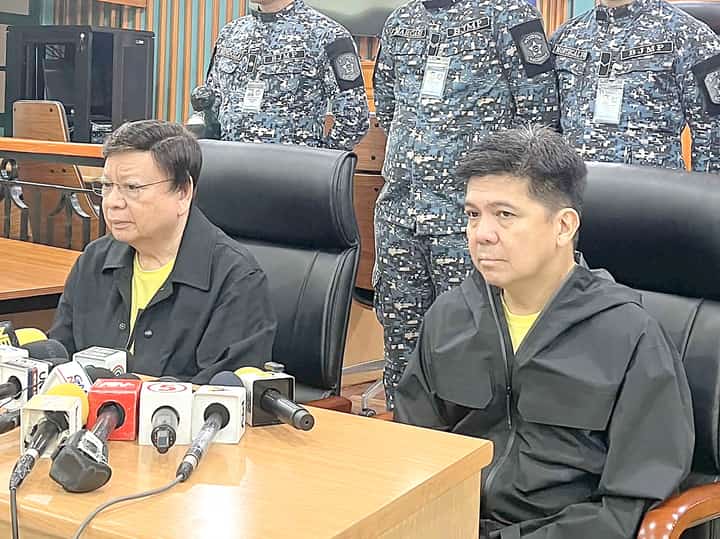
UNDER guard Senator Rodante Marcoleta (left), wearing a yellow persons deprived of liberty shirt beneath a black jacket, faces the press at the Sandiganbayan on Thursday. Beside him is former congressman Mike Defensor, his co-accused in a plunder case involving campaign donations.
Photograph by Jerod Orcullo for DAILY TRIBUNE
Senator Rodante Marcoleta on Thursday questioned the Senate impeachment court’s decision to revisit the constitutional threshold for convicting an impeached official, saying the matter should not be subject to a vote.
“Why should it be a subject of votation? Are you questioning the language of the Constitution?” Marcoleta said Thursday during a press conference at the Sandiganbayan.
He said he had no intention of seeking furlough to participate in the pending deliberations, maintaining that Article XI, Section 3(6) of the 1987 Constitution clearly requires the concurrence of two-thirds of all 24 senators.
“The Constitution says that nobody should be judged guilty without the concurrence of two-thirds of all the members of the Senate. That’s it. It is as simple as that,” he said.
The Senate impeachment court is reviewing the initial ruling of presiding officer Sen. Francis “Chiz” Escudero that 16 affirmative votes would be sufficient to convict Vice President Sara Duterte, based on the Supreme Court ruling in Bayan v Zamora.
The four articles of impeachment against Duterte accuse her of misusing confidential funds, bribery, unexplained wealth and making death threats against President Ferdinand Marcos Jr., First Lady Liza Araneta-Marcos and then-House Speaker Martin Romualdez.
On 16 September, the Senate heard arguments from four retired Supreme Court justices invited as amici curiae, or friends of the court, on the interpretation of the constitutional provision.
Retired Chief Justices Reynato Puno, Hilario Davide Jr. and Artemio Panganiban agreed that fewer than 16 votes can convict Vice President Sara Duterte, while retired Associate Justice Adolf Azcuna, one of the framers of the 1987 Constitution, said the denominator should be the full 24.
21 only
After hearing the amici curiae and the prosecution and defense, Escudero said the Senate would rule on the matter on 23 September.
Also on Thursday, retired Supreme Court Associate Justice Antonio Carpio said only 21 senator-judges are currently qualified to vote.
Carpio said senators who are detained, suspended or have not taken their oath should not be included in the denominator for computing the two-thirds vote required to convict an impeached official.
“When you die or you were removed or you are suspended because you are charged before the Sandiganbayan for anti-graft or anti-plunder acts, you are automatically suspended,” he said.
He said the Supreme Court had ruled that an official under preventive suspension for a non-bailable offense cannot hold public office during the suspension.
Carpio cited Senators Marcoleta and Jinggoy Estrada, who are detained in connection with separate plunder cases, as examples of lawmakers who cannot perform their senatorial duties.
‘Slippery slope’
Marcoleta is detained over a P75-million plunder case, while Estrada faces a P573-million plunder charge.
Senator Ronald “Bato” dela Rosa, meanwhile, has not been seen in public since leaving the Senate premises on 14 May after authorities attempted to serve him with an International Criminal Court warrant.
Meanwhile, lawyer, political analyst and DAILY TRIBUNE columnist Edward Chico said the provision should be applied according to its plain meaning, warning that changing the threshold could create a “slippery slope.”
“Honestly, when we lawyers talk among ourselves, without politics, it is clear to us what two-thirds means. Under the plain meaning rule, if the law is clear, you simply apply it,” Chico said.
He said the threshold had become an issue only because the Senate, or those itching to convict Duterte, cannot seem to secure the 16 votes required under the all-members provision.
Changing the calculation for one proceeding, he said, could have implications for other constitutional provisions requiring a two-thirds vote, including the provision on calling a constitutional convention.
“There are many provisions in the Constitution allowing for two-thirds votes,” Chico said.
He also warned that lowering the threshold based on the number of participating senators could encourage political actors to manipulate participation in impeachment proceedings.
Voting eligibility
“Have you considered that if you insist on those 16 votes, the government could simply prevent nine senators from participating, leaving only 15? Then the impeachable officer would not be convicted,” he said.
For his part, University of St. La Salle vice chancellor Ralph Sarmiento, a lawyer and former law dean, had a different interpretation, distinguishing Senate membership from eligibility to vote in a particular proceeding.
“Respectfully, the three former chief justices may have missed the real question. The issue is not whether a senator who was absent or failed to participate may still vote,” Sarmiento said in a social media post.
He argued that a senator disqualified from voting may remain a member of the Senate. Since the Constitution refers to “all the members of the Senate,” he said, voting eligibility does not necessarily alter the denominator.
“Eligibility to vote is one question. Membership is another. The former does not, by itself, change the denominator or lower the constitutional voting threshold,” Sarmiento said.