
China’s decades-long indoctrination drive targets Filipinos
Powell cited two programs involving the Philippine Chinese Education Research Center which he called the Blood Transfusion Plan and the Blood Generation Plan.

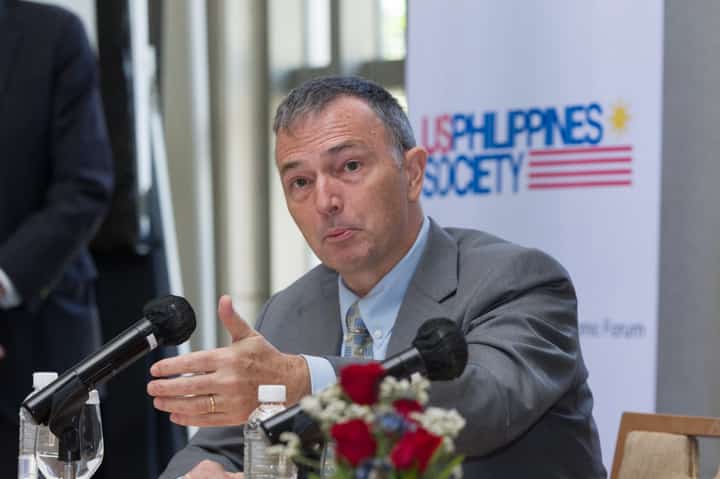
Chinese-language schools and teacher-training programs in the Philippines have become channels for Beijing to promote its political narratives, including its position on territorial disputes and maritime security, according to a maritime security analyst.
Ray Powell, director of the SeaLight Foundation, said the issue gained urgency after scholars from China’s Jinan University took part in a June symposium where they argued that Batanes was a natural geographic extension of Taiwan and should be under Chinese sovereignty.
The National Historical Commission of the Philippines rejected the claim, while Defense Secretary Gilberto Teodoro called it disinformation.
Speaking in an interview on DAILY TRIBUNE’s Straight Talk program, Powell said Beijing had spent years building ties with Chinese-language schools and institutions in the Philippines, many of which were historically more closely aligned with Taiwan.
“When you look into a lot of these influence operations, in Chinese language education, for example, in Manila, almost all Chinese language schools have, to a degree, fallen under foreign influence,” Powell said.
“Beijing has expended years of efforts and many, many resources to make sure that they all now sort of answer back to Beijing,” he added.
A SeaLight report identified China’s Jinan University as a major training ground for Chinese-language teachers working in Chinese-Filipino schools in the Philippines.
‘Blood plans’
Powell cited two programs involving the Philippine Chinese Education Research Center (PCERC), which he called the “Blood Transfusion Plan” and the “Blood Generation Plan.”
According to SeaLight, the Blood Transfusion program began in 1991 and brought thousands of mainland Chinese teachers to the Philippines to work in Chinese-language schools.
A subsequent Blood Generation program sent Filipino-Chinese students to Chinese universities for teacher training, with graduates expected to return to the Philippines.
“These people are not doing anything treasonous. They’re taking advantage of an opportunity,” Powell said, stressing that participation in such programs did not mean the individuals were knowingly engaging in espionage or other illegal activities.
But he said the programs could serve a broader political purpose than language instruction.
“China does not bring all of these people to China just to teach them Chinese characters and culture. They are trying to indoctrinate them to a certain degree so that they understand China’s perspective and can teach young children in the Philippines that same perspective,” Powell noted.
Foreign influence
SeaLight alleged that Chinese Communist Party-linked organizations have become intermediaries between Chinese institutions and Chinese-language schools in the Philippines, including in teacher training, language testing, and curriculum development.
The organization has also identified the PCERC as having links to Chinese government and Communist Party institutions. The foundation has reported that the center worked with Chinese ministries and the United Front Work Department, a Communist Party body responsible for building influence among groups outside the party.
The Philippines’ Department of National Defense (DND) said the government’s review of foreign-funded educational programs was aimed at guarding against foreign influence and interference, rather than targeting the Chinese-Filipino community.
The DND subsequently said that greater transparency over foreign state funding and academic partnerships was necessary to protect both local education and national security.
Jinan University and Chinese officials have disputed the Philippine government’s characterization of China-linked academic exchanges. In July, a Jinan academic said Philippine authorities were stretching national security concerns too far and treating Chinese-language education as a security risk without sufficient evidence.
Warning vs conflation
For Powell, the concern extends beyond what students learn in language classes to the networks through which teachers, educational institutions and Chinese organizations interact.
“Most of the information about these events, about these groups are taking place in Chinese and most Filipinos don’t speak Chinese,” he said.
Powell said SeaLight has been examining Chinese-language websites, newspapers, and organizations to map what it considers Beijing’s influence activities in the Philippines.
He said the Jinan controversy illustrated why Manila should examine Chinese-language education as part of a broader information environment rather than as an isolated cultural activity.
At the same time, he warned against conflating or confusing Chinese-Filipino communities with the Chinese state.
“The last thing anybody should want is for Chinese-Filipinos to be stigmatized and to be treated as if they were the enemy. Most of them, I’m quite certain, are loyal and patriotic Filipinos. They are the target of a major, superpower-led influence operation that wants to change their minds and bring them on the team,” Powell said.