
Sixteen, or however many are left
This country does not suffer from a shortage of accusations against its officials — for plunder, unexplained wealth, bribery, and worse. It suffers from the public’s near-total loss of confidence.

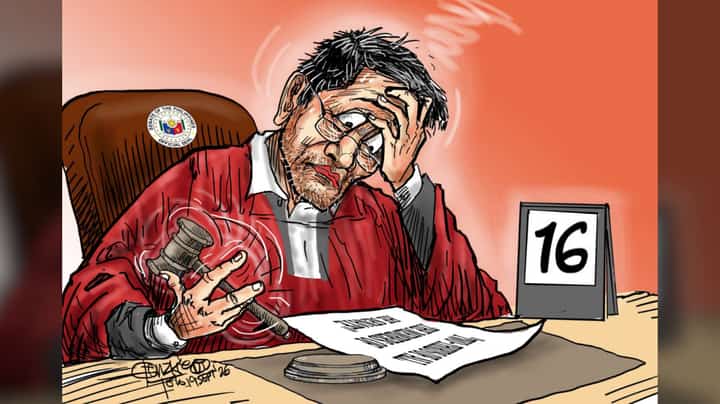
For three days the Senate impeachment court has argued less about Sara Duterte’s guilt than about arithmetic. It is a peculiar spectacle: four former justices, robes long since retired, summoned back to referee a dispute over what “two-thirds” means when a chamber is not a whole.
Former Chief Justices Artemio Panganiban, Reynato Puno, and Hilario Davide Jr. — the last in a memorandum, having recently undergone a medical procedure — largely agreed that the Constitution’s phrase “two-thirds of all the members of the Senate” cannot be frozen at 16 votes out of 24 when several senators are incapable of sitting in judgment.
Two are in jail for plunder. One is a fugitive wanted for mass murder. One is on an extended medical leave. Davide’s reasoning was the most surgical: the framers never debated this scenario so the denominator should be based on those actually able to sit as judges, not the roster on paper.
Panganiban went further, arguing that a senator who has not participated in “the search for evidence and truth” that the trial demands has no claim to being counted at all.
Only Azcuna dissented, and his dissent deserves more than a footnote. A threshold that moves with attendance, he warned, is a threshold that can be engineered — to pad the absences, shrink the denominator, manufacture a conviction.
“It must be determinable from the start,” he said, not negotiated mid-trial. That is not a small objection. It is the difference between a constitutional rule and a political convenience.
Will this speed things up? Almost certainly, yes — but not because the law has been settled. It hasn’t.
The amici were unambiguous that the final call belongs to the senator-judges. What the four justices did was hand the impeachment court intellectual cover to move. If a majority of senators wants to rule that only 20 (or 19, or however many) qualified members set the baseline, they now have three eminent, ideologically varied legal minds to cite.
That lowers the bar for conviction from 16 to something like 13 or 14 — a number close enough for whatever bloc is leaning toward finding the Vice President guilty.
Whether the senator-judges heed this is a question on what kind of institution the Senate wants to be remembered by. An impeachment is supposed to be the Constitution’s most solemn check — deliberately hard to trigger, deliberately hard to complete, precisely so it isn’t wielded as a tool of factional convenience.
If the threshold is refashioned mid-proceeding to fit the votes already in the room, even a legally defensible reading will look, to much of the public, like a scoreboard changed at halftime.
Azcuna’s warning about manipulation is not paranoia; it is the whole point of having a fixed rule in the first place.
And that is the larger stake here, beyond Sara Duterte’s fate.
This country does not suffer from a shortage of accusations against its officials — of plunder, unexplained wealth, bribery, and worse.
It suffers from the public’s near-total loss of confidence that accountability, when it comes, comes because the rules were followed rather than because the numbers finally lined up.
The senator-judges’ actual obligation — to the Constitution, to their constituents, to a country that has watched institution after institution bend to whoever holds the pen — is to resolve this question on its legal merits, publish their reasoning, and get back to the evidence.
The Philippines does not need a faster verdict. It needs one that will survive scrutiny long after the gavel falls.