
Straight from the source
The trial concentrates the roles of accuser, prosecutor and judge in one branch at once, and the Constitution answered with an internal check: no faction, however dominant, could convict alone.

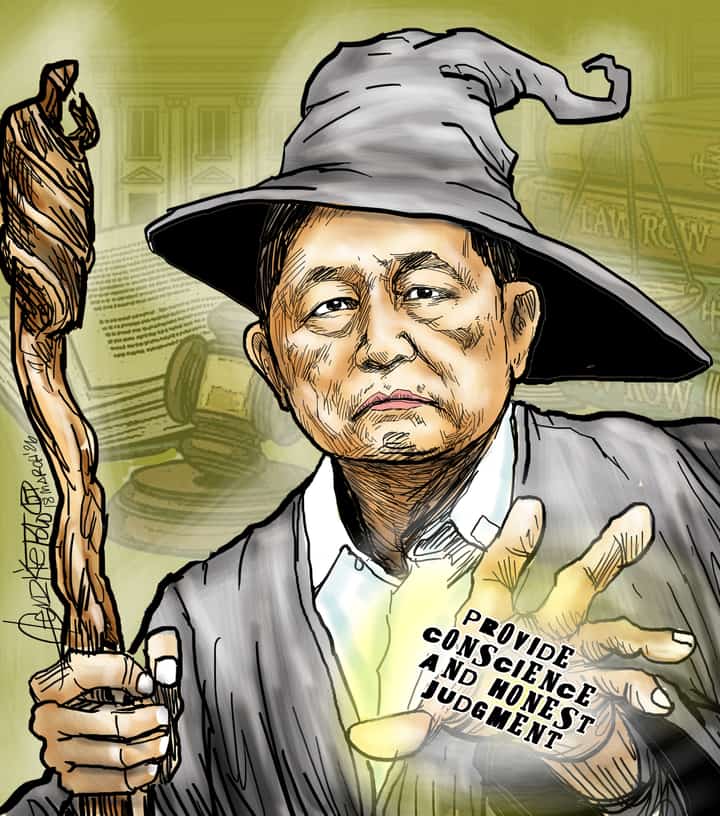
Retired Associate Justice Adolfo Azcuna is not merely one of the four jurists the Senate impeachment court consulted as an amicus curiae. As a member of the 1986 Constitutional Commission, he helped draft the provision now at the center of dispute.
The Senate court invited retired Chief Justices Reynato S. Puno, Artemio V. Panganiban and Hilario G. Davide Jr., along with Azcuna, to give their views on the required voting threshold amid the dwindling number of senator-judges.
At the heart of the debate is Article XI, or “Accountability of Public Officers,” whose crucial voting provision could determine the outcome of the Senate court’s proceedings.
The question before the Senate is whether the Constitution’s requirement of a two-thirds vote of all Senate members can be interpreted as two-thirds of those present.
While the other amici brought scholarship and the accumulated wisdom of careers spent interpreting laws others had written, Azcuna offered a view that made sense as to what the framers meant when they chose one word over another.
When the Supreme Court itself recently needed to settle what the word “forthwith” was meant to convey, it turned to Azcuna, quoting him directly and accepting his explanation that the term meant “immediately and without reasonable delay,” or, in the framers’ own tongue, “agad-agad.”
So when Azcuna turned, before the senator-judges, to the question of what “all the members of the Senate” means for purposes of the two-thirds conviction threshold, he was applying the same interpretive method the Court had already certified.
Because the denominator, he argued, must be fixed and not fluid. It must be the Senate’s full membership of 24, undiminished by absence, incapacity, or abstention and reduced only by death, resignation, or removal. The threshold cannot be allowed to shrink simply because fewer senators show up to vote.
A supermajority requirement is meant to shield against factional capture. The safeguard would collapse, under the pressure of mere attendance, into the very simple majority it was designed to prevent.
With 20 sitting senator-judges, a two-thirds vote would require 13 or 14 votes.
The supermajority requirement is intended to ensure sound judgment, or the closest approximation possible, because an impeachment conviction is irreversible and effectively overturns a decision the electorate already made.
The trial concentrates the roles of accuser, prosecutor and judge in one branch at once, and the Constitution answered with an internal check: no faction, however dominant, could convict alone.
Azcuna said the 1935 Constitution’s quorum interpretation, invoked by petitioners through Avelino v. Cuenco, spoke only of a “majority of the Senate” rather than “all the members,” which was specific in the provision he helped craft.
Azcuna dismissed its relevance outright, holding that a case interpreting one phrase under one Charter cannot govern a different phrase under another.
Whether a senator-judge who missed hearings may still cast a vote, Azcuna called it an internal matter for the Senate to resolve using its wisdom.
But even there, his personal inclination leaned toward inclusion, provided conscience and the written record could sustain an honest judgment.
After all, he noted, it is a tribunal of record, with its testimony preserved precisely for such a contingency.
What the Senate heard was the drafter of the accountability clause interpreting his own handiwork, under oath, in the very proceeding for which that clause was written.
For that reason, his interpretation carried extraordinary weight in the dilemma confronting a trial already under scrutiny over maneuvers allegedly aimed at rigging the vote.