
Luzon Economic Corridor draws global investment interest
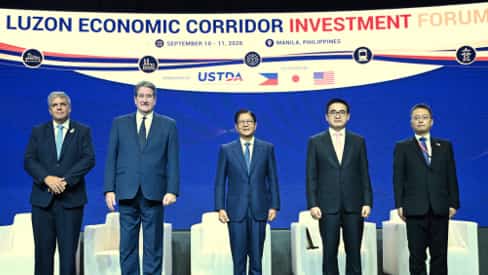
More than 600 investors, business leaders and government officials gathered in Manila for the first Luzon Economic Corridor (LEC) Investment Forum, highlighting growing international interest in projects spanning transportation, energy, digital infrastructure and advanced manufacturing.
The forum, held on 10 September 2026, was hosted by the governments of the Philippines, the United States and Japan as part of efforts to mobilize private capital and expand commercial partnerships along the corridor.
The LEC stretches from Subic Bay and Clark through Manila to Batangas, covering an economic area that accounts for about half of the Philippines’ gross domestic product.
The partnership aims to improve connectivity, strengthen supply chains and create jobs by coordinating investments in major infrastructure and industrial sectors.
Philippine President Ferdinand R. Marcos Jr., Finance Secretary Frederick D. Go, Japanese Chargé d’affaires ad interim Minister ONO Sho, US Ambassador Lee Lipton and United States Trade and Development Agency Deputy Director and Chief Operating Officer Thomas Hardy attended the forum.
The event also showcased investment opportunities and brought together stakeholders from the public and private sectors as the corridor seeks to attract more international participation.
Beyond its original Philippine-US-Japan framework, the LEC has expanded to include Australia, Canada, Denmark, France, Italy, South Korea, Sweden, the United Kingdom, the European Union and Spain.
Ono said broader stakeholder engagement would help deepen understanding of the corridor’s potential and encourage greater participation in its development. He also stressed the importance of ensuring the smooth progress of existing businesses as a foundation for further investment promotion.
The LEC is aligned with Japan’s “Free and Open Indo-Pacific” initiative, which promotes high-quality investment anchored on sustainability and the rule of law.
The three core partners reaffirmed their commitment to work with other participating countries to accelerate economic growth and improve connectivity across Luzon.