
Devotion in motion in Naga City: Pagbalyo ki Inâ and the Traslación during the Festivities of El Divino Rostro and Our Lady of Peñafrancia
The intertwined feasts draw hundreds of thousands into a centuries-old expression of communal faith, carrying Bicol’s enduring devotion from city streets to cathedral and river.
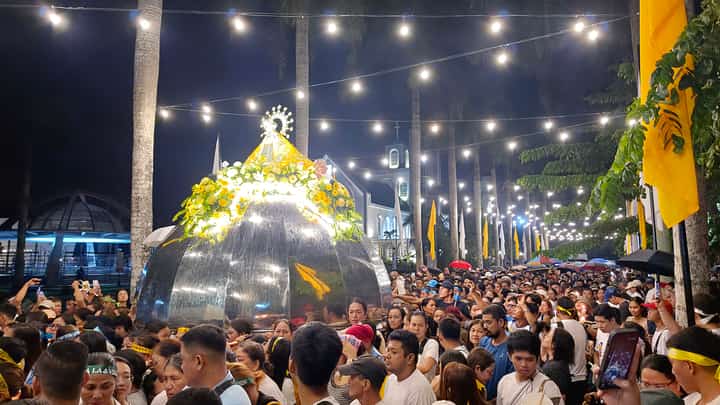
DAWN procession, Pagbyalyo ki Inâ, transferring the image from the Minor Basilica to the Old Shrine.
Photographs by Roel Hoang Manipon for DAILY TRIBUNE
Rain came and went over Naga City, widely recognized as the economic and educational hub of the Bicol Region in southern Luzon, but the multitude kept moving. Barefoot voyadores pressed around the andas, pilgrims prayed the rosary, bands played hymns, and white handkerchiefs fluttered above a sea of yellow. Some voyadores — the usually male and barefoot devotees — clambered up toward the sacred images, hoping to touch them or grasp a flower from their adornments. Along the route, the cries rose again and again: “Viva El Divino Rostro!” and “Viva la Virgen!”
On 11 September, the sacred images of El Divino Rostro and Our Lady of Peñafrancia — the patroness of Bicol affectionately called Inâ (mother) — were borne from the Our Lady of Peñafrancia Parish Church, popularly called Old Shrine, along Peñafrancia Avenue to the Naga Metropolitan Cathedral. The Emergency Operations Center–Incident Management Team estimated the Traslación procession crowd at 820,000, filling the streets along the route and spilling into the cathedral grounds and the adjoining roads of Elias Angeles and Jorge Barlin.
The procession joined two devotions in one powerful movement. It brought the Feast of El Divino Rostro to its culmination while opening the nine-day novena to Our Lady of Peñafrancia. At the cathedral, thousands raised candles and waved handkerchiefs to welcome Inâ after the hours-long journey. In the days that followed, devotees formed long lines for the chance to approach and touch her image.
Yet the day’s movement had begun long before noon. At around four in the morning, while much of the city remained in darkness, thousands accompanied Inâ from her permanent home at the Minor Basilica and National Shrine of Our Lady of Peñafrancia to the Old Shrine. This quieter procession is known as Pagbalyo ki Inâ.
At the Old Shrine, she was reunited with El Divino Rostro, whose novena had concluded the previous day. Father Jene Lois Sarmiento, assistant rector of the basilica, celebrated the send-off Mass and led the procession. Archbishop of Cáceres Rex Andrew C. Alarcon received the image and presided over the Mass for the Feast of El Divino Rostro with the parish clergy. Hours later, the two images left together for the cathedral in the Traslación.
THE dawn Mass at the Minor Basilica and National Shrine of Our Lady of Peñafrancia.
ANDAS carrying Our Lady of Peñafrancia moving through crowds during the Traslacion procession.
THE image of El Divino Rostro being brought out of the Old Shrine to join Our Lady of Peñafrancia in preparation for the Traslacion procession.
THE Porta Mariae, a triumphal arch outside the Naga Metropolitan Cathedral that honors 300 years of devotion to Our Lady of Peñafrancia.
IMAGE of Our Lady of Peñafrancia, the patroness of Bicol Region.
The sequence gives the festivities their distinctive shape: the Holy Face of Christ and his Mother are not celebrated as separate endpoints but encountered together along a common road. Archbishop Alarcon described true devotion as directed beyond the self — toward the beloved, the community and, above all, God. Bishop of Daet Herman G. Abcede, who presided over the Mass before the Traslación, placed that message in the language of the present: “We are always connected, but we are not always in communion.”
That understanding is embodied in this year’s theme, “Inâ: Nurturing a Growing Church.” It presents Inâ not simply as the object of devotion but as a mother guiding the Church toward deeper communion, participation, and mission. Growth, in this sense, is measured not only by the size of the crowds but by the willingness of every believer to belong, assume responsibility, and make room for others. During the processions, the theme became visible as clergy, voyadores, families, organizations, and pilgrims moved together as parts of one living Church.
The devotion to Our Lady of Peñafrancia began far from Bicol. Its Spanish tradition tells of Simón Vela finding an image of the Virgin and Child on Peña de Francia in Salamanca. In Nueva Cáceres, now Naga, the devotion took root around 1710 through Father Miguel Robles de Covarrubias. Drawing from a small holy picture he carried, he commissioned a local artisan to carve an image and had a chapel built for it. The devotion grew among the people, who came to regard Mary as Inâ, their mother and refuge.
The bond with El Divino Rostro emerged during a time of calamity. In 1882, when cholera struck Nueva Cáceres, Father Pedro de la Torre brought his image of the Holy Face of Jesus to the cathedral, while Bishop Casimiro Herrera called for the image of Our Lady of Peñafrancia. According to the Archdiocese of Cáceres, this was the first time Bicolanos prayed before the two images together. After the epidemic passed, church leaders and the faithful fulfilled a vow to honor them in linked celebrations — the Feast of El Divino Rostro every second Friday of September and the Solemnity of Our Lady of Peñafrancia every third Sunday of September.
Continuing that remembrance of fear answered by prayer, relief, and gratitude, the 2026 observance commemorates the 144th Feast of El Divino Rostro, which falls on 11 September, and the 316th Solemnity of Our Lady of Peñafrancia, which falls on 20 September.
The celebrations opened on 1 September with the Pagbalyo ki El Divino Rostro procession from the basilica to the Old Shrine, followed by its novena from 2 to 10 September. Harubay, a motorcade and pilgrimage of religious organizations, helped sound the opening note of the wider celebration.
After the Traslación, novena Masses for Inâ continue at the cathedral through 19 September, accompanied by religious, civic and cultural events across the city. This year also carries special meaning for the Archdiocese of Cáceres, which celebrates its diamond jubilee on 17 September.
On the afternoon of 19 September, during the bisperas, the much-anticipated fluvial procession will bear the two images along the Naga River and return Inâ to her basilica.
The festivities culminate in the Solemnity of Our Lady of Peñafrancia on 20 September.
Between those two great processions — the Traslación by road and the homeward journey by river — the city becomes a vast devotional landscape. Its streets, churches and waters receive generations of prayers. The handkerchiefs, candles, bare feet and rain-wet faces reveal why these interconnected feasts remain among the country’s largest Catholic gatherings: faith here is not held still. It walks, surges, waits and returns home.