
MVNP records rare leucistic Philippine Duck in Lake Malagsum

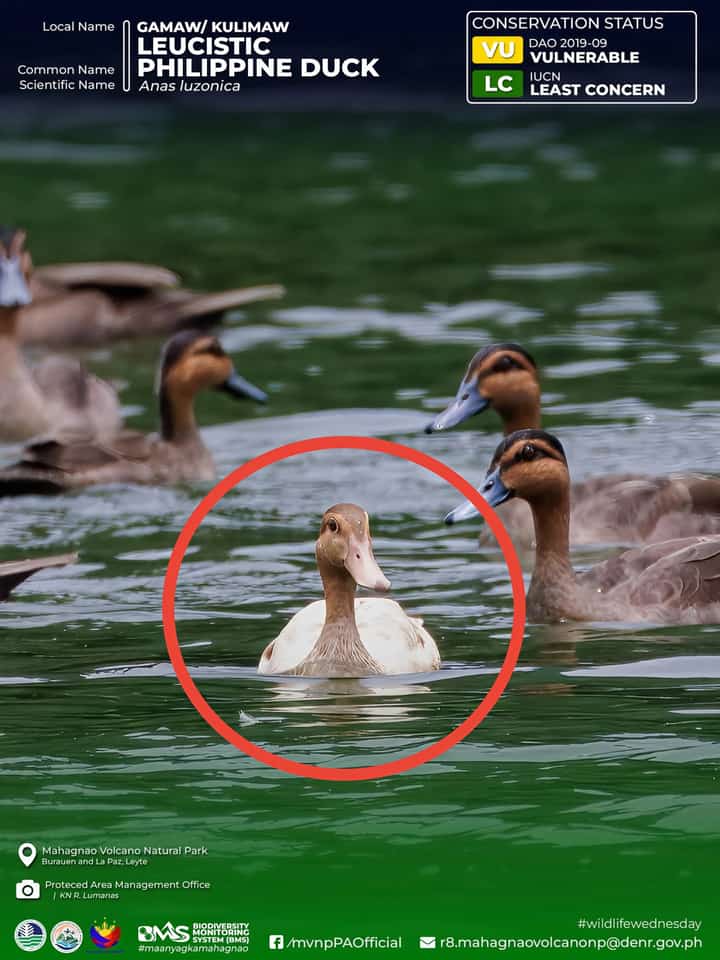
The Biodiversity Monitoring Team of the Protected Area Management Office of Mahagnao Volcano Natural Park (MVNP) has recorded a rare leucistic Philippine Duck (Anas luzonica) in Lake Malagsum in Leyte during the regular patrolling of the Protected Area Rangers.
According to the MVNP, "Leucistic means having reduced pigmentation that causes unusually pale or white feathers, but not complete albinism. This rare sighting is significant as it adds to our biodiversity records and highlights MVNP as a safe habitat for threatened and unique wildlife."
Leucism is a genetic condition that causes partial or total loss of pigmentation, resulting in unusually pale, white, or patchy feathers.
The difference between albinism and leucism is that leucism is not the complete absence of melanin, and the animal does not have pink or red eyes found in albinos.
Normal individuals have a cinnamon-colored head, a dark eye stripe, a bluish-grey bill, a grayish-brown body, and a bright iridescent green or blue-purple wing patch called a speculum.
Under DENR Administrative Order No. 2019-09, the Philippine Duck (Anas luzonica) is officially classified as a Vulnerable species. Under Section 28 paragraph (c) of Republic Act No. 9147 or the Wildlife Resources Conservation and Protection Act, the killing or destroying a Vulnerable species carries a penalty of imprisonment of two (2) years and one (1) day to four (4) years and a fine of ₱30,000 to ₱300,000. Under Section 28 for illegal acts under paragraphs (f) and (g), the following penalties/fines shall be imposed; For hunting, capturing, or possessing, the penalty is (6) months and one (1) day to two (2) years imprisonment and a fine of ₱10,000 to ₱100,000, if inflicted or undertaken against vulnerable species.
"Let this be a reminder that conservation efforts truly matter - every species, even the rare ones, deserves protection," MVNP stated.