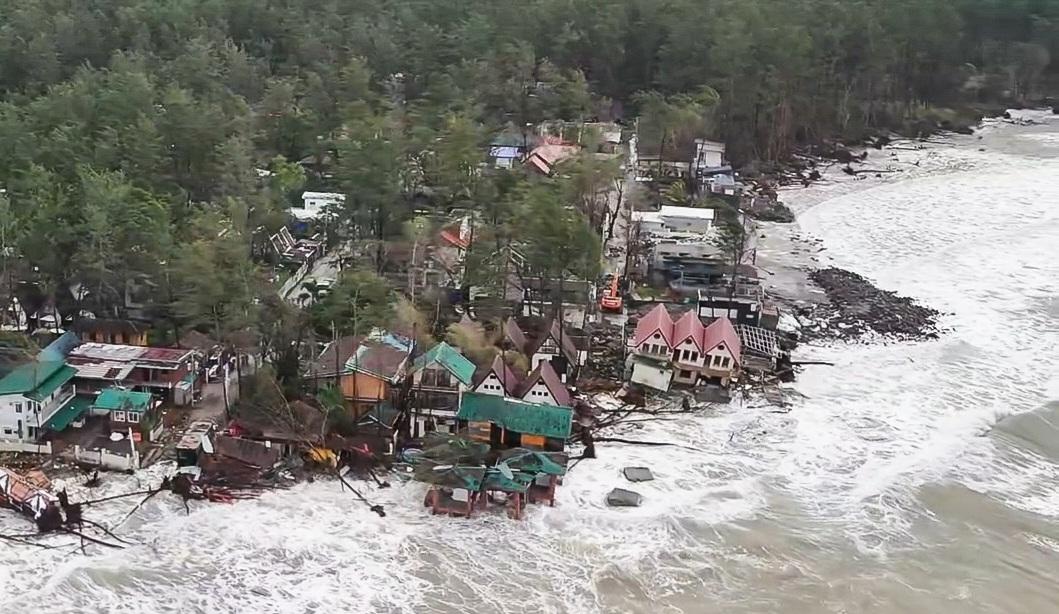
The sea has long been a part of life in Liwliwa, San Felipe, Zambales. But along portions of the province’s coast, the familiar boundary between land and sea appears to be shifting.
A resort in Barangay Liwliwa has raised the alarm over the worsening coastal erosion, which it attributes to large-scale sand dredging operations in the province.
The resort recently posted a video on social media appealing to residents, tourists, and environmental advocates to help protect what remains of Liwliwa’s coastline.
In an exclusive interview with DAILY TRIBUNE via Messenger on Tuesday, the resort said portions of its property had gradually collapsed over the last two months, with the erosion beginning in the first week of July.
A concrete seawall that once stood several meters from the high-tide line is now crumbling into the surf, while palm trees have toppled into the sea.
“[It is the] sand dredging. Before, no matter how many typhoons passed through, not a single tree would fall,” the resort said.
It claimed that about 12 dredging vessels operate in the area at a time, with another batch replacing them after they left.
“This year, almost 12 ships were dredging. After the 12 ships left, they were replaced by another 12. That is why the sand is disappearing so quickly, which has resulted in the coastal erosion,” it said.
The resort also questioned why private establishments had to shoulder the cost of materials to reinforce their properties while the provincial government, through its Provincial Engineering Office, provided equipment and machinery.
“It’s a government project so it should be funded by the government. But resort owners are the ones buying the armor rock, sand and cement,” it said.
Citing Philippine Ports Authority data, the Zambales Ecological Network (ZEN) said 57.8-million metric tons of sand had been dredged from the mouth of the Santo Tomas River as of 31 July.
The figure, it said, was far higher than the provincial government’s reported 4.8-million cubic meters, which ZEN estimated would translate to roughly seven to eight million metric tons based on the DPWH Master Dredging Plan.
Sand is disappearing
ZEN, a community-based nongovernment environmental organization in Zambales, has called for a House investigation into the effects of the sand extraction in the province, amid reports of coastal erosion and a recent lahar-related flooding incident in Barangay Santa Fe, San Marcelino.
In a statement Tuesday, ZEN said the authorities should determine whether the large-scale extraction from the Santo Tomas River estuary was affecting the broader river and coastal system.
The government described the activity as a river rehabilitation under Department Administrative Order 2019-13, a 2019 Department of Environment and Natural Resources (DENR) order covering the large-scale dredging of heavily silted rivers.
“For years, the focus appears to have been on how much sand could be extracted and where it could be delivered, including for major projects associated with the Manila Bay reclamation and the Bulacan International Airport,” ZEN said.
“The question that should have come first was: What happens to Zambales when we remove that sediment?” the group said.
ZEN said the consequences are becoming increasingly visible, pointing to the coastal erosion, damage to communities and tourism establishments, and the recent lahar-laden flooding that destroyed a bridge and isolated the residents of Santa Fe.
It also questioned whether the dredging activities at the Santo Tomas and Bucao river mouths might have been connected to the disaster.
ZEN cited United States Geological Survey researchers who studied the aftermath of the 1991 Mount Pinatubo eruption and documented extensive sediment movement through the Santo Tomas-Marella river system, including river aggradation, channel blockage, and shifting flow paths.
The group said the Philippine Institute of Volcanology and Seismology (Phivolcs) has warned that substantial volcanic deposits remain in the watershed and could still be remobilized by intense rainfall, potentially generating lahar downstream.
ZEN said this makes the lack of a comprehensive sediment budget and cumulative-impact assessment of large-scale estuarine dredging particularly concerning.
River a living system
It urged the DENR and the provincial government to stop treating the sand as merely a commodity but instead consider the river a “living system.”
The group questioned the lack of a complete sediment budget, before-and-after bathymetric surveys, wave and sediment-transport modeling, and cumulative-impact assessments.
“If the extraction was driven primarily by the demand for construction and reclamation materials in Manila and Bulacan, then the people of Zambales deserve to know why they should bear the ecological risks while others receive the benefits,” ZEN said, stressing that “Zambales is not the sand quarry of Manila.”
ZEN called for an independent scientific investigation and the suspension of further large-scale extraction until the cumulative impacts of the Santo Tomas dredging are established.
DENR: No vessels in eroding area
DENR Zambales, however, said its monitoring found no dredging vessels near Sitio Tektek in Barangay Sindol, San Felipe, where the shoreline was reportedly eroding near homes.
DENR Zambales Provincial Environment and Natural Resources Officer Marife Castillo told DAILY TRIBUNE Tuesday that dredging vessels had been monitored only in designated zones in Bucao, Botolan, and the Santo Tomas River area draining toward Macolcol or Santo Niño in San Felipe.
“We have daily monitoring. There are no dredging vessels along that area. The dredging vessels were only found in Bucao, Botolan, and the Santo Tomas River draining into Macolcol or Santo Niño, San Felipe, Zambales,” Castillo said.
She stressed that the dredging was limited to river estuaries or deltas within designated zones.
“They should confine the area. They cannot go around anywhere. They will only dredge there,” she said.
Castillo said monitoring is conducted daily, although no monitoring was carried out Tuesday because of a gale warning. She added that dredging operations had stopped for about a month before resuming Monday.
She also rejected reports that 17 Chinese vessels were conducting dredging operations in San Felipe and Bucao.
“There are no Chinese dredging vessels in San Felipe and Bucao,” she said.
According to Castillo, DENR monitoring also tracks the movement of dredged materials through satellite data, including their transport toward Bulacan.
Asked whether government agencies had conducted environmental studies before allowing the dredging operations, Castillo said the activities were based on DAO 2019-13.
“Definitely, the [sand dredging] has been studied because it is based on Department Administrative Order (DAO) 2019-13,” she said.
She said several agencies were involved in the process. The DENR’s Environmental Management Bureau studied the areas where the dredging could be conducted and its potential environmental impacts, while the Mines and Geosciences Bureau monitors dredged materials.
The Department of Public Works and Highways prepared the dredging plan, while the Philippine Coast Guard monitors the dredging vessels.
‘How much sand is too much?’
For ZEN, however, the central issue is how much sediment is being removed from the system.
The group warned that continued extraction would have consequences beyond the immediate dredging sites, including beach erosion and coastal retreat, infrastructure damage, declining fish harvests, saltwater intrusion, and biodiversity loss.
For now, the competing claims leave one question hanging over Zambales: How much sand can be removed from a river system before the coastline begins to pay the price?