
Defense invokes Constitution against bid to compel Sara testimony

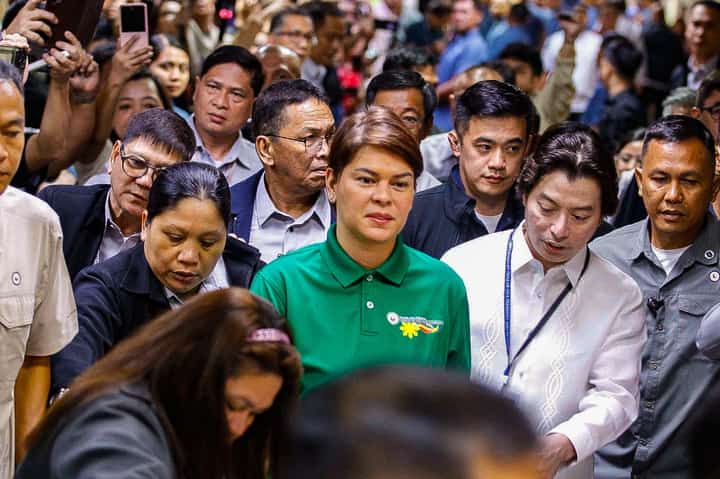
VICE President Sara Duterte arrived at the Senate on Tuesday, 7 July, along with one of her lawyers Atty. Michael Poa prior to the second day of the impeachment trial against her.
Aram Lascano
Vice President Sara Duterte cannot be compelled to take the witness stand for the prosecution in her impeachment trial, her lead defense counsel Sheila Sison said Tuesday, invoking the Constitution’s protection against self-incrimination after prosecutors signaled they intended to call Duterte as their witness.
Sison’s objection came after private prosecutor Lorna Kapunan said the prosecution would drop its remaining 15 witnesses for the first impeachment article involving allegations of misuse and misappropriation of confidential funds and instead seek to call Duterte to testify on issues raised in the case.
“There is an innate problem in that kind of request. The Constitution prohibits this kind of testimonial compulsion from the accused herself,” Sison told the Senate sitting as an impeachment court.
She cited Article III, Section 17 of the 1987 Constitution, which states that no person shall be compelled to be a witness against himself, and argued that the guarantee does not disappear simply because an impeachment trial is considered sui generis rather than an ordinary criminal proceeding.
“This is not only a simple right or a statutory right. This is a fundamental right,” Sison said, adding that the protection was one that every Filipino facing prosecution or what she described as a malicious accusation should understand.
Sison said the defense would cite jurisprudence dating back decades to support its position, arguing that Philippine courts have historically drawn a distinction between an ordinary witness and an accused person.
Supreme Court rulings have held that while an ordinary witness generally must appear in response to a subpoena and invoke the right against self-incrimination when a specific incriminating question is asked, an accused in a criminal case enjoys broader protection and may refuse altogether to take the witness stand.
Sison warned against allowing the prosecution’s objective, however well-intentioned, to override constitutional safeguards.
“The preservation of liberties does not depend on motives,” she said, quoting language she attributed to the Supreme Court. “A suppression of liberty has the same effect whether the suppressor is a reformer or an outlaw.”
Kapunan said the prosecution had decided to forego all 15 remaining witnesses originally lined up for Article I, saying the evidence already presented had sufficiently clarified the case, while reserving the right to summon Duterte to address matters covered by the impeachment charges.
Sison, however, rejected any suggestion that Duterte’s absence from the proceedings meant she was refusing to defend herself.
“The respondent is here through her counsel. If the respondent is not interested in this trial, she would not have even sent her lawyers to defend her in this case,” Sison said.