
The Odyssey: NLEX edition
What constituted sufficient elevation, drainage capacity or flood allowance for one generation may no longer provide the same resilience for the next.


The Odyssey tells of a man who spent 10 years trying to complete a journey that should have taken only a few weeks.
Recently, motorists on the North Luzon Expressway were offered something approaching the immersive version.
The journey through NLEX had everything from navigating dangerous waters while Waze played the part of the Sirens by suggesting alternative routes that also got congested eventually. Debating whether to take a long detour or powering through the flood was like deciding between the whirlpool or the monster.
NLEX reported that the water buildup around San Simon was connected to the rising level of the Pampanga River after days of heavy rain brought by the enhanced southwest monsoon. Even several days later, kilometers of traffic remained around Tulaoc, with some lanes still impassable.
Some motorists were reportedly caught in traffic for nearly 22 hours. One traveler who left La Union in the morning reached Taguig only before dawn the following day. At that point, the drive home had ceased to be a commute and acquired the structure of an epic.
The NLEX corridor through Pampanga is already about half a century old. The road we use today has been substantially rehabilitated and modernized, but its relationship with the surrounding landscape has been evolving for decades.
The affected area was a floodplain then when it was originally built, just as it is today. What has not remained constant are the conditions that determine how that floodplain behaves. Roads may give us the reassuring impression that geography has been conquered but the floodwater reminds us otherwise.
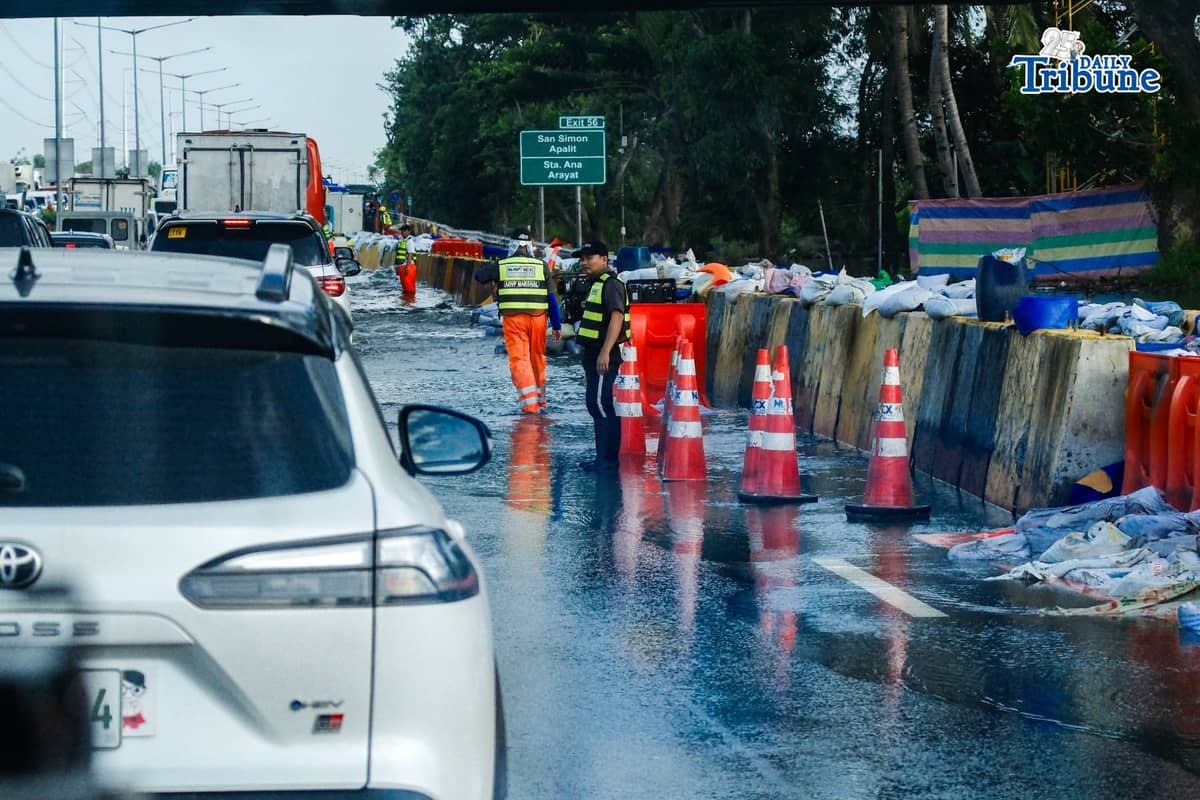
Floodwaters encroach on NLEX near San Simon, Pampanga, illustrating how changing environmental conditions can quickly disrupt even major transport infrastructure.
A 2011 JICA study of the Pampanga River Basin documented progressive land subsidence across parts of the Pampanga Delta. Earlier measurements cited in the report estimated long-term subsidence at around half a centimeter per year near Mexico, increasing toward lower-lying areas closer to Manila Bay. Half a centimeter sounds insignificant until it accumulates year after year, decade after decade.
A road can have been competently designed for the conditions understood at the time but will still eventually require adaptation in response to change. What constituted sufficient elevation, drainage capacity or flood allowance for one generation may no longer provide the same resilience for the next.
The design assumptions of infrastructure, in other words, have a shelf life. The need to raise pavements, elevate bridges and improve pumping capacity are not necessarily admissions that infrastructure has failed. We cannot construct something once and expect the landscape to politely remain as we found it. Major roads, bridges and drainage systems need to be periodically reassessed against the conditions that now surround them: rainfall, waterways, ground levels, urban development and the movement of water across the wider landscape. The experience on NLEX this week gave thousands of motorists a rather exhausting demonstration of that principle.
Odysseus eventually made it home. So did the motorists caught in San Simon. The task now is to make sure our infrastructure keeps adapting to the landscape around it, so that an ordinary journey home need not become quite so epic.