
Slim’s 1980s masterpieces now in postcards
Slim was never afraid of color or construction. There are ruching, appliqués and metallic fringes in various forms — all captured in a postcard.

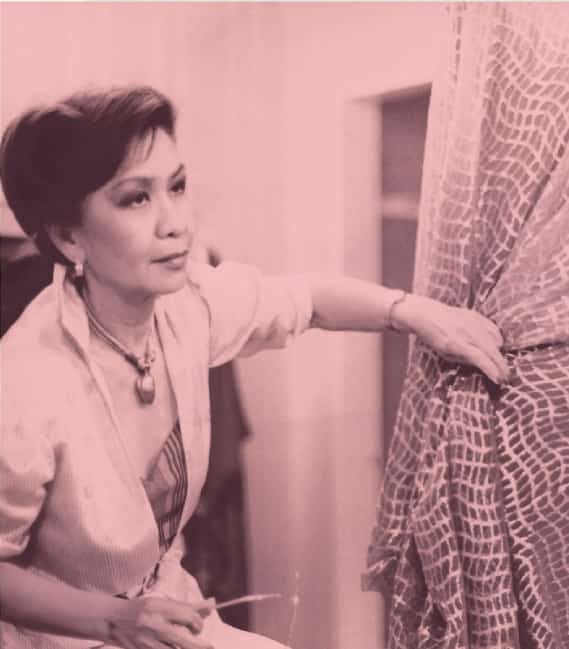
In celebration of the custodianship of Slim’s Fashion and Arts School, now an institution of the De La Salle-College of Saint Benilde, the Benilde Fashion Museum (BFM) had previously introduced a sought-after collection of memorable postcards of meticulously selected ternos. The Philippine national dress, with its unmistakable butterfly sleeves, made for a lovely first set.
And lovely enough that the public asked if there would be more!
The inquiries kept on coming. Would there be another release? Others were more adamant. There should be other Slim’s treasures that need to find their way into these small, collectible cards!
Due to public outcry, the depository has now complied with a new set — this time featuring Salvacion Lim Higgins’ creations from the lively 1980s, the final decade of her career.
Established by the De La Salle-College of Saint Benilde in 2024, the Benilde Fashion Museum, with architect Gerry Torres as its director, documents the evolution of Philippine couture and honors the obras of designers and artisans. With more than 300 garments, it now houses the largest collection of Slim creations in the country.
Born Salvacion Lim Higgins, she transformed Philippine haute couture from the late 1940s onward. After further studies and exposure to the fashion worlds of Paris and New York, she returned to Manila intending to combine international sensibilities with Filipino style.
Magenta silk georgette dress featuring gold-colored striped appliqué motifs and a wide slit band at the hem.
Two-piece ensemble floral dress in butterscotch and dusty blue print, featuring ruched detailing and a bustle skirt accented by a large bow, paired with a cropped ruched overtop with gigot sleeves.
Three-piece ensemble comprising a blue-green Shantung silk blazer and a wrap pencil skirt, paired with a purple sequined chiffon tube top.
Mustard-yellow crepe blouson dress embellished with grey beadwork, featuring gathered puff sleeves with beaded wide cuffs. and accented with a purple satin ribbon
Magenta-colored Dognin lace mini dress with a deep plum ruched velour skirt draped with an iridescent Thai silk bow.
Together with her sister Purificacion, she established Slim’s Fashion and Arts School in 1960 to train generations of Filipino designers and fashion professionals. In 2022, she was posthumously conferred the title of National Artist for fashion design.
For this new batch, son Mark Higgins graciously opened his home for the photoshoot — the very first time the residence had been photographed. He designed its interiors himself, and the apt setting became a fated meeting of two artistic worlds: the outputs of a devoted son embracing the legacy creations of his caring mother.
And what masterpieces they are!
Magenta Dognin lace meets deep plum velour. Parma-violet silk takes on a generous bubble skirt. Pink chiffon is hand-beaded and gathered into an oversized bow, while fuchsia satin, black tulle, butterscotch florals and blue-green Shantung silk remind us that Slim was never afraid of color or construction. There are ruching, appliqués and metallic fringes in various forms — all captured in a postcard.
Pink hand-beaded silk chiffon dress with a draped, structured oversized bow.
Strapless dress with a black silk chiffon bodice featuring an orange velvet floral motif with metallic gold pile, overlaid with a draped sarong in black georgette with lurex, paired with a boxy cropped black taffeta jacket.
Fuchsia-pink satin ensemble featuring a ruched dress with bow appliqués.
Salmon-pink pleated dress of silk organdy with a 3D floral appliqué on the shoulder and a layered ruffled hem.
Parma-violet silk satin dress with a voluminous bubble skirt and a ruched band at the hemline.
Now, little pieces of heirlooms may be held in one’s hand. Best of all, proceeds from each purchase support the museum’s operations — and assist in the preservation of this fashion heritage.