
SYDNEY’S MARATHON MOMENT

Ahead of this year’s race, Sydney Marathon organizers found themselves apologizing for an unfortunate design blunder: the finisher medal referenced Allianz Stadium in Munich, Germany, rather than anything to do with Sydney itself.
It’s the kind of mix-up that becomes a footnote fast — a Great North Run-style “wear sorry” moment rather than a real scandal — but it did put the race back in headlines just days before the start line opens on the Harbour Bridge. And honestly, a race this good doesn’t need a medal controversy to earn attention. It’s got plenty going for it already.
Since joining the World Marathon Majors in 2025 — the seventh race admitted to that elite club alongside Berlin, Boston, Chicago, London, New York and Tokyo — Sydney has quickly built a reputation as the major that punishes complacency.
At roughly 313 meters of cumulative elevation gain, it’s the hilliest course in the Majors series by a wide margin. Runners who show up expecting a flat harbourside cruise are in for a rude introduction to Sydney’s undulating terrain, particularly the long, grinding climb up Oxford Street that has become the course’s signature test. Negative splits are a fantasy for most; survival through the hills in the back half is the real race.
Then there’s the start time. At 6:30 a.m., Sydney sends its field off earlier than most Majors, and for good reason. Sydney’s late-August weather sits at a tricky in-between point — cool enough at dawn to be pleasant, but capable of climbing toward 25°C by late morning as the sun gets to work. That early gun is a deliberate hedge against the heat, giving the faster runners a shot at the course record before temperatures start working against them, while back-of-pack finishers still contend with real warmth in the final hours. It’s a marathon that rewards those who respect both the hills and the clock.
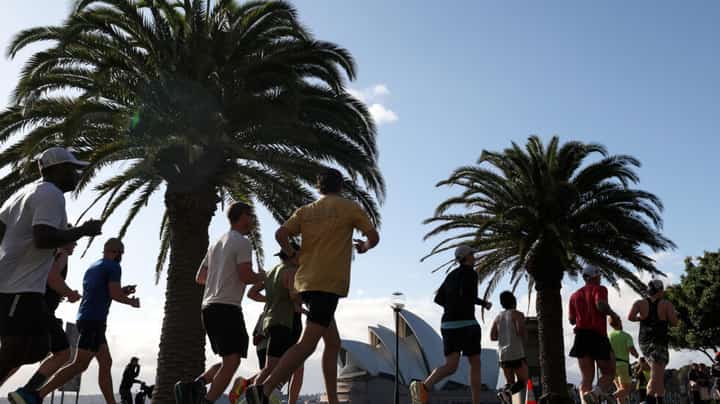
What it lacks in flatness, though, it makes up for spectacularly at the finish. Runners spill off Anzac Parade and make their way toward the water, closing out 42.195 kilometers with the sails of the Sydney Opera House rising ahead of them and the Harbour Bridge at their back. There’s a serious case to be made that this is the best finish line in marathon running — the Opera House isn’t just a backdrop, it’s one of the most photographed buildings on Earth, and crossing the line beneath it turns an exhausted shuffle into something that feels genuinely triumphant.
None of this happens in a city that’s merely a running venue, either. Sydney is one of the world’s great harbour cities — lively, sun-soaked, and endlessly walkable, with a restaurant and café scene that ranges from unpretentious fish and chips by the water to some of the finest modern Australian cooking anywhere. A post-race lap through the Rocks, a swim at Bondi, or a slow afternoon over coffee and pastries in Surry Hills makes the trip worthwhile even before the race itself.
For Filipino runners in particular, Sydney has an appeal that Berlin or Boston or London simply can’t match: it’s close. A direct flight from Manila lands in under eight hours — none of the multi-leg journeys or brutal jet lag that come with chasing a Major in Europe or North America. That accessibility, paired with a course that genuinely tests you and a finish line that genuinely rewards you, is exactly why the Sydney Marathon’s ballot keeps filling up — medal design mishaps and all.
That sense of connection with the crowd is something I felt firsthand last year, when I ran the course in a singlet inspired by the Palestinian flag, with “Free Palestine” printed across the front.
The response along the route was something I hadn’t expected from a marathon crowd. Most of it was warm — strangers breaking into applause, a raised fist here and there, spectators shouting encouragement as I passed. A handful of people tried to strike up a debate with me mid-stride, jogging alongside for a few metres to make their case before falling back into the crowd. All of it has stayed with me.