
Hawk-eagle nest found in Leyte forest
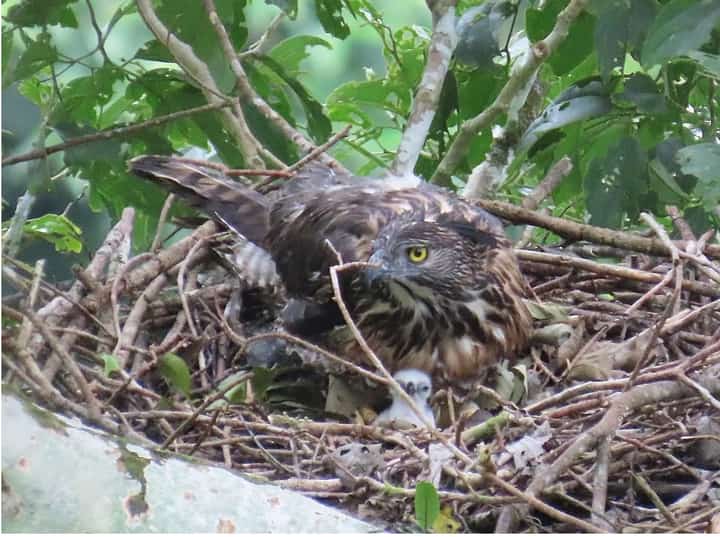
PALO, Leyte — Wildlife conservationists have discovered a nesting pair of South Philippine Hawk-Eagles, or lawin, in the forests of Burauen, Leyte, offering new hope for the globally endangered species.
Philippine Eagle Foundation (PEF) biologist Tristan Senarillos and his team documented the pair’s complete nesting cycle, from nest building to the chick’s first flight.
The South Philippine Hawk-Eagle is classified as endangered on the International Union for Conservation of Nature (IUCN) Red List because of its declining population, largely due to habitat loss from logging and agricultural expansion, as well as hunting, trapping and poaching for the pet trade.
The pair was first documented in November 2025 inside Mahagnao Volcano Natural Park, a protected area in Burauen, during routine PEF fieldwork.
The team initially spotted a hawk-eagle calling from a large native tiga tree before another bird appeared and began arranging fresh twigs on a nearby nest.
Because the birds are sensitive to disturbance during nest building, the researchers left the area and returned in January 2026. By then, the female was incubating a single egg.
Researchers then monitored the nest daily from a camouflaged observation blind.
After 41 days of incubation, the egg hatched on March 2. The researchers documented the chick’s development as it began lifting its head, standing, walking, growing feathers and eventually flapping its wings.
On May 17, the young hawk-eagle made its first flight.
PEF said the discovery marks the first documented active South Philippine Hawk-Eagle nest on Leyte Island and the first recorded in Eastern Visayas. It also marks the first time researchers have documented the species’ complete nesting cycle, from nest building and incubation to hatching and fledging.
The 76 days of monitoring are expected to provide valuable information for conservation efforts.
“Data from this nest can help scientists better understand its breeding biology, identify critical nesting habitats, improve population monitoring, and guide stronger protection of breeding pairs and their forests,” the group said.
The discovery has also prompted local conservation measures. The Protected Area Management Board of Mahagnao Volcano Natural Park approved four resolutions aimed at protecting the nesting site and the hawk-eagle family.
The Burauen local government is also preparing an ordinance recognizing the South Philippine Hawk-Eagle as one of the municipality’s flagship species for conservation.
Meanwhile, the PEF research team is preparing scientific papers on the findings and recommendations for protecting the species and its habitat.