
No overstepped ruling
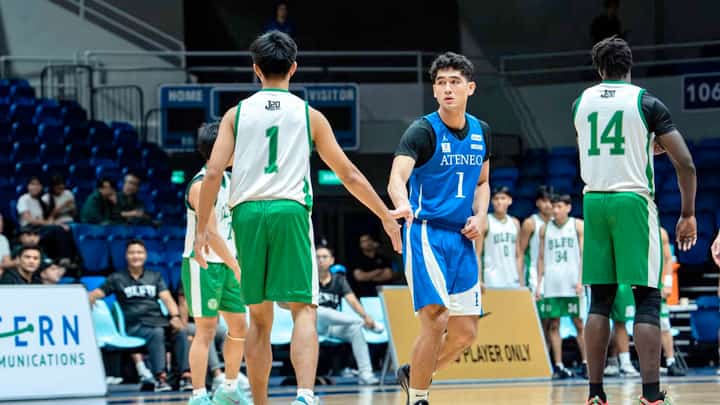
ATENEO de Manila University enters UAAP Season 89 with no pressure but a renewed purpose, as coach Louie Alas leads the Blue Eagles in rebuilding chemistry, honoring departed teammates and preparing for a challenging return to the Final Four.
Photo courtesy of PinoyLiga
Expect a full roster of University Athletic Association of the Philippines (UAAP) teams as Ateneo de Manila University gets the go-signal to participate in Season 89 hurdling the threat of over-all suspension.
This is hailed as a huge win for all Blue Eagle athletes who are set to compete across various UAAP sporting events this school year. While the UAAP Board’s decision last 7 August clearing Ateneo to compete in season 89 has understandably been interpreted by many as the end of the institutional reckoning over the Aurora drowning tragedy — it actually does not.
A separate and, in some respects, more consequential proceeding remains very much alive: the show-cause order that the Commission on Higher Education (CHEd) issued against Ateneo on 16 June 2026. Understanding why these two processes do not simply collapse into one another requires being precise about what each body is actually asking.
The UAAP was answering a narrow, contractual question: did the conduct of Ateneo personnel violate league rules or otherwise justify sanctions affecting participation in UAAP activities? That is disciplinary authority exercised over a member of a voluntary athletic association. CHEd’s question is structurally different and considerably broader: did Ateneo, as a higher-education institution entrusted with the welfare of its students, comply with its regulatory obligations under CHEd Memorandum Order (CMO) No. 63 on off-campus activities, CMO 6 and the Anti-Hazing Act of 2018, and its duty of reasonable supervision under the doctrine of in loco parentis?
Read closely: the UAAP decision does not actually say Ateneo committed no institutional lapse. It imposed serious sanctions on the adults involved, including a permanent disqualification of the head coach, and it conditioned the team’s continued participation on a “comprehensive reassessment” of the athletics program’s organizational structure, specifically to strengthen student-athlete protection, welfare, accountability, and institutional oversight. That is not a clean bill of health.
If anything, it is an implicit acknowledgment that something in the governance of the program needed fixing.
CHEd’s case, meanwhile, carries an additional procedural layer that has nothing to do with fault for the deaths themselves. By CHEd’s own account, Ateneo did not initially furnish the incident report, the CMO 63 compliance certificate, or the CMO 6 documentation that was requested as early as 9 June that alleged non-cooperation, independent of any ultimate finding on hazing or supervision, is itself a live dangling regulatory issue.
The anti-hazing dimension raises the stakes further.
Whether the Aurora activity was a legitimate team-building activity or something that crossed into initiation-rite territory under RA 11053 is a question CHEd will have to examine on its own facts — purpose, coercion, voluntariness, supervision, and connection to team selection — regardless of how UAAP characterized the incident for league purposes.
It is worth being focused about not conflating four distinct tracks of accountability that are unfolding here: individual responsibility of personnel, institutional responsibility of Ateneo as a school, criminal responsibility under ongoing Philippine National Police-Criminal Investigation and Detection Group and Department of Justice processes, and league-level responsibility under UAAP rules.
Each operates under its own standard of proof, its own respondents, and its own range of sanctions. A finding — or lack thereof — in any single track tells us little about the outcome of the others.
The UAAP board decision clearing Ateneo to have its athletes compete in Season 89 is valid as the board confined itself to its own rule implementing jurisdiction and correctly avoided encroachment issues related to other pending cases. Ateneo’s eligibility to play basketball this season and its standing as a higher-education institution under CHEd’s regulatory eye are simply not the same question. One has been decided. The other remains yet to be settled.