
Temple of Leah in Cebu: Architectural monument of undying love
‘I constructed this temple in the year 2012 A.D. as a symbol of my undying love for and ceaseless devotion to Leah Villa Albino-Adarna, my wife for 53 years.’


Built in 2012, the Temple of Leah is often called Cebu’s ‘Taj Mahal.’ Commissioned by Teodorico Adarna in honor of his late wife, Leah.
Photographs courtesy of Marco Polo
High in the hills of Barangay Busay, Cebu, the Temple of Leah rises as a monumental expression of love, memory and architectural grandeur.
Often compared to India’s Taj Mahal because of the devotion behind its creation, the Temple of Leah is distinctly its own work — a sprawling, classical-inspired structure conceived not simply as a temple, but as a lasting shrine, museum, library and repository of family history.
Commissioned in 2012 by Teodorico Adarna in memory of his late wife, Leah Villa Albino-Adarna, the structure was envisioned as a physical embodiment of a love that could endure beyond a lifetime. Leah had passed away in 2010 after 53 years of marriage. On one of the temple’s walls, Teodorico expressed the purpose behind the project in his own words:
“I constructed this temple in the year 2012 A.D. as a symbol of my undying love for and ceaseless devotion to Leah Villa Albino-Adarna, my wife for 53 years.”
That inscription provides the emotional foundation of the entire complex. The architecture is not merely ornamental; its scale, permanence and spatial organization were intended to give form to remembrance itself.
Architecture designed to endure
One of the most striking aspects of the Temple of Leah is its commanding Greco-Roman architectural language. Monumental columns, elaborate classical details, sculptural elements, broad stairways, terraces, fountains, and symmetrical arrangements give the complex the character of an ancient European monument transplanted into the Cebu highlands.
Teodorico specifically described his intention to adopt an architectural and structural design that could withstand time and remain appreciated for generations. The goal was for the temple to become a landmark of Cebu and a place where future generations of the Adarna family could return to trace their roots and heritage.
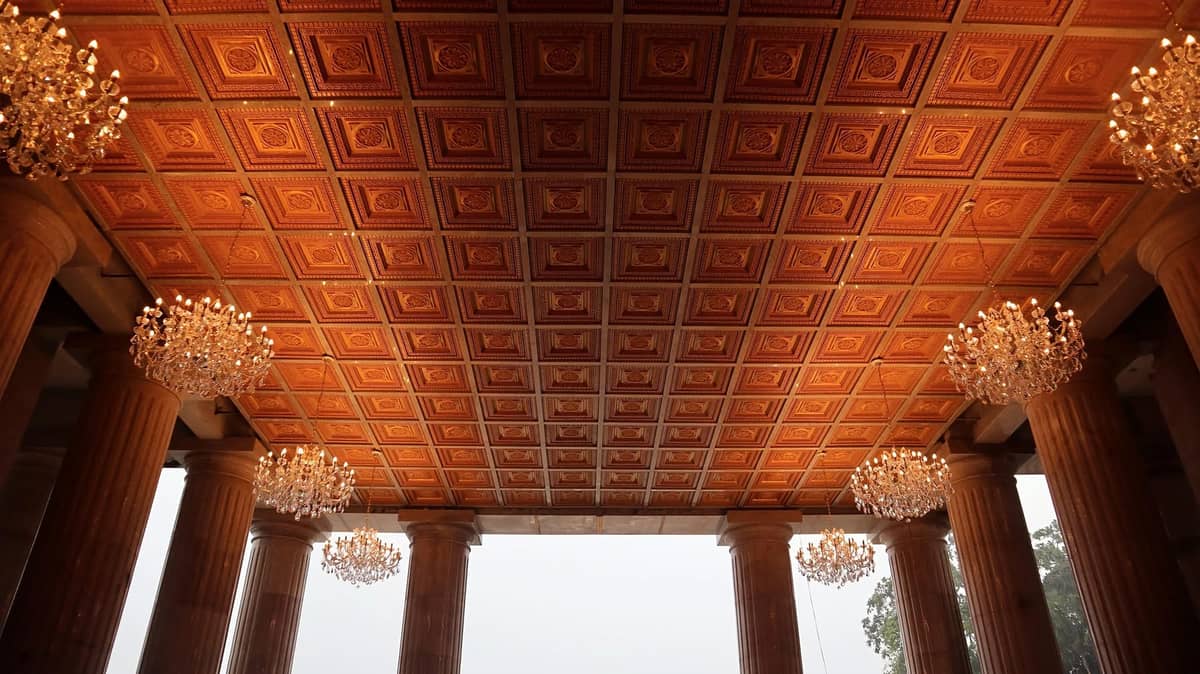
Grand coffered ceiling and neo-classical Doric columns adorned with crystal chandeliers in the lobby of the Temple of Leah.
This ambition is evident in the building’s massive proportions. The architecture communicates permanence through its weight, height, repetition, and carefully framed spaces. Rather than feeling like an ordinary residence or memorial, the complex was conceived on the scale of a monumental institution.
The approach to the temple immediately establishes this sense of grandeur. A wide ceremonial staircase leads visitors toward the main structure, flanked by imposing golden lion sculptures that function almost like guardians of the entrance. Classical statues occupy the surrounding spaces, while fountains, columns, balustrades and terraces create layers of visual depth throughout the grounds.
At the heart of the main façade stands a golden statue of Leah, transforming the entrance into more than an architectural threshold. It becomes a symbolic encounter with the woman for whom the entire complex was created.
Spaces that turn memory into architecture
What makes the Temple of Leah particularly compelling is not simply its façade, but the way its spaces were intended to preserve a life.
According to Ellen Adarna, Leah’s granddaughter, the project was originally conceived as a storage facility for Leah’s extensive collection of belongings and heirlooms. Leah was known within the family for keeping her possessions, and Teodorico initially envisioned using their property in Busay as a place where these objects could be preserved.
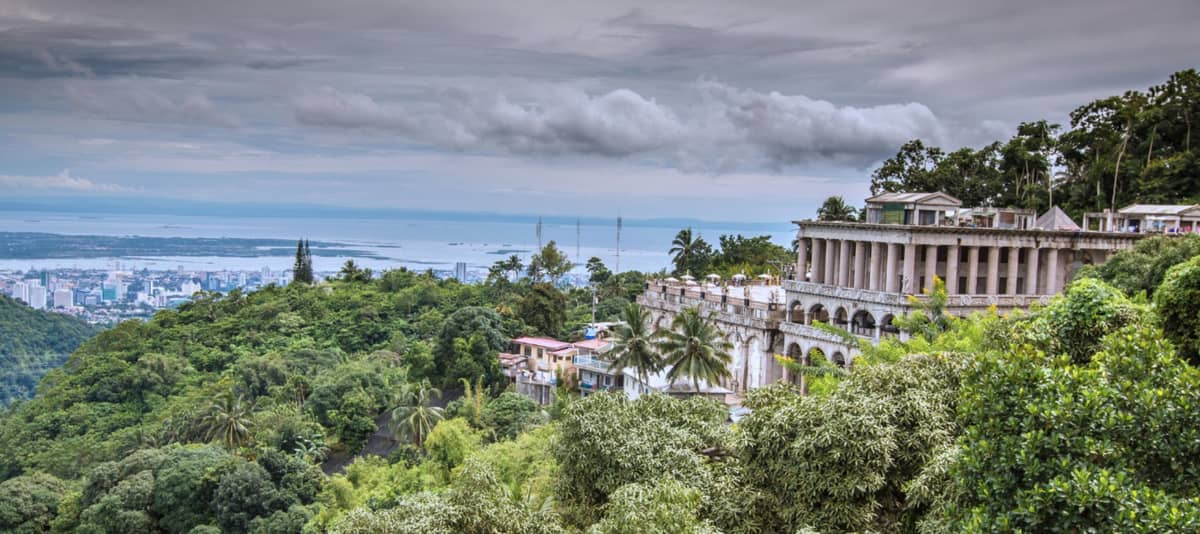
Roman-inspired landmark features grand columns, statues and sweeping staircases. With panoramic views of Cebu City, it has become both a monument of devotion and a striking cultural attraction.
Yet even as a storage space, the building was never meant to be ordinary.
Teodorico chose to give the structure an extraordinary architectural treatment. What could have been a conventional repository was transformed into a monumental complex of columns, grand halls, stairways, terraces, galleries and ceremonial spaces. The architecture elevated the act of preserving personal belongings into something much larger: the preservation of memory, identity and family heritage.
The interior spaces were envisioned to accommodate Leah’s lifetime collections, including books, letters, personal belongings and other treasured possessions. In this sense, the Temple of Leah functions not only as a monument but also as a museum and family archive.
Its rooms and corridors give physical space to objects that might otherwise have remained hidden inside a family home. The architecture therefore becomes a container for personal history.
Every room contributes to the larger narrative. The corridors connect one memory to another; the galleries give treasured objects a formal setting; the expansive halls create an atmosphere appropriate to the importance Teodorico placed on Leah’s life. The building turns private possessions into a curated heritage, allowing future generations to encounter the material traces of the woman at the center of the monument.
The relationship between architecture and memory is particularly powerful here. Leah is remembered not through a single statue or plaque, but through an entire environment designed to contain, frame, and preserve the things she left behind.
Approaching the Temple of Leah is a carefully staged architectural experience. Its monumental staircase creates a sense of procession, leading visitors toward the grand classical structure. Inside, courtyards, terraces, fountains, columns, statues and balconies offer striking views from different elevations.
Built from a husband’s desire to preserve the memory of his wife, the Temple of Leah is ultimately architecture made out of memory. Perched above Cebu, it stands as a lasting symbol of Leah Villa Albino-Adarna and Teodorico Adarna’s enduring love.
More than a tourist attraction, it shows how architecture can become a vessel for love, heritage and remembrance.