
AI agents emerge as next frontiers of enterprise tech in PHL
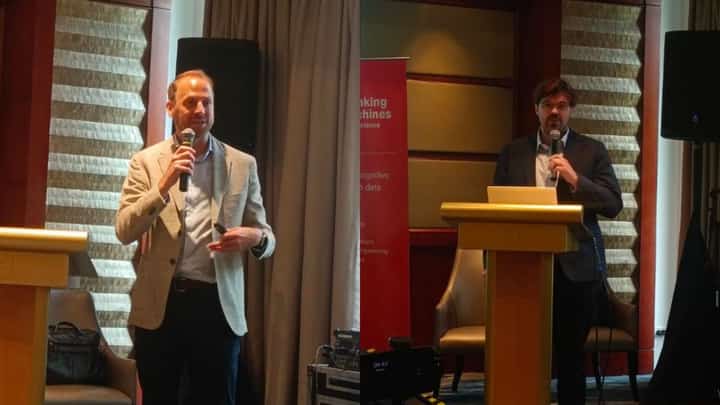
The Philippines is moving toward the next phase of artificial intelligence (AI) adoption as businesses shift from using AI mainly as a productivity tool to deploying agents capable of carrying out tasks and workflows, OpenAI and its partner Thinking Machines (TM) stated.
Speaking at a joint media briefing in Makati City, OpenAI Director for Partnerships for Southeast Asia and Taiwan Mark Jeffrey said the next phase is no longer simply about using AI, but integrating it into organizations and rethinking how work is done.
“It's not just about simply using AI, right? It's about how you can actually genuinely reimagine how you work. So we've seen this in organisations where they are really rethinking how they work, right? So it's not just, oh, let's just add AI to the existing processes. It's really about how can we reimagine how we work,” Jeffrey said.
TM Vice President for Commercial Niek van Veen, on the other hand, said AI has evolved from simple chatbots designed to assist individual users into goal-oriented workspace agents capable of executing tasks.
“What we see now is that there are skills and agents and workflows developed and agentic systems that move beyond the individual to an organisation-wide capability,” Niek said.
“So what we're seeing is that there's a shift from just individual productivity to how can you really enable an organisation with AI.”
OpenAI said the shift is already visible among enterprises, with AI increasingly being used to execute longer, multi-step workflows. Its data showed growing use of Codex for legal, sales and recruiting, marketing and engineering tasks, showing that agentic AI is expanding beyond software development.
“What we're seeing is that the next step is that we're seeing people delegate more and more of their work to these agents. So instead of just asking it a question, you can actually give it a task and it will go away and do that task for you,” Jeffrey said.
From prompts to execution
For Philippine businesses, the transition could allow AI to take on portions of workflows that previously required constant human intervention.
TM cited one deployment involving an agentic system designed to manage a supplier workflow from purchase order to payment.
The system handles supplier communications, processes invoices and shipping documents, and operates within predetermined guardrails.
According to the company, the system made the workflow 32 times faster by automatically handling supplier follow-ups that previously had to be monitored and performed by employees.
The system can also process documents in different languages, including Chinese, highlighting how AI agents can automate complex business processes across markets.
“The agent basically does the work for you. So it will communicate with the supplier, it will read the invoice, it will read the shipping documents, it can actually do that in Chinese as well, and then it will follow up with the supplier,” Niek said.
Technology needs more than powerful models
Still, the speakers stressed that deploying increasingly capable AI goes beyond acquiring the latest model.
Jeffrey said organizations must connect AI models to relevant information and tools while establishing clear permissions, governance and employee support. Companies also need to redesign their processes instead of simply adding AI to existing systems, he said.
“It's not just about simply using AI, right? It's about how you can actually genuinely reimagine how you work. So we've seen this in organisations where they are really rethinking how they work,” Jeffrey said.
TM likewise identified data foundations as critical as companies move from AI experiments toward larger deployments.
The company said organizations need to invest in data platforms, data management and data governance to maximize advanced AI models.
“Data foundations are absolutely critical to get in place. So investing in a data platform, data management or platforms as well is absolutely critical to make these models and these make AI produce the best outcomes for the organisation,” Niek said.
The challenge, according to TM, is often identifying a significant business problem where AI can deliver measurable value.
Rather than starting with small AI experiments, organizations should identify one or two use cases where solving a significant problem can justify the technical, governance and operational requirements needed to bring the system into production.
PH as emerging AI technology hub
The developments come as the Philippines continues to see strong consumer adoption of AI.
OpenAI said the country ranks among its top 15 markets globally for ChatGPT users, with writing, communication, education and learning, and creative media among the leading use cases. Nearly 40 percent of messages on its consumer platform in the Philippines are work-related, according to the company.
“The Philippines is actually a top 15 market globally for ChatGPT. So that's really exciting for us. And when we look at the types of use cases, what we see is that writing and communication, education and learning, creative media are some of the top use cases,” the OpenAI Director shared.
For TM, the country's growing AI adoption also presents an opportunity to develop local technological capability.
Founded in Manila, the company said it has grown to more than 150 data scientists, engineers and AI professionals and expanded its operations to Singapore and Thailand.
The company aims to develop AI capability in the Philippines and bring that expertise to the wider region.
Its partnership with OpenAI, which formally began in 2025, has positioned Thinking Machines as an OpenAI services partner in the Asia-Pacific region and the company's only reseller in the Philippines, according to the presentation.
As AI technology moves from individual assistance to organization-wide execution, the companies said the Philippines can leverage its AI adoption, technical talent and workforce capabilities to strengthen its position in the region's emerging AI ecosystem.