
Edwin Wilwayco’s ‘Mountain Rhapsody’ captures nature in motion
In his latest exhibit, the abstract expressionist transforms the mountain from a silent landscape into a restless force of nature, his canvases capturing creation in motion — immense, elemental and forever ascending.

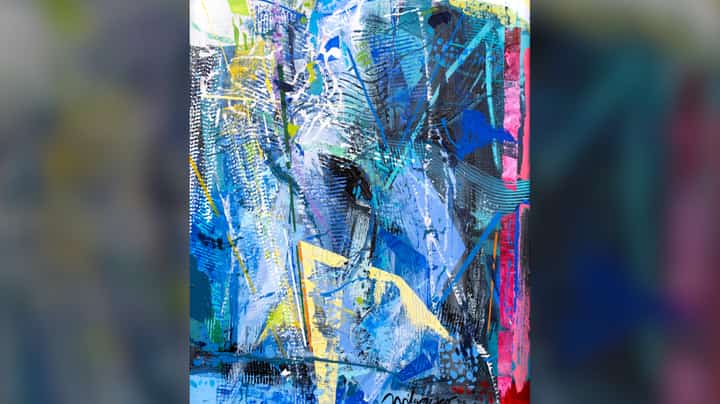
The mountain emerges not merely as landscape but as a living, restless force in Mountain Rhapsody, the latest exhibition of acclaimed Filipino abstract expressionist Edwin Wilwayco.
On view from 7 to 17 August at Galerie Joaquin at the Power Plant Mall, Rockwell Center in Makati City, the exhibition presents the mountain as an experience of movement, energy and transformation. Rather than depicting recognizable peaks or recording the details of a particular place, Wilwayco evokes the elemental processes that shape mountains — the collision of tectonic plates, the pressure of subterranean fire and the gradual thrust of stone toward the sky.
Art critic Cid Reyes describes the works as portrayals of creation still unfolding. “What emerges on the canvas is therefore not a portrait of a mountain but the drama of becoming,” he writes. “Color erupts, collides, and settles into temporary harmonies. Forms rise and dissolve.”
The mountain has long occupied a powerful place in art, religion and the human imagination. Its scale inspires awe, while its permanence makes it a symbol of strength, transcendence and the mysterious forces of nature. Artists across generations have returned to it as a subject, perhaps most famously French Post-Impressionist Paul Cézanne, who repeatedly painted Mont Sainte-Victoire in Provence.
While Cézanne contemplated the mountain from different vantage points and translated it into structures of color and geometry, Wilwayco takes a more visceral approach. “Wilwayco enters the mountain as one enters a tempest,” Reyes observes. “He confronts it not as an object but as a living upheaval.”
Wilwayco’s vigorous method is rooted in the Philippine abstract expressionist tradition. As a student at the University of the Philippines, he came under the influence of National Artist José Joya, whose gestural paintings emphasized bodily movement, spontaneity and the dynamic behavior of paint.
For nearly five decades, Wilwayco has explored subjects through sensation rather than literal representation. Music, prayers, rivers, winds and seas have all inspired his compositions. In these works, color and gesture communicate what cannot be adequately expressed through recognizable images.
Mountain Rhapsody extends this lifelong inquiry. Sweeping strokes carry the eye across the canvases like winds coursing over ridges, while surging colors suggest both eruption and renewal. The mountain seen in nature becomes an interior landscape shaped by memory, emotion and instinct.
As Reyes writes, “The mountain before him is transformed into the mountain within him.” In Wilwayco’s hands, it is not silent or immovable, but “immense, restless, and forever ascending.”