
Moving women to the heart of ASEAN’s economy

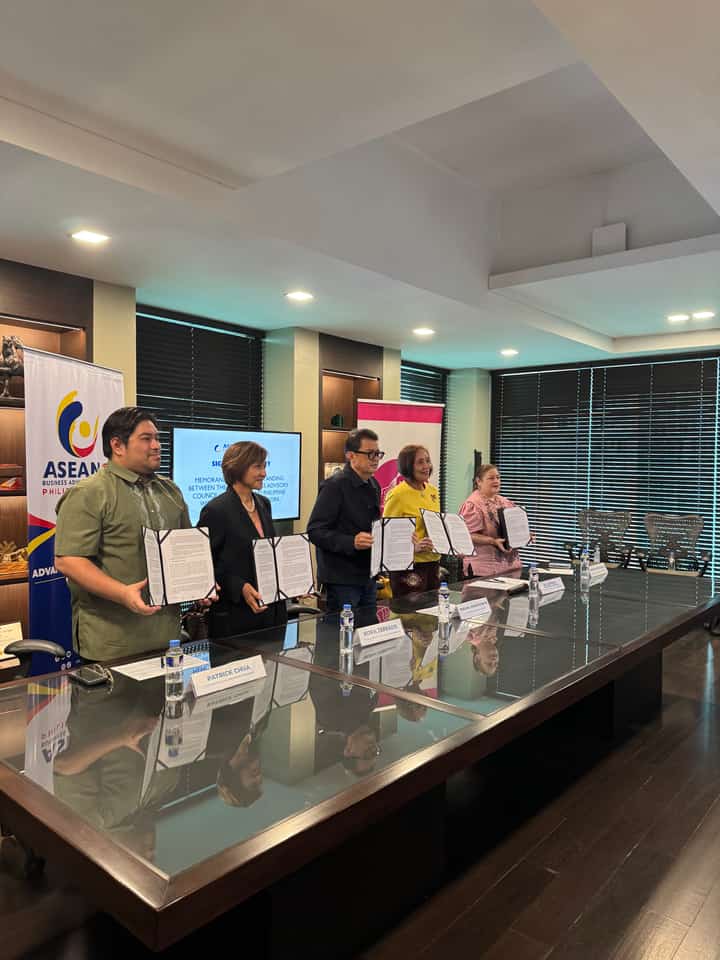
SIGNATORIES are (from right) PhilWEN chairman Cristina Concepcion, president Aurora Boots Garcia, ASEAN-BAC Philippines chairman Joey Concepcion, Senior Adviser for Women and former Trade Undersecretary Noya Terrado and executive director Patrick Chua.
PHOTOGRAPH COURTESY OF ASEAN-BAC/PHILWEN
Sometimes the most important moments are not the signing ceremonies themselves, but the many months — even years — of conversations, negotiations and quiet work that happen long before anyone picks up a pen.
That was the story behind the Memorandum of Agreement signed on 4 August between the ASEAN Business Advisory Council (ASEAN-BAC) Philippines and the Philippine Women’s Economic Network (PhilWEN). More than a ceremonial document, it formalized a shared commitment to advance the 2026 Action Agenda on Women’s Economic Empowerment and Gender Mainstreaming across the ASEAN region.
This year, as the Philippines hosts ASEAN and prepares for the series of high-level meetings culminating in November, PhilWEN serves as the lead partner for Knowledge Management and Policy Execution. Its task is both simple and ambitious: to keep the eye on the ball until women’s economic empowerment becomes firmly embedded within ASEAN’s Economic Pillar.
This is an important shift. Since 2015, the women’s agenda has largely been housed under the ASEAN Socio-Cultural Community Pillar. While social protection remains vital, women are far more than beneficiaries of social programs. They are entrepreneurs, innovators, manufacturers, investors, workers, and builders of economies. It is time that ASEAN officially recognizes women not only as a social constituency, but as a primary economic force.
The agreement was signed by ASEAN-BAC Philippines chair Joey Concepcion, senior adviser for Women and former Trade Undersecretary Noya Terrado, and executive director Patrick Chua, together with PhilWEN chair Cristina Concepcion and president Aurora Boots Garcia.
Their joint commitment goes beyond policy statements. It seeks to embed gender inclusion into regional economic policies while developing practical mechanisms within the ASEAN-BAC alliance that unlock the measurable economic potential of women-led enterprises. More importantly, it positions ASEAN as a platform for regional leadership in advancing women’s role in inclusive, sustainable and future-ready industrial transformation.
But policy only matters when it reaches people. This is where PhilWEN brings the conversation to the ground. Beginning with a series of roundtable discussions in partnership with various groups, the dialogue moves beyond social protection toward the economic realities that matter: industrial productivity, workforce retention, resilient value chains and regional competitiveness.
Persistent gender gaps continue to limit women’s full contribution to industrial productivity, innovation and economic growth. Every discussion on women must therefore also be an economic discussion. This has always been one of PhilWEN’s strongest advocacies — to ensure that whenever women are discussed, the conversation reflects not only equity and inclusion but also the measurable economic value that women create.
These roundtables are designed to remind business leaders and policymakers that gender-inclusive industrial policies are not merely social initiatives. They are essential drivers of corporate growth, stronger industries and more competitive economies. Across ASEAN, women represent nearly half of the workforce, yet their participation in STEM and industrial sectors remains below 20 percent. This gap represents not only inequality but also lost productivity, untapped innovation and missed economic opportunity.
The discussions also aim to establish common indicators that ASEAN countries can use to monitor progress collectively. Reliable data will help measure where improvements are taking place and where structural barriers continue to prevent women from fully participating in high-value industries. Current statistics already illustrate both the challenge and the opportunity. Women across ASEAN are 30 percent more likely than men to use mobile-based financial services, demonstrating their readiness to adopt new technologies. Yet structural barriers continue to limit their advancement into leadership roles and higher-value industrial sectors.
The work ahead is clear. The initiative seeks to identify and address the structural barriers, while recognizing emerging opportunities that influence women’s participation, leadership and advancement in industry — contributing directly to the Philippines’ 2026 Priority Economic Deliverables.
It aims to generate actionable, evidence-based recommendations through sustained multi-stakeholder dialogue, with the goal of integrating these into the ASEAN Leaders’ Declaration and the Chair’s Statements. It also seeks to build regional consensus around policy directions that align with ASEAN’s Gender Mainstreaming Framework.
Finally, the vision is to pilot a flagship project in the Philippines that can eventually be rolled out across ASEAN as a practical follow-through to the Action Agenda on Women in Industry, creating a legacy that extends well beyond the Philippines’ ASEAN Chairmanship in 2026.
Perhaps this is the larger shift taking place. For decades, we have spoken of women’s empowerment as a matter of inclusion. Today, we are beginning to understand it as a matter of economic strategy. The future competitiveness of ASEAN will depend not only on technology, trade, and investment, but also on whether it fully unlocks the capabilities of half of its people.
When women move from the margins of policy to the center of economic planning, entire nations become stronger. That is the promise behind this year’s ASEAN agenda — and one well worth pursuing.