
Transport groups threaten strike if fare hike is not approved
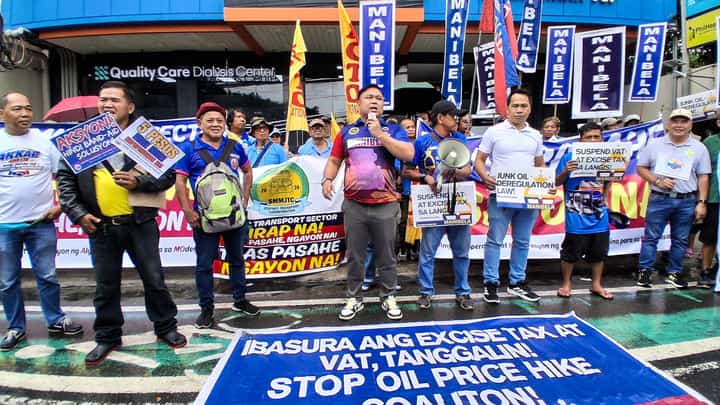
Transport groups Manibela, PISTON, ACTO National, and Sunshine Monteverde Mandarin Jeepney Transportation Corporation (SMMJTC) gathered in front of the LTFRB office along Kalayaan Avenue, Quezon City, on Monday morning, 3 August, to call for fare increase and attend the public hearing with the Land Transportation Franchising and Regulatory Board (LTFRB) regarding their ₱1 to ₱10 fare hike proposals.
PHOTOGRAPH by Sean Magbanua for the Daily Tribune
Transport groups led by Manibela and the Pagkakaisa ng mga Samahan ng Tsuper at Opereytor Nationwide (PISTON) gathered outside the Land Transportation Franchising and Regulatory Board (LTFRB) on Monday to demand a fare increase, warning they would stage a transport strike next week if the government fails to act on their petition.
"Ngayon pa lamang, nagdedeklara na kaming lahat ng tigil-pasada sa susunod na linggo kung walang ipatutupad na fare increase," Manibela President Mar Valbuena said during the protest."Hirap na hirap na ang pampublikong transportasyon, kailangan niyo na po kaming pakinggan," he added.
The transport groups said they are seeking a fare increase due to rising fuel prices. They are also calling for lower fuel prices and a review or amendment of the Oil Deregulation Law.
Valbuena said the government has failed to address the transport sector's appeals over the past six months despite the increase in global oil prices following tensions in the Middle East.
LTFRB weighs proposals
The LTFRB met with transport groups during a public hearing to discuss proposals for a provisional fare increase ranging from ₱1 to ₱10.
LTFRB Chairman Vigor Mendoza said the agency cannot immediately approve PISTON's proposed ₱10 provisional fare increase.
"Hindi naman natin puwede ibigay ang sampung pisong provisional fare increase na hinihingi ng PISTON," Mendoza said.
He explained that the government has yet to gather sufficient data to determine whether commuters can afford the proposed increase.
Mendoza also noted that the temporary suspension of the ₱85 minimum wage increase in Metro Manila is among the factors the LTFRB must consider before approving any fare adjustment.
"More so, na-suspend ang kanilang wage hike. So, we have to do our math here. Kaya ba ng mga commuter iyong sampung piso?" he said.
He added that the LTFRB is coordinating with the Department of Economy, Planning, and Development (DepDev)and the Department of Labor and Employment (DOLE) to assess the impact of a fare increase on commuters.
While acknowledging the transport groups' right to protest, Mendoza said the LTFRB must strike a balance between the welfare of public utility vehicle operators and the riding public.
PISTON defends proposal
PISTON President Modesto Floranda said the group's proposed ₱10 fare increase is intended to help drivers and operators continue providing public transportation services.
"Yung i-finile natin ay hindi naman para gumanda ang buhay ng mga driver at operator kundi maibsan at tuloy-tuloy na makapagserbisyo sa ating mga mamamayan," Floranda said.
He added that PISTON is also preparing a series of protests calling for the repeal of the Oil Deregulation Law, as well as the removal of the excise tax and value-added tax (VAT) on fuel.
"Ibasura iyong Oil Deregulation Law na halos 29 years na nagpapahirap hindi lamang sa sektor kundi sa mamamayan," Floranda said.