
Marcos takes dev’t agenda nationwide
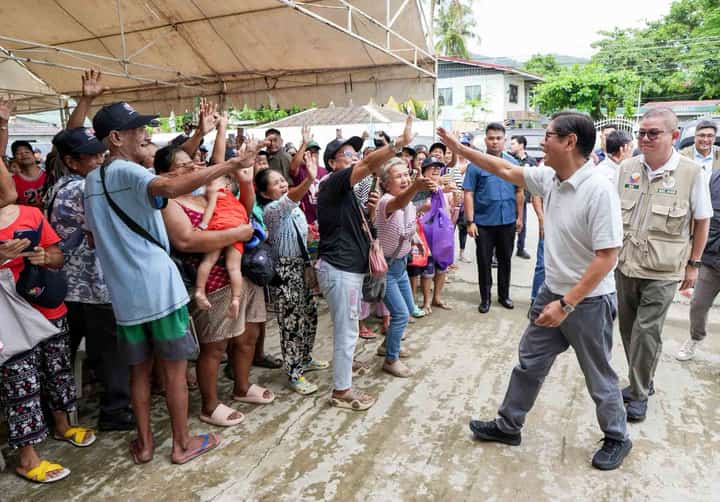
SUAL casts forward A big catch means little if it rots before reaching market. That is why the Sual Fish Port — the only regional fish port in Northern Luzon — has been modernized. President Ferdinand Marcos Jr. (second from right) made the statement to fishermen during the launch of new processing, cold storage, sorting, docking, and access road facilities in Pangasinan.
President Ferdinand Marcos Jr. followed his fifth State of the Nation Address (SoNA) with a series of regional engagements aimed at translating his commitments into government action, focusing on healthcare, housing, energy, food security and grassroots development.
After outlining his administration’s accomplishments and priorities — from addressing the controversy surrounding flood control projects to defending the country’s interests in the West Philippine Sea (WPS) — Marcos took his agenda outside Malacañang, visiting communities and inspecting projects across the country.
From Luzon to Mindanao, the President met with foreign diplomats, attended to judicial appointments, launched government initiatives, and inspected key infrastructure projects as his administration moved to implement the commitments laid out in his penultimate SoNA.
27 July
Raps vs relative; power issues
Mr. Marcos opened his SoNA by stressing that he is not the president of his family and friends but of the country, as he revealed the Office of the Ombudsman was set to file charges against his cousin, former Speaker Martin Romualdez, in connection with the anomalous flood control projects.
The President then went on to call on Congress to amend the Electric Power Industry Reform Act and remove the system loss charge and value-added tax from consumers’ electricity bills.
He also called for the immediate passage of the Sariling Kuryente Act, which would simplify and reduce the cost of installing solar panels and battery storage systems in homes, allowing more families to generate their own electricity and bring down electricity rates.
Holding the line
Also drawing cheers was his assurance the Philippines would continue to uphold the 2016 Arbitral Award, saying the government would use every peaceful and legal means to defend the country’s rights in the West Philippine Sea.
Marcos also warned foreign oppressors the Philippines will not yield, declaring that Filipinos were not greedy, racist, or liars.
The firm reminder came days after Philippine Navy and Bureau of Fisheries and Aquatic Resources personnel were assaulted by the China Coast Guard at Ayungin Shoal and a Chinese news organization depicted Filipinos as monkeys.
Staple grain within reach
He also said the administration continues to expand its food security initiatives, with the Benteng Bigas Meron Na program benefiting more than 12 million Filipinos nationwide.
He also reported the country now had 23 free trade agreements in force or under negotiation with other nations, noting that its strong foreign relations have earned the Philippines incalculable dividends, elevating it once again as a full member of the community of nations.
28 July
Shelter for all
A day after the SoNA, the Chief Executive flew to Davao City where he visited People’s Ville, a condominium-type housing development in Barangay Riverside, Calinan District.
One of the government’s aims in establishing housing developments in Davao City is to reduce the housing backlog and address future demand, particularly for displaced and vulnerable families.
People’s Ville is one of the housing projects under the Expanded 4PH Program of the Department of Human Settlements and Urban Development (DHSUD).
Davao ayuda swing
Marcos led the activities for the Bawat Bayan Makikinabang program for the provinces of Davao de Oro, Davao del Norte and Davao Occidental. He underscored the importance of close coordination between the national government and local government units in delivering effective services to communities.
He also led the distribution of nearly P133 million worth of agricultural machinery, farm inputs, and fisheries assistance from the Department of Agriculture and the Bureau of Fisheries and Aquatic Resources, benefitting around 9,708 farmers and fisherfolk in Davao de Oro.
The President also witnessed the sale of about 14,000 kilos of affordable rice under the government’s Benteng Bigas, Meron Na! initiative. He then led the ceremonial turnover of P113 million in Socio-Civic Projects Fund (SCPF) assistance to 565 barangays in the three Davao provinces.
29 July
Efficient power showcase
At the inauguration of the country’s first interactive Energy Museum, the President reaffirmed his administration’s commitment to lowering electricity costs by pursuing reforms like doing away with the system loss charge.
The Department of Energy’s Energy Museum supports the administration’s directive to the DoE to strengthen public awareness on energy issues through interactive exhibits featuring the country’s diverse energy sources and technologies, including solar, geothermal, wind, hydropower, natural gas, energy storage systems and nuclear energy.
Whole-of-nation approach
The President also urged the public to support the government’s energy efficiency campaign, stressing that energy security requires the participation of every Filipino.
He signed into law Republic Act 12321 institutionalizing government support for public basic education schools in geographically isolated and disadvantaged areas (GIDA) and other underserved communities to improve access to quality education nationwide.
Known as the Last Mile and GIDA Schools Act, the measure establishes a comprehensive national program under the Department of Education to address longstanding gaps in school infrastructure, learning resources, teacher support, and other essential services in remote and economically disadvantaged communities.
30 July
Fisheries upgraded
The President inspected the newly rehabilitated Philippine Fisheries Development Authority-Sual Fish Port Complex in Pangasinan, highlighting the government’s continuing efforts to modernize fisheries infrastructure and strengthen support for Filipino fisherfolk.
At the fish port in Barangay Poblacion, Sual, the President witnessed the sale of 500 sacks of government-subsidized rice at P20 per kilo to local residents before touring the upgraded facilities.
Mr. Marcos inspected the Refrigeration and Processing Building where he received a briefing on the rehabilitation project and its operational improvements. The upgraded complex is expected to improve fish handling and processing efficiency, reduce post-harvest losses, expand market access for fisherfolk, and ensure a steady supply of quality fish and other marine products.
EV perks touted
The President signed Executive Order (EO) 121 establishing the Electric Vehicle Incentive Strategy (EVIS) Program to boost the local manufacture of electric vehicles (EV) and attract investments in the country’s automotive industry.
The EO provides fiscal incentives for the local manufacture of hybrid and battery electric passenger cars, commercial vehicles, and their parts and components.
The EVIS program aims to expand domestic EV production, create quality jobs, reduce the country’s dependence on fossil fuels, and position the Philippines as a regional automotive manufacturing hub.
Preparing for future
The President then went to Tarlac where he urged the Presidential Scholars in Tarlac City to use their grants wisely, focus on their studies, and aspire to become the country’s future leaders.
He said that whatever little thing they would do to contribute to the betterment of the community, of the country, of their fellow Filipinos is important.
Through the SCPF, each barangay is allocated P200,000, with half of the amount — P100,000 — to support five Presidential Scholars per barangay, with each scholar receiving P20,000 in educational assistance.
President Marcos also led the ceremonial turnover of SCPF financial assistance checks amounting to P102.2 million for the 511 barangays in Tarlac represented by Governor Yap, Liga ng mga Barangay–Tarlac chapter president Edward Christopher Suarez, and a representative of the Tarlac Presidential Scholars.